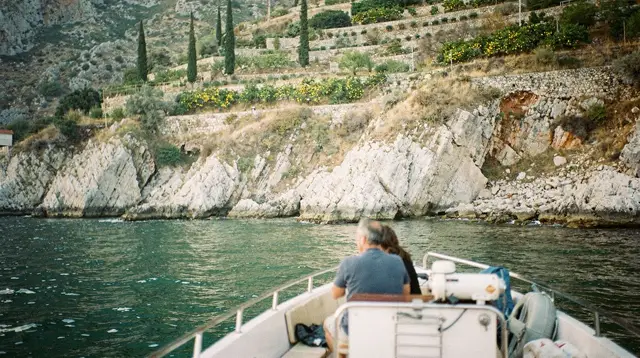
The Gorges du Verdon sit well outside day-trip range for most of the Riviera’s easy excursions. From Nice, count on about 2h30 to 3h of driving each way, which means a round trip eats up 5 to 6 hours in the car before you’ve walked a single viewpoint. It’s a genuinely spectacular canyon and worth the effort, but it isn’t a casual half-day like Eze or the Îles de Lérins. Go in with that expectation set correctly and the day works; go in expecting a quick loop and you’ll spend more time on the road than at the gorge.
Why the drive is worth planning around
Most disappointment with the Verdon traces back to one thing: underestimating the road. The route from Nice runs inland through Provence, mostly on secondary roads once you leave the A8 motorway, with plenty of bends through the hills above Castellane. Traffic is rarely heavy outside peak August weekends, but the roads themselves are slow by design — this is scenic driving, not a straight motorway run. Add fuel and rest stops and a “2h30” estimate on a map can easily become 3 hours in practice.
That’s why it pays to treat this as a full day rather than a half-day add-on. Leave Nice by 7:30 or 8am if you’re driving yourself, and expect to get back well into the evening. If mornings aren’t your thing, a guided day trip that picks you up in Nice removes the driving decision entirely and lets you sleep on the way back, which matters more than it sounds after a long day outdoors.
For travelers weighing this against other full-day options from the coast, it’s worth comparing against day trips from Nice more broadly, and against Saint-Tropez, which sits on the Var coast and involves a similarly long drive for a very different kind of day — more information in our Saint-Tropez day trip guide.
One of Europe’s largest canyons, not its deepest
The Gorges du Verdon get called “the deepest gorge in Europe” often enough that it’s become a kind of travel-brochure reflex. It isn’t accurate. What’s true, and still impressive on its own terms, is that the Verdon is one of the largest canyons in Europe, carved by the Verdon river over millions of years, with the gorge walls dropping as much as roughly 700 metres in the deepest sections. That’s a serious canyon by any measure — walking the rim trails or looking down from the Route des Crêtes on the north side, the scale is obvious without needing an exaggerated superlative attached to it.
The correction matters less for bragging rights than for expectations: this isn’t a narrow slot canyon you peer into from a single overlook. It’s a long, winding gorge with multiple access points, several villages around its edges, and a lake at one end, so the “how do we actually see it” question has more than one answer depending on how much time and energy you have.
Lake Sainte-Croix: the easiest way in
Lake Sainte-Croix (Lac de Sainte-Croix) is a turquoise reservoir formed by a dam on the Verdon river, sitting right where the gorge opens out. For a day trip, it’s usually the most practical starting point. Several beaches around the lake are set up for swimming, and rental stands along the shore hire out kayaks, canoes, pedalos and stand-up paddleboards by the hour.
Paddling from the open lake up into the mouth of the canyon, where the cliffs start closing in and the water turns a deeper green, is one of the best ways to get a sense of the gorge’s scale without committing to a full hiking route. It’s calm, family-friendly water near the lake itself, and it doesn’t require any hiking fitness — useful if you’re already tired from the drive. Our Verdon kayaking and canyoning guide covers the different put-in points and what to expect from the current further upstream.
| Activity on Lake Sainte-Croix | Typical duration | Fitness needed |
|---|---|---|
| Swimming from a lake beach | 30 min-2 hours | None |
| Pedalo hire | 1 hour | Low |
| Kayak/canoe toward the canyon mouth | 1.5-3 hours | Moderate |
| Guided canoe or rafting trip further into the gorge | Half day | Moderate-high |
Moustiers-Sainte-Marie: faience and a dramatic setting
At the western edge of the gorge, Moustiers-Sainte-Marie is a village built into a cliff face, with a star suspended on a chain strung between two rock faces above it — a local legend attaches to the star, and nobody agrees on which version is true. The village has been known for faience pottery since the 17th century, and several workshops and boutiques around the main square still produce and sell hand-painted ceramics, from small souvenir tiles to full dinner services.
It’s a compact place — an hour or two is enough to walk the main streets, see the church perched above the village, and browse a workshop or two — which makes it a natural stop to pair with time at the lake, only a short drive away. It gets busy in July and August, particularly around midday, so arriving earlier in the day works better if you want to walk the narrow streets without a crowd.
Castellane: the gateway to the gorge itself
Castellane sits at the eastern end of the gorge, below a limestone cliff topped by a small chapel (Notre-Dame-du-Roc), reachable by a steep path if you want the view. It’s a smaller, more workaday town than Moustiers, and it functions as the main base for people heading into the canyon itself — rafting and canyoning outfitters are concentrated here, and it’s the starting point for the Route des Crêtes and the scenic roads that trace the gorge’s rim.
For a single day from Nice, Castellane works well if your priority is an activity in the gorge rather than a village to wander — rafting, canyoning, or simply driving the rim roads for the viewpoints. Some day-tour itineraries also build in a lighter, more social stop here; an escape-game-style aperitif activity in town is one option if you want a break from driving and hiking without heading back to the coast yet.
The Valensole lavender plateau
South and east of the gorge, the Valensole plateau is one of Provence’s best-known lavender-growing areas, with fields stretching toward the horizon in long violet rows. The bloom is seasonal and the timing moves around from year to year — plan on roughly mid-June to mid-July as a rough window, not a fixed date, and check closer to your trip if the exact dates matter to you. Harvest typically follows soon after flowering, so fields you saw in bloom in late June can be cut and gone within a couple of weeks.
Outside that window, the plateau is still a pleasant stretch of Provençal countryside — stone villages, olive groves, roadside stands selling honey and lavender products — but it won’t have the photograph-ready purple fields that show up in most images of the region. If lavender season is the whole point of your visit, it’s worth checking current bloom reports before committing to a specific date, since no operator or guide can promise a fixed schedule for something that depends on the weather.
a private day tour from the Riviera that combines lavender fields, a Provençal village and a wine stop is one way to see the plateau without worrying about navigating the back roads yourself, particularly useful if you’re trying to catch the bloom in its short window.
Booking a guided trip vs driving yourself
Given the distance, this is one of the excursions from Nice where a guided option genuinely earns its cost for a lot of visitors, rather than just being a convenience. Driving yourself gives you control over the schedule and lets you linger somewhere that catches your interest, but it also means over 5 hours of driving added to whatever else you do that day, on unfamiliar mountain roads.
A guided day tour to the Gorges du Verdon from Nice typically covers the main viewpoints, a stop at the lake, and time in one of the villages, with a driver handling the roads both ways. For a more flexible pace with fewer other travelers, a private day trip to the gorge and its surrounding villages lets you adjust the stops to what you actually want to see. If the lake itself is the main draw, a full-day tour built around the gorge and Lake Sainte-Croix keeps the focus there rather than spreading thin across multiple villages.
For those who want to be on the water rather than just looking at it, options range from a guided canoe and rafting trip inside the gorge to simply renting your own canoe, kayak or paddleboard for a few hours at your own pace.
| Way to visit | Who it suits | Rough cost per person |
|---|---|---|
| Self-drive rental car | Flexible schedules, comfortable with mountain roads | Car hire + fuel, from around €60-80 for the day |
| Guided coach day trip | No driving, fixed itinerary, easiest logistics | Roughly €90-140 |
| Private day trip | Small groups wanting a tailored pace | Roughly €150-300+ per group |
| Rafting/canyoning add-on | Active travelers wanting time in the canyon itself | Roughly €50-100 on top of transport |
See our full breakdown of driving and rental options on the Riviera if you’re deciding whether to self-drive, and the Verdon Gorge day trip guide for a more detailed itinerary walk-through. For those short on time but curious about the canyon’s wildlife, keeping an eye on the skies over the gorge is worth it — griffon vultures have been reintroduced to the area and are often visible riding the thermals above the cliffs, which a dedicated vulture-watching excursion in the canyon is built around.
Practical tips for a long day out
A few things make the difference between a satisfying day and an exhausting one. Fill up on fuel before you leave the coast — stations thin out once you’re off the motorway. Bring more water and snacks than feels necessary; shops in the smaller villages keep limited hours and close for lunch. Sun protection matters even in a car with the windows up, given how much of the day is spent outdoors around the lake or on viewpoints.
If you’re driving, check the Route des Crêtes and other rim roads for seasonal closures before setting out, since some sections shut in winter. Mobile signal drops out in stretches of the gorge itself, so download any maps or tour details you need in advance. And build in slack: a day this long, on roads this winding, doesn’t leave much margin if you also want to stop for lunch in Moustiers-Sainte-Marie or spend an unhurried hour on the water.
For a broader sense of how this trip fits against other options — cost, timing, what to skip if you’re tight on days — the Verdon Gorge and Provence road trip itinerary lays out a version that spreads the drive across more than one day, which is worth considering if a single-day round trip from Nice sounds like too much. For travelers weighing the Verdon against nearer options, our guide to common Riviera travel mistakes covers a few other trips people regularly underestimate, and Nice trip cost breakdowns and budget planning for the French Riviera can help you weigh a Verdon day against other spending for the trip. If timing your visit around weather and crowds matters, check the best time to visit Nice for how the Verdon season lines up with the coast’s own high season, and browse more things to do around the Gorges du Verdon for activity options beyond the ones covered here.
Gorges du Verdon day trip: your questions answered
How far is the Gorges du Verdon from Nice?
About 130-150 km depending on the route, which works out to roughly 2h30 to 3h of driving each way. There’s no direct train, so it’s a car or a guided coach trip, not a quick outing.
Are the Gorges du Verdon really the deepest in Europe?
No. That claim gets repeated a lot but it isn’t accurate. The Verdon is one of the largest canyons in Europe, with the gorge reaching a depth of roughly 700 metres in places, but it isn’t ranked as the continent’s deepest.
Is Lake Sainte-Croix good for swimming and kayaking?
Yes. Lake Sainte-Croix is a turquoise reservoir at the mouth of the gorge, with several beaches for swimming and rental points for kayaks, canoes and pedalos. Paddling from the lake up into the narrower canyon entrance is one of the most popular things to do here.
When does the lavender bloom near Valensole?
Roughly from mid-June to mid-July, but the exact dates shift from year to year depending on weather, so treat it as a window rather than a fixed date. Fields are harvested soon after, so a trip planned for late July can easily miss it.
Can you visit the Gorges du Verdon without a car?
It’s difficult on your own; public transport into the gorge itself is very limited. A guided day tour from Nice that includes transport is the realistic option if you don’t want to drive.
Is a day trip to the Gorges du Verdon worth it from Nice?
It can be, if you go in knowing the drive is long and you build in a proper stop at the lake and at Moustiers-Sainte-Marie rather than trying to see everything. People who find it disappointing are usually the ones who underestimated the road time and arrived exhausted with too little daylight left.
What’s the best base for exploring the Verdon: Moustiers-Sainte-Marie or Castellane?
For a single day trip from Nice, neither is really a base since you’re not staying overnight. Moustiers-Sainte-Marie suits a shorter, scenic loop with the lake and faience workshops; Castellane suits those heading further into the gorge itself, including canyoning and rafting put-in points.