French Riviera on a budget: getting around beats where you stay
What's the single best way to explore the French Riviera on a budget?
Buy TER train tickets instead of renting a car. The coastal line links Cannes, Antibes, Nice, Villefranche-sur-Mer, Eze-sur-Mer, Monaco, Menton and Vintimille, so a full day trip to two or three towns costs a fraction of car rental, fuel, tolls and parking — and Nice itself is not worth driving in at all.
This isn’t about how much a trip to Nice itself costs — that’s covered in our Nice trip cost guide. This is about the bigger question once you’re already here: how to see Villefranche, Eze, Monaco, Menton, Cannes and Antibes without spending most of your budget on getting between them.
The real lever: a train ticket, not a rental car
Nice itself doesn’t need a car. Parking is scarce, the historic centre has a low-emission zone, and most of what matters — Vieux-Nice, the Promenade des Anglais, Cimiez — is walkable or a short tram ride away. The Nice tram guide covers lines 2 and 3, which link Nice Côte d’Azur Airport to the centre and the port.
The real question is how to reach everything outside Nice cheaply. The answer, for most of the coast, is the same regional train line the locals use every day: the TER. It runs along the water from Cannes through Antibes, Nice-Ville, Villefranche-sur-Mer, Beaulieu-sur-Mer, Eze-sur-Mer, Monaco, Menton and on to Vintimille just across the Italian border. A ticket for any one leg costs a small fraction of a day’s car rental once you add fuel, tolls on the coastal autoroute, and parking in towns where a space is hard to find at all in summer. For the full rundown of stops and how to read the timetable, see our French Riviera by TER train guide and the wider getting around the French Riviera guide.
The trade-off: the TER follows the coast, so it reaches Villefranche, Eze-sur-Mer (not the hilltop village itself — more on that below), Monaco and Menton directly, but it doesn’t climb to Saint-Paul-de-Vence, Vence, Grasse or the Mercantour. Those need a bus, a taxi, a rental car, or a guided day.
Where a train ticket actually gets you
| From Nice-Ville | Typical one-way time | What’s there |
|---|---|---|
| Villefranche-sur-Mer | ~10 minutes | Old port, Cocteau chapel, easy walk down from the station |
| Beaulieu-sur-Mer | ~15 minutes | Villa Kérylos |
| Eze-sur-Mer (coast) | ~15–20 minutes | Connects to the hilltop village by bus or a steep uphill walk |
| Monaco–Monte-Carlo | ~20–25 minutes | Palace, Musée océanographique, Casino district |
| Menton | ~35–40 minutes | Old town, citrus gardens, closest French town to Italy |
| Vintimille (Italy) | ~45–55 minutes | Friday market, gateway to Sanremo and Dolceacqua |
| Antibes | ~20–25 minutes | Musée Picasso, ramparts, Cap d’Antibes |
| Cannes | ~30–35 minutes | La Croisette, Le Suquet, boats to the Îles de Lérins |
These are approximate travel times, not fares — schedules and prices change, and the point isn’t a number to memorise but the shape of it: everything on this list is close enough to do as a half-day or full-day trip without ever renting a car. Two or three stops chained together — Villefranche in the morning, Eze at midday, Monaco in the afternoon — make a full and inexpensive day out of a single train ticket pattern. Our day trips from Nice guide lays out more combinations, and Eze day trip from Nice, Monaco day trip from Nice, Villefranche and Cap Ferrat day trip from Nice, Menton day trip from Nice and Antibes day trip from Nice each go deeper on one stop at a time.
If you’d rather not plan the connections yourself, a guided minivan day covering several towns at once, like a private full-day trip through five Riviera towns, costs more than stringing together train tickets but removes the timetable-reading entirely — worth it if your time is tighter than your budget.
Monaco: no border, no currency, no hidden cost
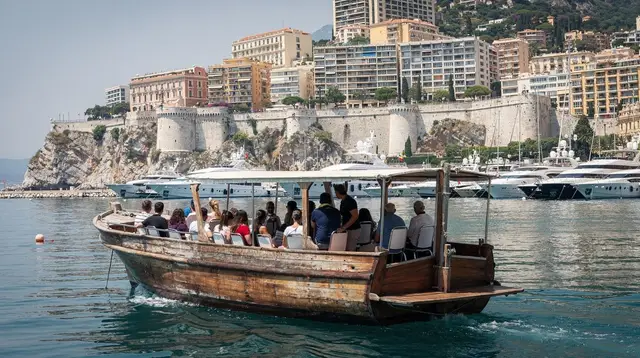
One genuine relief for a budget traveller: Monaco is not a separate financial hassle. It’s a sovereign state, not part of the European Union, but it uses the euro and has no border control with France — you walk or ride the train straight in, no passport check, no currency exchange counter, no visa. Whatever euros are in your pocket in Nice work exactly the same in Monaco. The only real cost difference is that things inside Monaco — a coffee near the Casino, a hotel room, a parking space — tend to run higher than the same thing in Nice or Menton, simply because it’s an expensive place, not because of any border formality. Monaco day trip from Nice and Monaco by train vs by bus go into the practical side.
A walk around Monaco-Ville, the old town on the Rock, and watching the changing of the guard outside the Palais princier around late morning, costs nothing beyond the train ticket to get there. The free things to do in Nice guide covers the equivalent list back in Nice.
Where you base yourself changes the daily transport bill
Nice is the natural base for a budget trip: it sits in the middle of the TER line, so Villefranche, Eze-sur-Mer, Monaco and Menton are all short hops in one direction, and Antibes and Cannes are short hops in the other. Basing in Cannes or Antibes instead turns every trip toward Monaco or Menton into a longer, pricier one, since you’re adding a leg through Nice either way. Nice vs Cannes as a base and Nice vs Antibes: where to stay weigh that trade-off in more detail, and where to stay in Nice by neighbourhood covers which parts of the city keep you within walking distance of the station and the tram, rather than needing a taxi just to start the day. Arriving by air, the tram covered in Nice airport to the city centre charges the same small flat fare as any other tram ride, well below a taxi or a private transfer for a solo traveller or a couple.
Saint-Tropez is not a cheap add-on
It’s tempting to picture Saint-Tropez as another quick coastal hop, but it isn’t on the TER line at all and it isn’t close: roughly 110 kilometres from Nice, often two to three hours of driving each way once summer traffic on the coastal roads is factored in. Treat it as a full day of its own, not something to squeeze in after a morning in Monaco. In season, a boat from Nice or Cannes is often a more relaxed option than driving, and it turns the transport itself into part of the day rather than a tax on it. See Saint-Tropez day trip from Nice for the realistic version of this trip, and Saint-Tropez and the Esterel coast in two days if you’d rather stay over than do the return drive twice in one day.
Villages that cost nothing to walk — if you time them right
Eze, Saint-Paul-de-Vence and Tourrettes-sur-Loup charge nothing to wander through. The budget risk there isn’t an entry fee, it’s crowding: all three fill up between roughly 11am and 4pm in high season, when the narrow streets get genuinely uncomfortable and it’s easy to end up paying for a guided skip-the-line option purely to escape the crush. Arriving early — on the first train or bus of the morning — gets you the same village for free, with room to actually look at it. A short guided walk, like a full day covering several Riviera highlights in one outing, can also help if mornings are tight and you’d rather not build the route yourself.
Eating without it eating your budget
Food is one of the easiest places to overspend without noticing, and one of the easiest to control. A socca from a stand or a simple counter in Vieux-Nice costs a fraction of a sit-down restaurant meal and is, if anything, more authentic — the socca and Niçois street food guide and what is a real salade niçoise cover what to actually order and where it’s made properly. The Cours Saleya market guide is useful for building a picnic instead of a restaurant lunch, which is the single easiest saving to make on a beach day or before a train out to Villefranche or Eze. Restaurant bills already include service, so there’s no need to calculate a tip on top of the total — the tipping and restaurant etiquette guide explains why leaving a little extra for genuinely good service is a courtesy on the Riviera, not an obligation the way it might be elsewhere.
What actually drains the budget
The real cost spikes on the Riviera aren’t day-to-day transport — they’re calendar dates. The Monaco Grand Prix travel guide covers late May or early June, when accommodation in and around Monaco tightens sharply and roads close for days around the circuit. The Cannes Film Festival for visitors covers May, when the same thing happens around La Croisette. Outside those windows and outside July–August, prices ease noticeably, and villages that are unbearable at midday in summer are pleasant even at midday in April or October.
| Cost driver | Rough impact | How to dodge it |
|---|---|---|
| July–August dates | Highest accommodation and boat prices, biggest crowds | Shift to May–June or September |
| Grand Prix (late May/early June) | Sharp spike around Monaco specifically | Book well ahead or avoid those dates near Monaco |
| Cannes Film Festival (May) | Sharp spike around Cannes specifically | Same as above, localised to Cannes |
| Renting a car for coastal towns | Fuel + tolls + scarce, pricey parking | Use the TER for Villefranche, Eze, Monaco, Menton, Antibes |
| Midday village visits | Not a direct cost, but pushes people toward paid shortcuts | Arrive before 11am or after 4pm |
A loose five-day frame
A reasonable budget-minded rhythm: two days on foot and by tram in Nice itself, one day by train hopping Villefranche–Eze–Monaco, one day by train to Antibes or Cannes with a boat out to the Îles de Lérins, and a fifth day kept for something that genuinely needs a car or a longer trip — a village like Saint-Paul-de-Vence, a full day toward Saint-Tropez, or, if the coast has started to feel repetitive, a run inland toward the Mercantour instead: it doesn’t cost more than the fuel or the bus fare to get there, and Mercantour day trip from Nice lays out what’s realistic in a single day versus what needs an overnight.
The five days on the French Riviera itinerary and the French Riviera on a budget, four days itinerary both build on this shape in more detail, and French Riviera travel mistakes to avoid rounds up the planning errors — including renting a car for Nice itself — that tend to cost people the most.
If a single organised day out appeals more than juggling train timetables, an option like a guided day covering several Riviera towns from Nice bundles transport and a route into one fixed plan, which can work out sensibly against the time cost of planning several separate train days yourself.
Budget questions about exploring the French Riviera
Is it cheaper to explore the Riviera by train or by rental car?
For day trips along the coast, the train wins by a wide margin once fuel, tolls and scarce parking in towns like Monaco or Villefranche-sur-Mer are added up. A car only earns its cost for villages the train doesn’t reach, such as Saint-Paul-de-Vence or Grasse.
Does visiting Monaco cost more because it’s a different country?
No. Monaco uses the euro and has no border control with France, so there’s no exchange fee and no passport check to plan around. Prices there run higher simply because Monaco is an expensive place, not because of any border cost.
Can I visit Saint-Tropez cheaply as a day trip from Nice?
It’s possible but it takes most of a day: roughly 110 kilometres, often two to three hours of driving each way in summer traffic. Treat it as its own outing, ideally by seasonal boat from Nice or Cannes, rather than an economical add-on to another day.
When are prices highest on the French Riviera?
Generally July and August, plus two sharper spikes: the Monaco Grand Prix in late May or early June, and the Cannes Film Festival in May, when accommodation near both towns is scarce and some roads close.
Are the perched villages free to visit?
Yes — walking through Eze, Saint-Paul-de-Vence or Tourrettes-sur-Loup costs nothing beyond transport. The budget risk is timing, not price: these villages are crowded roughly between 11am and 4pm in summer, so an early or late visit saves both the crush and the temptation to pay for a shortcut.
Is there a cheap way to see several Riviera towns in one day?
A day of TER stops — Villefranche-sur-Mer, Eze-sur-Mer, Monaco, Menton — costs little beyond the tickets. A guided minivan day covering several towns costs more but removes the planning if your time is tighter than your budget.
Does the Nice tramway save money over taxis?
Yes for anything inside Nice or out to the airport — the tram (lines 2 and 3) covers Nice Côte d’Azur Airport, the centre and the port for a small flat fare, against a taxi costing several times as much for the same trip.
Trip-planning guides for Nice and the Riviera
Verified deep-linked GetYourGuide tours. Book through these links and we earn a small commission at no cost to you.
GetYourGuide does not provide a product photo for this activity — the image shows the meeting point, photographed by us.