Monaco day trip from Nice
Can you visit Monaco from Nice in a day, and how do you get there?
Yes, and it is the easiest excursion on the Riviera. The train from Nice-Ville to Monaco-Monte-Carlo takes about 20-25 minutes along the Basse Corniche, with departures roughly every 15-30 minutes. A half-day covers the Rocher and the guard change; a full day adds the Oceanographic Museum or the Casino.
Why Monaco is the simplest day trip from Nice
Of every excursion on this coast, Monaco asks the least of you. There is no car to rent, no parking to fight, no boat schedule to plan around. You walk to Nice-Ville station, buy a ticket, and 20 to 25 minutes later you step out in Monaco-Monte-Carlo, the coastal railway having traced the Basse Corniche the whole way. Trains run roughly every 15 to 30 minutes through the day, so there is no need to plan around a single departure. You can do this trip in a morning and be back in Nice for lunch, or stretch it into a full day if you want the Oceanographic Museum, the Casino, or a proper walk around the port.
That ease is also why Monaco fills up. By late morning, Monaco-Ville and the palace square are dense with visitors, and the narrow streets of the old town move slowly. None of that makes the trip not worth doing — it just means arriving early is the one piece of advice worth following if you actually want to enjoy the Rocher rather than shuffle through it.
The confusion to clear up before you go
Three things about Monaco surprise first-time visitors, and getting them straight in advance makes the day easier to plan.
Monaco is not in the European Union. It is a sovereign principality of roughly 2 square kilometres, independent from France, with its own prince and government. What it shares with its neighbour is a customs union and the euro as currency — there has been no separate Monegasque currency for decades. There is also no border control between France and Monaco: you walk or ride across the line without showing a passport, the same way you would cross between two French communes. Entry rules for a visitor coming from France follow the Schengen area, not a separate Monaco visa.
Monte-Carlo is not the capital. It is one district of Monaco, the one built around the Casino, the Hôtel de Paris, and the harbour-facing hotels. The capital is Monaco itself, and the historic core sits on the Rocher, the rocky promontory known as Monaco-Ville, where the Prince’s Palace, the cathedral, and the old streets are. If your itinerary says “Monte-Carlo day trip,” it usually means the whole principality, but it is worth knowing you are not standing in the capital when you are watching roulette wheels.
There is no airport in Monaco. Every visitor arrives via Nice Côte d’Azur Airport (NCE) and continues onward — by train (about 20-25 minutes from Nice-Ville), by road, or by helicopter to the heliport in Fontvieille, a flight of around seven minutes. If you are coordinating a trip that starts or ends with a flight, Nice is always the gateway, never Monaco.
A day-trip itinerary that actually fits together
Morning — the Rocher and the guard change. Take an early train from Nice-Ville; arriving in Monaco by 9:30 or 10am gives you time to walk up to Monaco-Ville before the crowds thicken. Wander the old streets around the cathedral, then position yourself near the Prince’s Palace before 11:55am for the changing of the guard, a short, free ceremony that most visitors time their morning around. The square gets busy in the fifteen minutes before it starts, so arrive with margin.
Late morning — the Rocher’s other sights. Still on the Rocher, the Oceanographic Museum is the obvious next stop if marine life or the building itself (perched dramatically over the sea) interests you; budget an hour or more inside. The Jardin Exotique and the Fort Antoine area are also on this side of Monaco if you want more open-air walking with sea views.
Early afternoon — Monte-Carlo. Walk or take the local bus down toward the harbour and across to Monte-Carlo. This is where the Casino de Monte-Carlo sits, along with the Hôtel de Paris and the Café de Paris terraces. Even without gambling, the atrium of the Casino is open to visitors and worth five minutes for the architecture alone — smart dress required, and entry to the gaming rooms is 18 and over with valid ID.
Late afternoon — Port Hercule and the return. Port Hercule, Monaco’s harbour, is worth a walk for the yachts alone, and it sits conveniently on the route back toward the station. Trains back to Nice run at the same frequency as the outbound leg, so there is no need to plan the return down to the minute.
That whole sequence fits into a single day without rushing, and a shortened version — Rocher, guard change, one museum or the Casino atrium — fits into a half-day if you are combining Monaco with something else.
Monaco and Èze: the pairing that actually works
If you are trying to decide how to fill a Riviera day beyond Monaco itself, the honest answer is that Èze is the only addition worth making, and even that is optional. Monaco alone, done properly, is a full day if you include a museum or the Casino; it is a half-day if you stick to the Rocher and the guard change. Èze sits on the Moyenne Corniche between Nice and Monaco, so a combined itinerary — Nice, Èze village and its Jardin Exotique, then down to Monaco — is a natural sequence rather than a detour, and it’s the version most guided day trips from Nice actually run.
What doesn’t work is trying to add a third stop. “See the whole Riviera in a day” itineraries that stack Monaco, Èze, and somewhere else on top rarely leave enough time in any one place, and Monaco specifically punishes rushing — the guard change has one fixed time, the old town is dense to move through by midday, and a museum visit needs a real hour, not twenty rushed minutes. If your goal is Monaco and Èze, that pairing is already a satisfying, complete day. For the boat-based version of this stretch of coast — sailing along the water rather than visiting on land — that’s a different trip entirely, covered separately from the walking and driving route described here.
Other pairings exist if Èze doesn’t fit your route. Some visitors combine Monaco with Villefranche-sur-Mer and Cap-Ferrat along the same stretch of coast, or push further east and treat Monaco as the first stop before Menton, the last town before the Italian border. Either works better as a full-day itinerary than a same-day add-on to the plan above, since both add real travel time on top of Monaco itself.
Getting there without a car
The train is the default, and for good reason. The TER line along the coast connects Nice-Ville to Monaco-Monte-Carlo in about 20-25 minutes, running along the Basse Corniche with sea views for parts of the journey. Trains are frequent enough that you don’t need to book ahead or plan around a timetable; buy a ticket at the station or through the regional app and board the next departure.
If you’re coming straight from the airport rather than central Nice, Nice Côte d’Azur Airport connects to Nice-Ville by tram, and from there it’s the same train onward to Monaco — no need to detour into the city centre first if you’re short on time.
For a fuller side-by-side of every option — train, bus, car, and where each one actually makes sense — the Nice to Monaco transport guide and the more focused train vs bus comparison cover the trade-offs in more depth than a single day-trip itinerary needs.
Driving is possible but rarely worth it. Monaco’s streets are narrow, one-way systems are common, and parking is scarce and expensive; the principality is also easy to see almost entirely on foot once you arrive. If you’re combining Monaco with Èze in the same day, a car makes sense for that leg of the route, with the Monaco portion still done on foot once you park or take the train in from Èze.
What to book, and what not to
A handful of organised options make sense for this trip, mostly if you’d rather not coordinate the train yourself or if you want a guide to make sense of what you’re looking at on the Rocher.
A guided day trip from Nice to Monte-Carlo and the Monaco coast handles the transport and gives context along the corniche route, useful if you’d rather sit back than manage train times. For a closer look at the palace and Monaco’s royal history, a tour combining the Prince’s car collection with the palace adds a stop most independent visitors skip. If you want a local’s perspective on the streets of the Rocher rather than a guidebook’s, an independent guided walk through Monaco with a local guide is a lighter, more flexible option than a coach tour. And if you’d rather see Monaco lit up after dark than under the midday crowd, a Monaco by night excursion from Nice swaps the guard-change morning for an evening view of the harbour and the Casino district.
None of this is necessary, though. The train is cheap, frequent, and simple enough that a guided option is a convenience, not a requirement — book one if you’d rather not think about logistics, skip it if you’re happy navigating a short, well-signed old town on your own.
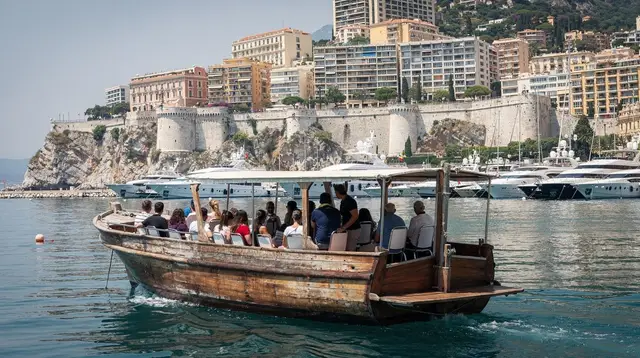
If one day trip leaves you wanting to build a whole Monaco visit around a single interest rather than the itinerary above, the dedicated guides go deeper on each angle: walking tours of Monaco for those who want the old town explained street by street, Monaco boat tours for seeing the Rocher and the harbour from the water, and Monaco food tours for visitors who’d rather structure the day around where to eat than around the guard change.
Costs and timing at a glance
| Item | Approximate cost or time |
|---|---|
| Train, Nice-Ville to Monaco-Monte-Carlo | one-way ticket, about 20-25 min each way |
| Changing of the guard | free, daily around 11:55am |
| Oceanographic Museum | entry fee, allow 1-1.5 hours |
| Casino de Monte-Carlo atrium | free to view; gaming rooms 18+, entry fee, ID required |
| Minimum time for a satisfying visit | half a day (Rocher and guard change) |
| Full day with a museum or the Casino | a full day, comfortably |
| Adding Èze on the same day | adds 1-2 hours of travel and a second village visit |
Practical notes for the day
Monaco uses the euro, the same as everywhere on this coast, and cards are accepted almost everywhere, including small shops near the Casino. Dress for the Rocher is casual, but the Casino atrium and gaming rooms expect smart dress, and swimwear or flip-flops won’t get you past the door. The old town has real hills and stepped streets, so comfortable shoes matter more than they might for a flatter itinerary. If you’re visiting in July or August, expect the guard change and the palace square to be genuinely crowded — arriving by 11:30am for an 11:55am ceremony is not overcautious, it’s necessary.
Pickpocketing risk on the coastal train and around the crowded parts of Monaco-Ville is worth normal city vigilance, nothing more. And if you’re timing your visit around the Monaco Grand Prix, note that it runs in late May or early June, not in summer proper — plan around it rather than into it, since streets close and prices rise sharply that week; the Monaco Grand Prix travel guide covers what changes that week in more detail.
Monaco day trip from Nice: frequently asked questions
Is Monaco part of the European Union?
No. Monaco is a sovereign state, not an EU member, though it uses the euro and has no border control with France. Coming from Nice, crossing into Monaco feels like crossing a street, not a border.
Is Monte-Carlo the capital of Monaco?
No. Monte-Carlo is a district of Monaco, known for the Casino and the Hôtel de Paris. The capital is Monaco itself, centred on Monaco-Ville, the old town on the Rocher where the Prince’s Palace stands.
Does Monaco have its own airport?
No. There is no airport in Monaco. Visitors arrive through Nice Côte d’Azur Airport (NCE), then continue by train, bus, car, or helicopter to Monaco’s heliport in Fontvieille.
What time is the changing of the guard at the Prince’s Palace?
It takes place daily at around 11:55am in front of the Prince’s Palace in Monaco-Ville. It is short, free to watch, and the single fixed appointment most day-trip itineraries are built around.
How long does the train from Nice to Monaco take?
About 20 to 25 minutes on the TER line that runs along the Basse Corniche between Nice-Ville and Monaco-Monte-Carlo station, with frequent departures through the day.
Do you need a full day for Monaco, or can you combine it with somewhere else?
A half-day covers Monaco-Ville and the guard change comfortably. Many visitors pair Monaco with Èze on the same day rather than adding a third stop, since both already involve walking, queueing, and a midday crowd on the Rocher.
Can you get into the Casino de Monte-Carlo as a visitor?
Yes, but only from age 18, with a valid ID, and in smart dress — no shorts or beachwear. The atrium and gaming rooms are open to visitors outside restricted members’ areas.
If Monaco is the only excursion you make from Nice, it’s a good one to pick: short, well-served by train, and structured around a real event in the guard change rather than a vague promise of atmosphere. For the wider set of options beyond Monaco, the day trips from Nice overview lays out the rest of the coast, and the two-day Monaco, Menton and Italian Riviera itinerary is worth a look if one day in the principality leaves you wanting more. If you’re still deciding how to spend a longer stay in Nice, the three days in Nice and the Riviera itinerary slots this Monaco day trip into a fuller plan.
Day trips to Monaco, Cannes and Saint-Tropez
Verified deep-linked GetYourGuide tours. Book through these links and we earn a small commission at no cost to you.
GetYourGuide does not provide a product photo for this activity — the image shows the meeting point, photographed by us.