Monaco walking tours: Monaco-Ville and Monte-Carlo on foot
Are Monaco-Ville and Monte-Carlo the same walking tour?
No. Monaco-Ville is the capital, on the Rocher, with the Palais princier and the cathedral. Monte-Carlo is a separate district built around the Casino, the Opera and the Hôtel de Paris. Most walking tours cover one or link both on foot via Port Hercule, roughly 25 to 35 minutes apart.
Two places, one small principality
Most people arrive in Monaco expecting one town. What they get is two distinct districts joined by a port, and a lot of confusion about which one is which. Monte-Carlo is not the capital of Monaco. It’s a district — the one built around the Casino, the Opéra de Monte-Carlo and the Hôtel de Paris. The actual capital is Monaco-Ville, up on the Rocher (the Rock), where the Palais princier, the cathedral and the Musée océanographique sit above the sea. Between them, at sea level, is Port Hercule, Monaco’s main harbour and the easiest way to picture how the principality fits together.
This matters for a walking tour because the two districts don’t feel alike and don’t reward the same pace. Monaco-Ville is a compact old town on a promontory — narrow streets, a fortified feel, sweeping views over the Mediterranean. Monte-Carlo is a set piece of Belle Époque architecture around a formal square, with gardens, boutiques and the Casino itself. Walking both on the same morning is entirely possible — Monaco day trip from Nice covers doing that as part of a longer day from Nice — but this page stays inside Monaco itself, on foot, without folding in a boat trip, a corniche drive or a multi-stop itinerary. If you want the vehicle version of the corniches toward Èze, that’s a separate trip: Èze day trip from Nice: a practical guide.
Monaco is genuinely small — about 2 km² in total — which is why walking is the natural way to see it. There’s no metro, and a car is more hindrance than help once you’re inside the principality; most visitors arrive by train or bus from Nice (about 20 to 25 minutes by train from Nice-Ville) and do everything else on foot. For the practical side of getting there, see Nice to Monaco: transport options and Monaco by train or bus from Nice: which to choose.
Walking Monaco-Ville: the Rock
Monaco-Ville sits on a rocky promontory that juts into the sea, separate from the rest of the principality both physically and in feel. This is where Monaco started, centuries before Monte-Carlo existed, and it still reads as a fortified old town rather than a resort district.
The centrepiece is the Palais princier, the official residence of the ruling Grimaldi family. The changing of the guard happens daily around 11:55 in the small square in front of the palace — arrive 15 to 20 minutes early in high season, because the square is genuinely small and fills up fast. The palace’s state apartments are open to visitors on a seasonal schedule; check current opening dates before planning around them, since they vary year to year.
A short walk from the palace is the cathedral (Cathédrale de Monaco), a 19th-century Romanesque-Byzantine building that holds the tombs of several Grimaldi princes, including Rainier III and Grace Kelly — a quiet, frequently visited stop that rewards a few unhurried minutes rather than a rushed pass-through.
At the tip of the Rocher, the Musée océanographique de Monaco is one of the oldest aquariums in Europe, built into the cliff face with views straight down to the water. It’s a paid ticket and one of the few sights in Monaco-Ville that takes real time — budget an hour if you go in, more with kids.
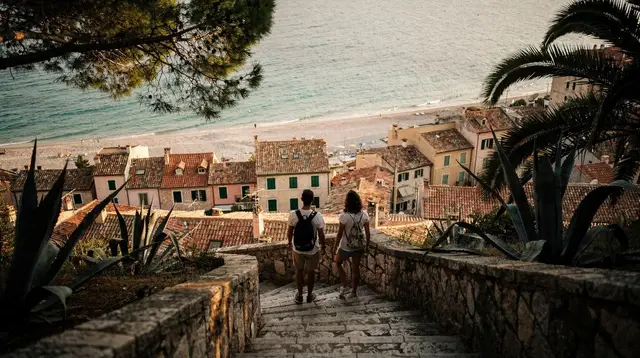
Beyond the named landmarks, Monaco-Ville’s real appeal is the walk itself: narrow lanes, pastel façades, small squares, and — almost everywhere you turn — a gap between buildings that opens onto the sea. The old town is compact enough to cover on foot in an hour if you’re moving with purpose, or close to half a day if you linger at the viewpoints, the cathedral and the aquarium. For the street-level version of this walk, guided rather than self-navigated, see the tour options below.
Walking Monte-Carlo: the Casino quarter
Monte-Carlo is a different kind of place entirely, and treating it as “more of Monaco-Ville” is the mistake this guide exists to correct. It’s a purpose-built 19th-century district, laid out around the Place du Casino, with the Casino de Monte-Carlo, the Opéra de Monte-Carlo (inside the same building, designed by Charles Garnier, architect of the Paris Opéra) and the Hôtel de Paris forming the formal centre.
Walking Monte-Carlo means walking a square and its radiating streets: manicured gardens in front of the Casino, a line of luxury boutiques on the avenues behind it, and terraces that look back down toward the port. The Casino’s exterior — the façade, the gardens, the row of parked cars that collect outside — is worth seeing even if you have no interest in going inside. Entering the gaming rooms is a separate decision: minimum age 18, a passport or ID required, and a dress code that gets stricter after the early evening. Casual clothing is fine for the square and the streets around it.
Beyond the Casino itself, Monte-Carlo’s appeal is the architecture and the gardens rather than a checklist of sights — the Jardin Exotique de Monaco overlooks the district from higher ground and pairs well with a Monte-Carlo walk if you have the extra hour and don’t mind the climb. In the evening, the square and the Casino façade are lit, and a number of guided walks are built specifically around that change in atmosphere.
an evening walk through Monaco and Monte-Carlo once the Casino and the port are lit up is a different experience from the same route at midday — quieter streets, a cooler temperature in summer, and a view of the Casino quarter that the daytime crowds don’t allow.
Port Hercule: the link between the two
Between Monaco-Ville and Monte-Carlo sits Port Hercule, Monaco’s principal harbour and the geographic hinge of the whole principality. It’s not a sight in the way the Palais or the Casino are, but it’s unavoidable on foot, and it’s genuinely worth a slow pass rather than a quick crossing.
The port is where superyachts moor alongside working boats, where the Grand Prix’s temporary grandstands go up every spring, and where several boat excursions depart, including trips out toward Cap-Ferrat and along the coast. Walking around Port Hercule from Monaco-Ville to Monte-Carlo takes roughly 25 to 35 minutes at an easy pace, longer if you stop to look at the boats or detour up either side for a view back down. A network of free public lifts and escalators, tucked into the hillside on both sides, cuts out some of the steeper climbs — useful in summer heat or with limited mobility, and something a self-navigated first visit often misses entirely.
If your interest in Monaco is really about the water rather than the walk, a short excursion covers that separately: a two-hour cruise along the coast into Monaco gives a view of the Rocher and the port from the sea, which is a genuinely different perspective from anything you get on foot.
Planning your walk: routes, times, effort
There’s no single “correct” route through Monaco on foot — it depends on how much time you have and whether you want both districts or just one.
| Focus | Rough duration | What it covers |
|---|---|---|
| Monaco-Ville only | 1–2 hours | Palais princier, changing of the guard, cathedral, viewpoints |
| Monaco-Ville + Musée océanographique | 2.5–3.5 hours | Same as above, plus the aquarium |
| Monte-Carlo only | 1–1.5 hours | Casino square, gardens, Hôtel de Paris, boutique streets |
| Both districts via Port Hercule | 3.5–5 hours | Full loop, walking the port between the two |
| Both districts, evening walk | 2–3 hours | Casino and port lit up, cooler pace |
Two things to plan around: the 11:55 changing of the guard, which anchors a morning visit to Monaco-Ville if you want to see it, and the climbs. Monaco-Ville sits on high ground and Monte-Carlo isn’t flat either — comfortable shoes matter more here than the principality’s polished image suggests. The public lifts help, but they don’t eliminate every set of steps.
Crowds build through the morning and stay heavy into the afternoon, especially in July and August and on any day the Grand Prix calendar (typically late May or early June — never in July or August, whatever a rushed itinerary might imply) overlaps with your visit. An early start, before the day-trip groups arrive from Nice and Cannes, is the single easiest way to have the Palais square and the Casino terrace to yourself for a few minutes.
What a private walking tour adds
Both districts are walkable without a guide — Monaco isn’t a place where you’ll get lost, and signage is good. What a guided walk changes is context and pacing rather than access. On your own, the Palais is a photogenic building with a changing of the guard; with a guide, it comes with the family history behind it, why the Rocher was chosen as a defensible position centuries ago, and which viewpoints along the walk are worth the extra few minutes.
a private walking tour that covers Monaco-Ville and Monte-Carlo at your own pace is the most flexible option if you want both districts without matching a group’s schedule — useful if you’re travelling with kids, have mobility considerations around the port’s climbs, or simply prefer not to walk in a pack. For a version built specifically around a local guide’s own routes and stories rather than a fixed script, a guided walk through Monaco led by a local guide tends to spend more time on the parts of the old town that a self-guided pass skips — the smaller squares, the older gates, the spots where the view opens up without a crowd already there.
None of these tours include the corniche drive to and from Nice, and none of them combine Monaco with Èze or another stop on the same ticket — for that, see Monaco day trip from Nice or, if arriving by boat rather than road appeals more, Monaco boat tours from Nice: see the Rocher from the water. Anyone arriving by helicopter rather than train — a genuine option given Monaco has no airport of its own — can check Helicopter flights to Monaco from Nice: what to know for the transfer itself before picking up one of the walks above once on the ground.
Practical notes for walking Monaco
Monaco uses the euro, despite not being an EU member state; cards are accepted almost everywhere, including small cafés near the port. There’s no border control arriving from France, and no separate visa process for a visitor already in the Schengen area. Public toilets and water fountains are more limited in Monaco-Ville than in Monte-Carlo, so plan around the Palais square and the aquarium area if you need either.
Shade is genuinely scarce on the Place du Casino and along the port in the middle of the day — sun protection matters more here in July and August than the manicured setting suggests. Evenings shift the whole experience: cooler air, the Casino façade and the port both lit, and noticeably fewer day-trippers, since most coach and boat excursions from Nice and Cannes return before dinner.
For eating between the two districts, Port Hercule has the widest range of casual options; Monaco-Ville’s restaurants lean toward tourist-facing cafés near the Palais, and Monte-Carlo’s toward the expensive end, in keeping with its address. None of that requires advance planning beyond knowing which end of your walk you’ll be hungry at.
If Monaco is one stop in a longer Riviera trip rather than the whole point of the day, Monaco, Menton and the Italian Riviera in two days sequences it against Menton and the Italian border towns, and Nice airport transfers: tram, taxi and getting to the centre covers the arrival end for anyone landing at Nice before heading east.
For the district-level detail on Monte-Carlo’s dress code before stepping inside the Casino itself, see Monte-Carlo casino dress code and how to visit; for the neighbouring stretch of coast beyond Monaco, Eastern Riviera: Villefranche, Èze, Monaco and Menton and Things to do in Monaco and Monte-Carlo list the wider range of activities based in the principality; and if your visit happens to land during the Grand Prix, Monaco Grand Prix: travel guide from Nice explains how the race changes access to both districts. The destination overview is at Monaco and Monte-Carlo.
FAQ about walking tours of Monaco
Is Monte-Carlo the capital of Monaco?
No. Monaco-Ville, on the Rocher, is the capital, home to the Palais princier and the cathedral. Monte-Carlo is a district built around the Casino, the Opera and the Hôtel de Paris, about a 25 to 35 minute walk away across Port Hercule.
How long does it take to walk from Monaco-Ville to Monte-Carlo?
Around 25 to 35 minutes on foot along Port Hercule, longer if you stop at the port or climb the steps on either side. A free public lift network shortens some of the climbs.
Can you walk around Monaco without a guide?
Yes, the old town and the Casino quarter are both walkable independently with a map, and both are compact. A guide adds context on the Grimaldi family, the Casino’s history and viewpoints a first visit often misses.
What time is the changing of the guard at the Palais princier?
Around 11:55 daily, in front of the Palais princier in Monaco-Ville. Arrive 15 to 20 minutes early in summer, as the small square fills up.
Do you need to dress up to walk through Monte-Carlo?
No, casual clothing is fine for walking the streets and the Casino square. Entering the Casino’s gaming rooms is different: minimum age 18, photo ID, and a dress code that tightens in the evening.
Is Monaco walkable, or do you need a car?
Monaco is small, around 2 square kilometres, and both Monaco-Ville and Monte-Carlo are walkable on their own. A car is not useful inside the principality; most visitors arrive by train or bus from Nice and walk once there.
What’s the difference between a group walking tour and a private one in Monaco?
A group tour runs on a fixed time and pace with other travellers; a private walking tour lets you set the pace, skip what doesn’t interest you, and ask questions freely, usually at a higher price per person.
Walking tours of Vieux-Nice and the Riviera
Verified deep-linked GetYourGuide tours. Book through these links and we earn a small commission at no cost to you.
GetYourGuide does not provide a product photo for this activity — the image shows the meeting point, photographed by us.