Monte-Carlo casino dress code and how to visit
I got the geography wrong the first time I tried to explain Monaco to a friend visiting from home. I told her the casino was “in the capital,” and technically I was already lying before she’d even booked her train ticket. Monte-Carlo isn’t Monaco’s capital. It’s a quarter — one of ten that make up the principality — built around the Casino, the Opéra Garnier de Monte-Carlo next door, and the Hôtel de Paris across the square. The actual capital is Monaco, specifically Monaco-Ville, the old town perched on the Rocher with the Prince’s Palace, the cathedral where Grace Kelly is buried, and the Oceanographic Museum. Two different hills, two different atmospheres, five minutes apart by bus. Get that straight before you go and the rest of the day makes a lot more sense.
Monte-Carlo is a quarter, not the capital
Monaco-Ville feels like a fortified village: narrow streets, changing of the guard at the Palace around 11:55am, views over the harbour. Monte-Carlo feels like a stage set for old money: manicured gardens, a casino façade lit gold in the evening, valets parking cars that cost more than most apartments. Both belong to the same tiny state — Monaco is a sovereign principality, not part of the European Union, though it uses the euro and has no border checks with France. But conflating the two quarters means you either miss the Palace looking for the Casino, or you wander Monaco-Ville wondering where the roulette wheels went. I’ve watched both happen to people who’d read “Monaco” and assumed it was one neighbourhood.
Getting into the casino: age, ID, dress code
The Casino de Monte-Carlo isn’t a museum with a suggested donation — it’s a working gaming house with rules that get enforced at the door, and I’d rather tell you plainly than have you turned away in front of everyone.
You need to be 18 or older. Staff ask for a passport or national ID card; I wouldn’t count on a driving licence being accepted. Curiously, Monegasque citizens themselves aren’t allowed into the gaming rooms — a rule from the casino’s founding, meant to protect residents from losing money to their own state’s main revenue source.
Dress code has two tiers, and I’ve seen people caught out by the second one:
| Area | When | What’s required |
|---|---|---|
| Public gaming rooms, atrium | Daytime | Smart casual — no shorts, sportswear, flip-flops or vest tops |
| Private gaming rooms | Evening, roughly after 8pm | Jacket and tie for men; no jeans or trainers, even smart ones |
You don’t have to place a single bet to walk through and look. A basic entry ticket gets you into the public rooms, and plenty of visitors go purely for the décor — gilded ceilings, chandeliers, the hush of a room where people are concentrating hard on cards. I found it more interesting as architecture than as a place to gamble, honestly; I lost twenty euros at a slot machine near the entrance and called it the price of admission.
Outside is free, and worth it on its own
If the dress code or the entry fee isn’t for you, don’t skip Monte-Carlo — just stay outside. Casino Square costs nothing, and the building’s front steps, the fountain, and the rows of vintage cars usually parked out front (Ferraris, the odd Bugatti, always someone’s convertible) are as photographed as anything on the Riviera. The gardens behind the Casino slope down toward the sea and make a good spot to sit for ten minutes before moving on. I’ve brought people here who had zero interest in casinos and they still wanted the photo by the entrance.
What it costs, what it doesn’t
Entry to the public rooms runs a modest fee, payable at the door; the private rooms and any actual gambling are a separate, open-ended expense that has nothing to do with the entry ticket. I won’t pretend this is a budget stop — the whole quarter is built to make you feel like spending money — but looking is free, and the fee for looking inside is genuinely small next to a dinner at the Hôtel de Paris across the square. For the fuller picture on doing Monaco without emptying your wallet, that’s really a separate conversation from the Casino itself.
Getting there from Nice
The train from Nice-Ville to Monaco-Monte-Carlo station takes about 20-25 minutes along the coast, and it’s the easiest way in — Monaco has no airport of its own, so everyone lands at Nice Côte d’Azur first. From the station it’s a short walk or a couple of bus stops up to Casino Square; the walk is uphill but manageable, past the harbour and the Casino gardens. If you’d rather not manage stations and timetables, a private tour from Nice covers Monaco alongside the corniche villages in one outing. I did the first stretch of coast road once on a guided tuk-tuk tour out of Nice, which turned out to be a relaxed way to take in the Basse Corniche before the day got serious in Monte-Carlo.
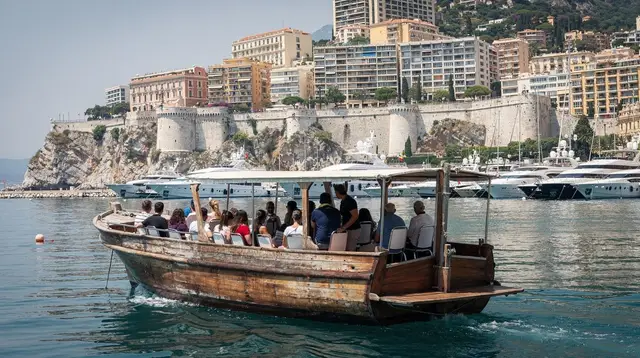
If you want the sea approach instead of the train, boats running along this stretch of coast give you Monaco’s skyline from the water, which is arguably the better angle on the Casino’s hillside setting than anything from street level. A private boat trip with food on board or a quieter small-group electric boat outing both pass this way from Nice, and neither requires you to dress for anywhere until you actually step off. For a day that folds Monaco in with Eze and the rest of the corniche, a Riviera day trip with a champagne stop covers more ground than the train alone.
Practical basics before you go
A few things are worth knowing before you queue at the door. Monaco uses the euro, same as France, even though the principality itself isn’t part of the European Union — there’s no border check crossing over from Nice, so you won’t need a passport for the journey itself, only for getting into the casino. Sockets are the standard French 230V type E, and the emergency number is 112 if you ever need it. If you’re staying in Nice rather than Monaco, it’s worth reading up on where to base yourself in Nice by neighbourhood and checking Nice’s weather by month before picking a date — the Riviera is at its most crowded, and its most expensive, in July and August, and the transport options between Nice and Monaco are worth comparing beyond just the train.
Other corniche stops worth folding in
Monte-Carlo rarely works as a stand-alone half-day if you’ve come this far along the coast. Villefranche-sur-Mer and Cap Ferrat sit on the same rail line back toward Nice and make an easy add-on before or after the casino. Push a little further east and Menton, the last town before Italy, has a completely different, quieter register than Monte-Carlo’s polish. If food is more your interest than roulette tables, there are dedicated Monaco food tours that go well beyond a café near the Casino, and for the view from the water rather than the square, Monaco boat tours or, for something faster, helicopter flights over Monaco both show the principality’s tight cliffside layout in a way street level never quite does.
Making a day of it
One visit to the Casino square rarely fills a whole day, and I don’t think it should try to. Pair it with Eze on the way — the Moyenne Corniche runs right past it — or spend the morning in Monaco-Ville before the afternoon in Monte-Carlo, so you actually see both halves of the principality instead of one photogenic postcard. If you’re coming down from Nice, the full Monaco day trip covers logistics for combining the two quarters properly, and a dedicated Monaco walking tour does a better job of the Rocher than I can in a paragraph here. For getting between the two towns without a car, compare the train against the bus — the train wins on speed, the bus on price.
Anyone timing a visit around the Monaco Grand Prix should know Casino Square sits right on the circuit, and access changes completely for race weekend in late May or early June — book well ahead or expect barriers where the square usually is. Outside race season, it’s just a very well-dressed neighbourhood with a famous front door.
Monte-Carlo casino: your questions answered
Is Monte-Carlo the capital of Monaco?
No. Monaco’s capital is Monaco-Ville, the old town on the Rocher with the Prince’s Palace, the cathedral, and the Oceanographic Museum. Monte-Carlo is a separate quarter, home to the casino, the Opera, and the Hôtel de Paris.
How old do I need to be to enter the Monte-Carlo casino?
18, with no exceptions. Staff at the door check identification, and Monegasque residents are actually barred from the gaming rooms altogether — it’s a rule that goes back to the casino’s founding.
What ID do I need to bring?
A passport or a national identity card. A driving licence usually isn’t accepted, so if that’s all you’re carrying, check before you queue.
What’s the actual dress code?
Smart daytime wear gets you into the public gaming rooms and the atrium: no shorts, no flip-flops, no sportswear, no vest tops. The private gaming rooms in the evening (after around 8pm) require jacket and tie for men; jeans and trainers are turned away there even if they passed earlier in the day.
Do I have to gamble to visit?
No. A ticket lets you walk through the public rooms and admire the décor without playing a single hand, though the atmosphere is built around people who are.
Can I just look at the outside for free?
Yes. The Casino Square, the gardens, and the building’s façade cost nothing and are worth the walk even if you skip the entry fee — this is the postcard shot most people came for anyway.
Is the Monte-Carlo casino the same as the Monaco Grand Prix circuit?
They’re neighbours, not the same thing. The Grand Prix circuit runs right past Casino Square, and the square itself becomes part of the track for race weekend in late May or early June.
How do I get from Nice to Monte-Carlo?
The train from Nice-Ville takes roughly 20-25 minutes and drops you a walk or short bus ride from the casino. Monaco has no airport of its own — everyone arrives via Nice.
tours.Landmarks
Verified deep-linked GetYourGuide tours. Book through these links and we earn a small commission at no cost to you.
GetYourGuide does not provide a product photo for this activity — the image shows the meeting point, photographed by us.