Monaco is its own country, not a Nice suburb
Say “Monaco” and most visitors picture a district of France with a famous casino. It isn’t. Monaco is a sovereign state of about 2 km², independent since long before the Riviera became a resort coast, and it is not a member of the European Union. It uses the euro, sits in a customs union with France, and has no border checkpoint on the road or the train line from Nice — you’ll cross into Monaco without a stamp, a barrier or even much of a sign. For a visitor arriving from France under Schengen rules, nothing changes at the line itself; the difference is administrative, not practical.
The other mix-up is bigger: Monte-Carlo is not the capital. It’s a district — the one built around the Casino, the Opéra and the Hôtel de Paris — and it’s the part most postcards show. The actual capital is Monaco-Ville, also called Le Rocher (the Rock), a fortified promontory holding the Prince’s Palace, the cathedral and the Oceanographic Museum. The principality has four main areas: Monaco-Ville on the Rock, Monte-Carlo around the Casino, La Condamine at the port, and Fontvieille, the reclaimed land to the west where the heliport and the stadium sit. They’re walkable from each other but each has a distinct feel, and treating “Monte-Carlo” as shorthand for the whole country will leave you looking for the Palace in the wrong district.
Getting there from Nice — no airport, several good options
Monaco has no airport of its own. Every visitor arrives via Nice, one way or another.
| Option | Time from Nice | Notes |
|---|---|---|
| Train (Nice-Ville to Monaco-Monaco Monte-Carlo) | 20-25 min | Simplest option; station is a short walk or bus ride from the centre |
| Bus (Lignes d’Azur regional service) | About 45 min | Cheaper, scenic, slower along the coast road |
| Car | 30-45 min without traffic | Parking is expensive and limited; not worth it for a day trip |
| Helicopter to Fontvieille heliport | About 7 min | A genuine option from Nice airport, priced accordingly |
The train is the easy default: frequent departures, a coastal route that runs past Èze and Beaulieu, and a station a few minutes’ walk from the port and the escalators up toward Monte-Carlo. If you’re combining Monaco with the rest of the eastern Riviera corniches in one day, the train also stops at Villefranche and Eze-sur-Mer, which makes stacking two stops realistic if you start early. For the mechanics of tickets, schedules and which station to use, see our dedicated guide to transport options between Nice and Monaco and the comparison of going by train versus by bus.
Arriving by helicopter is a real, bookable experience rather than a gimmick — worth doing once for the approach over the coast, less so as your only way to see Monaco given the cost.
a helicopter flight linking Cannes and Monaco covers the same short hop with a longer, scenic detour over the bay.
Monaco-Ville: the actual capital
Monaco-Ville sits on the Rock, above the port, and this is where the country’s institutions live. The Prince’s Palace is the focal point, and the changing of the guard in front of it happens daily at around 11:55am — a fixed, low-key ceremony rather than a spectacle, but worth timing your visit around if you want to see it. The Palace’s State Apartments are open to visitors on a seasonal schedule; check before you go, since opening months shift year to year.
Behind the Palace, the streets of the old town are narrower and quieter than Monte-Carlo’s boulevards — this is where the Cathedral of Monaco stands (Grace Kelly and Prince Rainier III are both buried here), and where the Oceanographic Museum occupies a dramatic clifftop building above the sea. The museum is genuinely worth the entry fee: an aquarium built into the rock, a rooftop terrace with wide sea views, and enough scale to fill an hour or two on its own.
Monte-Carlo: the Casino district
Monte-Carlo is where most people’s mental image of Monaco actually comes from — the Casino’s Belle Époque façade, the Place du Casino gardens, the Hôtel de Paris and the Café de Paris across the square. The Casino itself is open to visitors, but with conditions: entry from age 18, a passport or ID required, and a dress code that tightens as the evening goes on (the main gaming rooms expect jackets after a certain hour). You don’t need to gamble to look inside the atrium and the public rooms, and plenty of visitors do exactly that.
Monte-Carlo is also the district for the harbour views over the yachts moored below, for window-shopping the luxury boutiques, and — every year in late May or early June — for the Monaco Grand Prix, when the streets around the Casino become the racetrack itself. If your dates land anywhere near the race, expect hotel prices across the whole Riviera to spike and much of central Monaco to be fenced off for setup well before the actual weekend; our Grand Prix travel guide covers the timing and what changes.
a guided walk through both Monaco-Ville and Monte-Carlo with a local guide is the easiest way to get the geography and the history straight in one pass, rather than working it out street by street.
La Condamine and Fontvieille: the other two districts
Most day-trip itineraries stop at Monaco-Ville and Monte-Carlo and never mention the other two districts, which is a fair choice for a half-day visit but worth knowing about if you have more time. La Condamine wraps around the port, below the Rock — this is where the working harbour, the daily market at Place d’Armes and a run of ordinary cafés and bakeries sit, a noticeably less polished stretch than the Casino square a few minutes’ walk away. It’s also the easiest place to actually see the yachts up close rather than from a distance above.
Fontvieille, the reclaimed land to the west, is quieter still: the heliport, the Stade Louis II football stadium, a small zoo, and a rose garden dedicated to Princess Grace. Few day-trippers make it out this far, and there’s no strong reason to unless you’re arriving by helicopter or have a specific reason to see the stadium. For most first-time visitors, Monaco-Ville and Monte-Carlo cover what the country is known for; La Condamine and Fontvieille are for a second visit or a longer stay.
If walking the districts in order with some context sounds more useful than reading about them, a guided walking tour of Monaco covers the same ground with a route already worked out, and our Monaco food tours guide is a good starting point if you’d rather eat your way through La Condamine’s market stalls than plan a sit-down meal near the Casino.
A day plan that actually fits together
Monaco rewards a loose plan more than a checklist, because the districts are close but the walk between them (Monaco-Ville to Monte-Carlo) climbs and drops steeply. A workable order:
- Morning train from Nice-Ville, arriving before the day-trip crowds build.
- Monaco-Ville first: the Palace, timed for the 11:55am guard change if that interests you, then the old town and the Cathedral.
- The Oceanographic Museum, which can easily take an hour or two.
- Walk or take the free public lifts down toward the port, then up into Monte-Carlo for the Casino square and its gardens.
- Late afternoon train back to Nice, or extend into an early dinner if you’re staying for the evening light over the harbour.
If you’d rather not plan the logistics yourself, a full day trip from Nice covering the Monte-Carlo and Monaco coast bundles transport and a structured route into one booking. For a full write-up of this same route with timing and cost breakdowns, see our Monaco day trip from Nice guide.
Seeing Monaco from the water
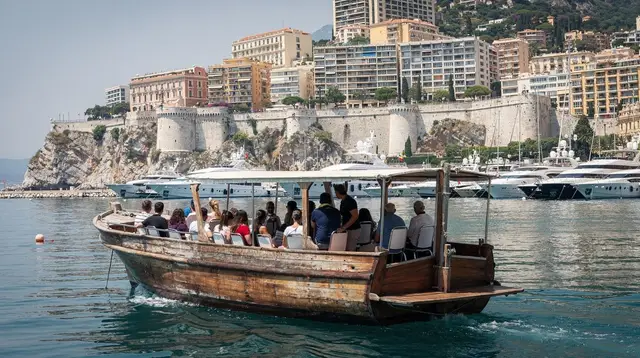
Monaco’s coastline and harbour are worth seeing from the sea at least once, whether that’s a short cruise past the Rock at sunset or a longer run along the coast toward the Riviera’s other harbours. a private sunset boat tour along the Monaco coastline gives a very different view of the Palace and the Casino district than you get on foot, especially as the harbour lights come on. Our Monaco boat tours guide lists the range of options, from short harbour loops to longer charters.
What a day actually costs
Monaco has a reputation for being expensive, and parts of it are — but a day trip doesn’t have to be. The train from Nice is a normal regional fare, walking Monaco-Ville and Monte-Carlo costs nothing, and the guard change and the Casino’s exterior are both free to see. Where the budget moves is museum entry, a sit-down meal near the port or the Casino square (expect Riviera-high prices, not exceptional-even-for-Monaco prices), and anything involving the Casino’s gaming rooms or a boat trip.
| Item | Typical cost |
|---|---|
| Train ticket, Nice-Ville to Monaco (return) | A regular TER fare, well under €10 |
| Oceanographic Museum entry | Moderate, worth budgeting for |
| Casino entry (public rooms) | Charged; gaming rooms have a separate, higher entry |
| Coffee or a light lunch | Riviera prices, higher near the Casino square |
| Sit-down dinner near the port | Noticeably higher than equivalent options in Nice |
Honest notes before you go
Monaco is compact but hilly, and the walk between Monaco-Ville and Monte-Carlo is steeper than it looks on a map — the public lifts and escalators help, and it’s worth using them rather than the stairs in midsummer heat. The Casino’s dress code is real and enforced, particularly in the evening; smart casual is the safe baseline, and the private gaming rooms expect more. Photography inside the Casino’s gaming areas is generally restricted, so don’t plan on it.
The principality feels different in July and August, when cruise groups and Riviera day-trippers overlap with the yacht-season crowd around the port. A morning arrival still beats an afternoon one. And if your visit happens to land during the Grand Prix, treat it as a different trip altogether — most of central Monaco is reorganised around the circuit for days before the race itself, hotel minimum-stay rules kick in across the coast, and this is not the week for a casual half-day visit unless the race is the reason you’re going.
Monaco versus its neighbours
Monaco isn’t the only stop on this stretch of coast, and it’s worth being clear about what it does and doesn’t have compared to the towns around it. Menton, the last French town before Italy, is quieter, cheaper and built around lemons rather than a Casino — a reasonable pairing if you want to see both in one day, and our Menton versus Villefranche-sur-Mer comparison covers a similar question one stop closer to Nice. Villefranche and Saint-Jean-Cap-Ferrat are smaller and calmer again, built around a bay and a couple of grand villas rather than a Casino district — a better fit if the goal is a quiet coastal walk instead of Monte-Carlo’s polish.
Some visitors extend the day further east into the Italian Riviera — Ventimiglia’s Friday market and Sanremo are both within reach beyond Menton — though that turns a half-day into a full one. If two full days are on the table rather than one, our Monaco, Menton and the Italian Riviera in two days itinerary lays out a workable order for covering all three without doubling back.
Money, tipping and dress code in practice
Monaco uses the euro and prices generally run a notch above equivalent spots in Nice, though not as far above as the country’s reputation suggests once you’re away from the Casino square and the port-front restaurants. Service is included on restaurant bills as it is across France, so tipping is a rounding-up gesture rather than an expectation; the same tipping and restaurant etiquette guide we use for the rest of the Riviera applies here without adjustment. If keeping the day cheap matters more than the Casino experience, our Monaco without breaking the bank piece goes further into which parts of a visit are free and which aren’t, and the Casino dress code and visit guide spells out exactly what “smart casual” means in practice if you’re unsure whether an outfit will pass at the door.
Monaco and Monte-Carlo: frequently asked questions
Is Monaco part of the European Union?
No. Monaco is a sovereign, independent state, not an EU member. It uses the euro through a monetary agreement with the EU and has no border control with France, but it’s a separate country from a legal and political standpoint.
Is Monte-Carlo the capital of Monaco?
No. Monte-Carlo is a district of Monaco, built around the Casino, the Opéra and the Hôtel de Paris. The capital is Monaco-Ville, on the Rock, where the Prince’s Palace, the Cathedral and the Oceanographic Museum are located.
Does Monaco have its own airport?
No. There is no airport in Monaco. Visitors arrive via Nice Côte d’Azur Airport, then continue by train (about 20-25 minutes from Nice-Ville), bus, car, or helicopter to the Fontvieille heliport (about 7 minutes’ flight).
Do you need a passport to visit Monaco from Nice?
There’s no border checkpoint on the train or road from France, so in practice most visitors pass through without any check. Carrying a passport or ID is still sensible, particularly since ID is required to enter the Casino.
What time is the changing of the guard at the Prince’s Palace?
The ceremony takes place daily in front of the Prince’s Palace at around 11:55am. It’s brief and low-key rather than a major show, but easy to fit into a Monaco-Ville visit.
Can you visit the Casino without gambling?
Yes. The public rooms and the atrium can be visited on a ticketed basis without playing. Entry requires being at least 18 with ID, and the dress code becomes stricter for the gaming rooms in the evening.
How long does it take to get from Nice to Monaco?
About 20-25 minutes by train from Nice-Ville, roughly 45 minutes by regional bus, and 30-45 minutes by car depending on traffic, which along this stretch of coast can be heavy in summer.
Does the Monaco Grand Prix affect visiting?
Significantly. The race runs in late May or early June, and hotel prices across the whole Riviera rise well before race weekend, with much of central Monaco closed off for circuit setup. Visiting outside that period is far more relaxed and considerably cheaper.