Monaco without breaking the bank
Why Monaco has a reputation it doesn’t fully deserve
Every time I mention going to Monaco, someone assumes I’ve booked a table at a rooftop bar and rented a blazer for the Casino. Monaco does have that side — super-yachts in Port Hercule, a Grand Prix that turns the whole principality into a racetrack, hotel rates that make Nice look cheap by comparison. But the reputation gets applied to the whole place, including the parts that don’t cost a euro. I’ve done Monaco on a tight day-trip budget more than once, and the free half of the day is genuinely good, not a consolation prize while you wait to spend money.
One thing worth clearing up before anything else: Monaco is a sovereign state, not part of France and not a member of the European Union. But you pay in euros there exactly as you do in Nice, and there’s no border check when you cross from France — you just notice the street signs change. No separate visa, no currency exchange, no customs stop. Functionally, for a day visitor, it feels like walking into a different neighbourhood of the same coastline. That’s worth knowing so you don’t overthink the logistics; the money question is about what things cost, not about crossing a border.
What’s actually free
Start in Monaco-Ville, the old town on the Rock — this is the capital, by the way, not Monte-Carlo, which is a separate district built around the Casino. Walking up from the port or from the bus stop costs nothing, and the streets around the Palais princier are open to wander. The changing of the guard happens outside the Palace at around 11:55am daily and is free to watch; get there 10–15 minutes early if you want a clear view, since it draws a crowd even outside peak summer.
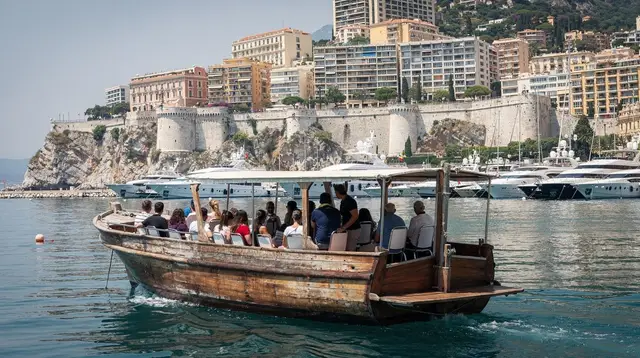
From the esplanade in front of the Palace, and from several points along the Rock, you get views over Port Hercule and the harbour that are worth the walk on their own — rows of yachts, the marina curving toward Monte-Carlo, the hills behind. None of that costs anything. I’ve spent a full hour just walking the perimeter of the Rock, down past the cathedral, without paying for a single thing.
The Casino de Monte-Carlo is the other half of that free-viewing loop. You can’t go inside without paying an entry fee (and being 18 or older, with ID), but the building itself — the belle époque façade, the gardens in front, the row of vintage and luxury cars often parked outside — is free to look at and photograph. Walk through the gardens, look at the fountain, watch people arrive for the evening. That’s the postcard version of Monaco, and it costs nothing to see it.
What you pay for is going inside: the Musée océanographique, the Jardin exotique, and the Casino itself all charge entry. They’re worth it if that’s what you came for — the Oceanographic Museum in particular is well done — but none of them is required to say you’ve “seen” Monaco. I usually pick one paid attraction per visit rather than trying to do all three, partly for budget and partly because Monaco is small enough that you don’t need a packed itinerary to feel like you covered it.
Where the real cost is
Where Monaco genuinely gets expensive is food and beds. A coffee on a terrace near the Casino costs noticeably more than the same coffee in Vieux-Nice, and a sit-down meal with a sea view can run high. My workaround is simple: eat in Nice, or eat cheaply in Monaco away from the harbour-front terraces — there are ordinary bakeries and sandwich spots a few streets back from the tourist strip. Staying overnight in Monaco is the biggest expense by far; hotel rates there are consistently among the highest on the coast. Basing yourself in Nice and doing Monaco as a day trip avoids that entirely, which is what most budget-conscious visitors end up doing anyway — it’s a short hop by train.
There’s no way around this part being real: Monaco’s wealth is visible and priced accordingly wherever there’s a roof over your head, whether that’s a hotel room or a restaurant table. What I’m pushing back on is the idea that the whole principality works that way. The street-level experience — walking, looking, watching the guard — doesn’t.
The one week where all of this gets more expensive, even for a day visitor, is the Monaco Grand Prix in late spring: hotel rates spike across the whole coast, not just in Monaco itself, and even a walking day gets harder because whole streets are fenced off for the circuit. If you’re planning around that week specifically, it’s worth reading the Monaco Grand Prix travel guide before you book anything, since the budget logic in this piece assumes an ordinary week rather than race week.
How I’d spend a low-budget day
Take the train from Nice-Ville to Monaco (around 20–25 minutes), walk up to Monaco-Ville for the 11:55am guard ceremony, wander the Rock and the cathedral quarter, then walk down to Port Hercule and along to the Casino gardens for the free view. Have lunch away from the harbour-front, then either walk back through Monte-Carlo or take the bus back to the station. That’s a full day with zero attraction tickets and a train fare as the main cost. If I want one paid stop, I add the Oceanographic Museum in the early afternoon, since it’s a short walk from the Rock.
For a version with a driver and a bit more ground covered — Monaco plus the villages above it — I’ve used a private car tour of the Riviera’s viewpoints, which takes in Monaco along the way, and on longer trips a full-day private tour covering five Riviera towns including Monaco. Neither is a budget option in itself, but they’re worth mentioning as the alternative to the free walking day if time matters more than money — useful for a short stay where you want Monaco plus Eze plus one more stop without managing trains yourself.
If you’d rather see Monaco from the water at some point, that’s a separate spend entirely — see the Monaco boat tours guide for that side of things; it’s not part of a no-cost day. A sunrise boat trip along this stretch of coast is a different kind of budget again — not cheap, but it’s the one way to see the Rock and the harbour from angles the free walking route never reaches, and it’s worth knowing it exists even if it’s not for a tight-budget day.
If walking on your own isn’t your thing, a guided version of the free route exists too — see the Monaco walking tours guide — and for food that isn’t harbour-front prices, the Monaco food tours guide covers tastings that are cheaper per bite than a sit-down harbourside meal, even if the tour itself has a fee. Neither is required for a low-budget day; they’re just the paid middle ground between the free loop and a full splurge.
Monaco isn’t the only free-to-walk town on this coast
If the appeal here is a full day of looking without paying, Monaco isn’t unique on this stretch of coast. Eze, perched above the corniche between Nice and Monaco, costs nothing to walk beyond the Jardin exotique entry fee — see the Eze day trip guide and, if you’re trying to decide between the two villages, Eze versus Saint-Paul-de-Vence. Menton, the last town before Italy, has a free old town and seafront walk of its own, covered in the Menton day trip guide. Villefranche-sur-Mer and Saint-Jean-Cap-Ferrat work the same way — free to wander, with the Villefranche and Cap-Ferrat day trip guide covering that walk. If you want to combine several of these low-cost stops into one trip rather than picking just Monaco, the Monaco, Menton and the Italian Riviera in two days itinerary strings them together.
Getting there without spending more than you need to
The train is the cheapest and simplest option from Nice — see the French Riviera train guide and the Nice tram guide if you’re coming straight from the airport. I’ve compared the train versus bus options before, and for a day trip the train wins on time even if the bus is marginally cheaper. For the fuller comparison of getting from Nice to Monaco specifically, see Nice to Monaco transport options. If you’re arriving from the airport rather than central Nice, the Nice airport to city centre guide covers that first leg, and if you’re flying in specifically, the Nice airport transfers guide compares the options.
I wouldn’t rent a car for this specific day trip — parking in Monaco is expensive and the town centre is easiest on foot, so a car only makes sense if you’re combining Monaco with villages the train doesn’t reach; see driving and parking in Nice and renting a car on the French Riviera if that’s the plan instead.
Basing yourself in Nice rather than Monaco is really what makes this whole budget approach work — see where to stay in Nice by neighbourhood for picking a base, and Nice trip cost for how a Monaco day trip fits into a wider Riviera budget.
Monaco on a budget: questions I get asked
Is Monaco expensive to visit as a day trip?
The day itself can be nearly free if you stick to walking, the guard ceremony, and the harbour and Casino gardens. What’s expensive is any hotel stay there, and food if you eat right on the harbour-front. As a day trip from Nice, the main cost is usually just the train fare.
Do I need euros or a different currency for Monaco?
No. Monaco uses the euro, the same as Nice and the rest of France, even though it isn’t part of the European Union. Cards are widely accepted.
Is there a border check between France and Monaco?
No. There’s no border control crossing from France into Monaco; you simply cross a street and the signage changes. No passport stamp, no separate entry process.
What’s free to see in Monaco?
Monaco-Ville and the Rock, the changing of the guard outside the Palace (around 11:55am), the walk around Port Hercule, and the exterior and gardens of the Casino de Monte-Carlo are all free.
What costs money in Monaco?
Entry to the Musée océanographique, the Jardin exotique and the Casino de Monte-Carlo, plus food and any overnight stay — hotel rates in Monaco are among the highest on the coast.
Is Monte-Carlo the same place as Monaco?
No. Monaco is the sovereign state and its capital, centred on the Rock (Monaco-Ville). Monte-Carlo is a district within Monaco, built around the Casino — it’s not the capital.
Can I do Monaco as a day trip from Nice without a car?
Yes, easily. The train from Nice-Ville takes around 20–25 minutes and drops you close to the harbour and the walk up to Monaco-Ville.
Is one day enough for Monaco?
For the free walking route plus one paid attraction, yes. Monaco is small; most of what’s worth seeing on foot fits into a day, especially if you’re staying nearby in Nice rather than trying to see it as a rushed stop on a longer multi-town day.
tours.Practical
Verified deep-linked GetYourGuide tours. Book through these links and we earn a small commission at no cost to you.
GetYourGuide does not provide a product photo for this activity — the image shows the meeting point, photographed by us.