Monaco Grand Prix: travel guide from Nice
When is the Monaco Grand Prix and how do you get there from Nice?
The Monaco Grand Prix runs late May or early June, never in July or August. Monaco has no airport, so visitors arrive via Nice Côte d'Azur (NCE) by train, bus, car or helicopter to the Fontvieille heliport, and race weekend fills trains, closes streets and pushes hotel prices well above summer rates.
Get the timing right first
The Monaco Grand Prix runs late in May or in the first days of June — never in July or August, when the Riviera is at its hottest and most crowded for entirely different reasons. The exact dates shift a little each year with the Formula 1 calendar, so check the current schedule before booking anything, but the window is fixed: a long weekend built around a Thursday practice day, Saturday qualifying and the Sunday race through the streets of Monaco.
It’s worth being blunt about a confusion visitors make constantly: the Monaco Grand Prix and the Cannes Film Festival are two separate events, in two separate towns, usually a couple of weeks apart in May. Cannes closes off the Croisette for red-carpet premieres; Monaco closes off its port and Casino Square for a motor race. Neither one moves to summer, and neither one happens in the other town. If a hotel deal or a date range doesn’t line up with what’s described above, assume it’s wrong rather than assuming the race moved.
This page is written for people planning to be in the area during the race — whether to watch it, or simply to be based in Nice while it happens nearby. It doesn’t re-describe Monaco-Ville, the Palais princier or the Musée océanographique in detail; those belong to the everyday Monaco destination guide. What follows is specific to race weekend: getting there, what it costs, what closes, and what a spectator can realistically expect to see.
Monaco has no airport — plan the approach through Nice
This is worth repeating because it trips up first-time visitors every year: Monaco has no airport of its own. Every visitor, race weekend or not, arrives through Aéroport Nice Côte d’Azur (NCE), about 20 km from Monaco along the coast, and then continues by one of four routes.
| Route | Typical time | Notes for Grand Prix weekend |
|---|---|---|
| Train (Nice-Ville to Monaco-Monte-Carlo) | 20-25 min | Fastest option; trains run more frequently but get very full, especially Thursday through Sunday afternoons |
| Bus (Lignes d’Azur network) | 45-60 min | Cheaper, but subject to the same road congestion as private cars |
| Car | 30-45 min normally | Expect much longer on race days; parking in Monaco is scarce and expensive even without an event |
| Helicopter to Fontvieille heliport | About 7 min | Priciest and least affected by ground congestion; book well ahead as demand spikes for the race |
None of these routes are unique to race weekend — see the full Nice to Monaco transport comparison and the train vs bus breakdown for the everyday version. What changes during the Grand Prix is volume: trains run closer to capacity, roads back up for kilometres either side of Monaco, and helicopter transfers — normally a novelty — become a genuinely practical way to skip the congestion. A shared panoramic helicopter tour from Nice lands close to the action at Fontvieille in a matter of minutes, which matters more than usual when the alternative is sitting in traffic on the Basse Corniche.
If flying is not in the budget, the train from Nice-Ville along the coast, described in the French Riviera by train guide, remains the single most reliable way in. Arrive earlier than you think necessary on race days — an hour of buffer before a scheduled session start is not excessive.
Visitors basing themselves in Nice rather than Monaco for race weekend have one more practical detail to plan around: getting from the airport into the city itself. The tram (lines 2 and 3) runs directly from Nice Côte d’Azur into central Nice, connecting through to Nice-Ville station for the onward train described above — useful for anyone flying in and out around the race rather than driving the whole way. See the airport transfers guide for the full range of options.
What actually closes, and when
The circuit threads through central Monaco: along the port, up past Casino Square, through the tunnel beneath the Fairmont hotel, and back down toward the harbour. Barriers, grandstands and catch fencing go up gradually in the two to three weeks before the event, closing sections of road to traffic well before the cars ever run. By race week, much of that loop is closed to normal vehicle and even pedestrian movement except through designated crossing points, and those points can involve real queues at peak times.
Practically, this means:
- Car access into central Monaco is restricted or impossible on event days; arriving by train, bus or on foot from outside the perimeter is the norm.
- Pedestrian movement within Monaco still works, but not freely — expect to route around barriers and show a ticket or accreditation at certain crossings near the grandstands.
- Businesses along the circuit route (shops, some restaurants) either close for the days affected or operate with restricted access.
- The disruption isn’t limited to race day itself — Thursday practice and Saturday qualifying bring their own partial closures, quieter than Sunday but still real.
None of this is a reason to avoid the area; it’s a reason to plan around it rather than expect Monaco to function as it does on an ordinary Tuesday.
Crossing into Monaco: what to know
Monaco is a sovereign principality, not part of France and not a member of the European Union — worth remembering for anyone used to French Riviera towns blending seamlessly into one another. There’s no passport control or border checkpoint between France and Monaco, and the principality uses the euro like the rest of the coast, so day-to-day spending and moving between Nice or the eastern Riviera and Monaco normally feels seamless.
During the Grand Prix, though, the security checks around the circuit perimeter function as an informal border of their own: bags get checked and accreditation gets verified at certain crossing points, and the usual free movement between Monaco and neighbouring towns along the corniches slows down near the barriers. Monaco’s capital is Monaco itself — Monte-Carlo is one of its districts, home to the Casino and much of the circuit, not the seat of government — a distinction worth knowing when reading event maps or looking up an address.
Getting around Monaco during race weekend
Monaco itself is small enough to cross on foot in well under an hour outside race weekend, and most visitors do exactly that once they arrive by train or car. During the Grand Prix, walking remains the most reliable way to move around inside the perimeter, since local buses share the same restricted roads as everything else and can get diverted or suspended near the circuit. For visitors who’d rather see the principality from above before or after a race session, a shared panoramic helicopter tour departing from Nice offers a quick alternate view of the coastline and the circuit’s outline from the air, landing back well away from the street-level congestion.
Watching the race: tickets, viewpoints, and honest expectations
Close-up viewing — grandstand seats along the harbour or the start-finish straight, terrace access at the Fairmont hairpin, hospitality packages — requires a paid ticket, and the good seats sell out or climb in price well before the weekend arrives. This is not a race where a grandstand seat can reliably be picked up at the gate.
Free viewing exists, but it comes with real limits: certain public streets and the hillsides above the circuit, particularly around Monaco’s upper districts, offer partial glimpses of the track for anyone willing to arrive early and stand for hours. Views from these spots are genuinely partial — a stretch of track, not the full circuit — and the good free spots fill up long before the first cars run. Nobody should plan a trip around free viewing and expect a comprehensive view of the race; it’s a way to feel the atmosphere and catch some of the action, not a substitute for a ticket.
Thursday practice — the Monaco weekend traditionally runs practice on Thursday rather than Friday, then rests Friday before qualifying Saturday and the race Sunday — is the easiest and cheapest day to experience in person: shorter queues, more available standing room, and a genuine look at the cars on track without the Sunday crowds or prices. For visitors who want to see Formula 1 cars on the Monaco streets without committing to a full grandstand package, Thursday is the realistic entry point.
Beyond the track itself, the wider event is as much about atmosphere as racing: the harbour fills with yachts, terraces along the route host viewing parties, and the town runs at a different tempo for four or five days. A walking tour of Monaco booked for a non-race day, or a boat tour along the coast that passes the harbour from the water, both give a sense of the spectacle without needing a grandstand ticket. Seeing the circuit and the moored superyachts from the sea — on something like a private boat tour with a chef aboard — is one of the more relaxed ways to take in the event’s scale from a distance, away from the street-level crowds.
What the event does to prices
Be prepared for this rather than surprised by it. Hotel rates in Monaco itself, and increasingly along the eastern Riviera into Nice, Menton and even hillside villages like Èze, commonly run several times their normal rate during race weekend, and many properties impose multi-night minimum stays regardless of how long a visitor actually wants to be there. Short-term rentals follow the same pattern. Restaurant prices along the circuit route and in Monaco’s central districts tend to rise too, particularly for anywhere with a view of the track.
Transport costs climb as well — helicopter transfers and private drivers see the heaviest demand and price increases of the year, and even ordinary taxis from Nice can charge a premium during peak arrival and departure windows. Booking accommodation and any planned transfers months ahead, rather than weeks, is the only real defence against these spikes.
For visitors on a tighter budget who still want to experience the atmosphere, staying in Nice rather than Monaco and commuting in for a single day — Thursday practice rather than the Sunday race — keeps both accommodation and ticket costs down substantially while still delivering a real taste of the event.
Where to stay: Nice, Menton, Èze or Monaco itself
For most visitors, the real choice isn’t whether to stay in Monaco — rooms there sell out fastest and cost the most — but which nearby base makes the most sense. Nice offers the widest range of accommodation, the easiest airport connections, and a full city to explore on non-race days, at the cost of a 20-25 minute train ride each way to Monaco. Menton, right at the Italian border, sits further from Monaco than Nice does but often holds slightly more availability during the event, and it makes its own worthwhile detour for the town behind the lemon festival outside race season. Èze, perched above the coast between Nice and Monaco, is closer in distance but has far fewer rooms overall, so it fills early and rarely offers a budget option during Grand Prix weekend.
Whichever base is chosen, an official guided tour taking in Monaco and the corniche villages on a non-race day is a straightforward way to see the wider area without a car or the hassle of race-week road closures, and it works equally well from a Nice, Menton or Èze base.
Making a trip of it beyond the circuit
Race weekend doesn’t have to be entirely consumed by the Grand Prix, particularly for visitors travelling with people who have no interest in motor racing. Basing in Nice and dipping into Monaco for a single session — rather than trying to be in Monaco for the full four or five days — keeps the trip flexible and avoids paying peak Monaco rates for every night.
An official guided tour departing from Nice that takes in Monaco alongside Èze and the corniche villages works well on a non-race day, when the roads and the town itself are back to their normal rhythm. On the days closer to the event, a Segway tour of Nice or a morning on the water with a solar boat cruise offers an easy way to fill time away from the crowds and closures, then head into Monaco later for the atmosphere once the day’s session has wrapped — an evening panoramic tour taking in Monaco and Èze is one way to see both lit up after dark without driving yourself through race-week traffic.
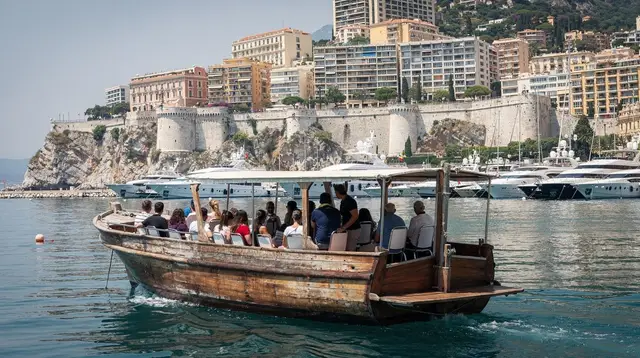
For anyone arriving specifically for the spectacle rather than the race itself, seeing Monaco’s harbour and the circuit from offshore — superyachts moored stern-to-stern, grandstands visible along the water’s edge — captures the scale of the event without needing to fight for street space. A private boat excursion between Monaco and Cap-Ferrat is one way to get that vantage point on your own schedule. It’s also one of the only ways to get a genuinely unobstructed view of the port area during the days when pedestrian access on land is most restricted.
Honest notes before you book
A few things worth saying plainly, since brochures rarely do:
- This is not the weekend for a relaxed first visit to Monaco’s sights. The Palais princier, Monaco-Ville and the Musée océanographique sit at the edges of or near the security perimeter and are harder to reach normally during the event. Save that visit for another trip.
- Free viewpoints deliver atmosphere, not a full view of the race. Anyone expecting to see the whole circuit from a free hillside spot will be disappointed; expect a partial view of one section, shared with a large crowd.
- The disruption starts well before race day. Barrier construction and partial closures begin roughly two to three weeks ahead, so a visit even shortly before the event proper can already feel affected.
- Nearby towns absorb the overload, not just Monaco. Menton, Èze and even Nice see room rates and demand rise as Monaco itself sells out, so “avoiding Monaco” doesn’t fully avoid the price effect.
- Book transport and rooms as early as realistically possible. This is the single highest-demand weekend of the year on this stretch of coast, ahead even of peak summer.
None of this is a reason to skip the event — for motorsport fans, watching Formula 1 cars thread through a genuine city street circuit, hairpins and all, is unlike any other race on the calendar. It’s a reason to plan the logistics with the same care as the tickets themselves.
Seasonal advice for visiting Nice and the Riviera
Verified deep-linked GetYourGuide tours. Book through these links and we earn a small commission at no cost to you.
GetYourGuide does not provide a product photo for this activity — the image shows the meeting point, photographed by us.