Monaco by train or bus from Nice: which to choose
Should I take the train or the bus from Nice to Monaco?
The TER train from Nice-Ville is the simplest option: it runs along the coast and drops you inside Monaco with no transfers. The bus, on the Lignes d'Azur network within the metropolitan area or the regional Zou! network beyond it, works too but takes longer in traffic along the corniche. No passport or currency change is needed either way — Monaco uses the euro and has no border control with France.
Two ways to reach Monaco, one clear winner for most visitors
This page is only about getting from Nice to Monaco, not about what to do once you arrive — for that, see the Monaco day trip guide. The choice comes down to two everyday options: the TER train from Nice-Ville station, or a bus on the Lignes d’Azur network within the Nice metropolitan area and the Zou! regional network beyond it. A third option, driving, is worth naming here mainly to explain why it is the weakest of the three for this particular trip.
Before comparing them, two confusions are worth clearing up, because they change how people plan the day.
Monaco is not in the European Union. It is a sovereign principality of about 2 km², in a customs union with France, using the euro and with no border checks on the road, train or bus from Nice. There is nothing to declare, no currency to change and no passport to show for a same-day visit from Nice — the crossing feels like moving between two French towns, even though Monaco is its own state.
Monaco has no airport. Visitors flying in land at Nice Côte d’Azur (NCE) and continue overland or by helicopter. That matters for this comparison because the train and bus both start in Nice — usually from Nice-Ville station or a stop in the city centre — not from any terminal in Monaco.
The train: the simplest option
The coastal TER line running from Nice-Ville hugs the shoreline past Villefranche-sur-Mer, Beaulieu-sur-Mer and Eze-sur-Mer before pulling into Monaco’s station, which sits underground in the principality. From there it continues to Roquebrune-Cap-Martin and Menton, and on towards the Italian border at Ventimiglia. For a visitor based in Nice, this is normally the easiest way to reach Monaco without a car.
A few practical points, without inventing timetable numbers that change from one season to the next:
- Trains run frequently through the day, closer together at peak commuting hours and further apart at midday and in the evening. Checking the current SNCF timetable before travelling is more reliable than any fixed schedule printed here.
- The ride is short — well under half an hour in normal conditions — and the views along the coast, particularly past Villefranche-sur-Mer, are part of the appeal rather than a downside.
- Monaco’s station is centrally placed for reaching Monaco-Ville, the Casino district around Monte-Carlo, and the port, all within a manageable walk or a short local bus ride once you arrive.
- Trains can be busy in summer and around events such as the Grand Prix, when standing room only is common on some services. Travelling earlier or later in the day avoids the worst of it.
The train’s main strength is that it removes almost every variable: no traffic, no parking search, one line, one direction, minimal walking to the platform from most points in central Nice. For anyone new to the region, or simply not wanting to think about logistics, it is the default recommendation. For more detail on how the line fits into the wider coastal network, see the French Riviera by train guide.
Buying a ticket is straightforward: SNCF sells TER tickets at station machines, counters where staffed, and through its app, and the same ticket works for the whole coastal line whether the trip ends in Monaco, Menton or further along towards the Italian border. As with any French regional train, a paper ticket needs to be validated before boarding at the platform machines; an app ticket generally does not. None of this changes from season to season the way timetables do, so it is one less thing to double-check on the day.
Combining Monaco with a stop along the coast
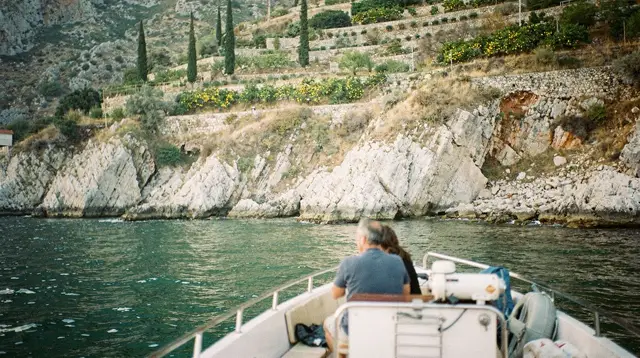
Because the train calls at several towns on the way, a Monaco trip does not have to be a straight there-and-back. Getting off partway is easy to build into the same outing: Villefranche-sur-Mer and Saint-Jean-Cap-Ferrat sit on the same line just minutes from Nice, Beaulieu-sur-Mer follows shortly after, and Eze-sur-Mer is the stop for the steep climb up to the perched village of Eze itself — a different, uphill walk from the coastal station rather than a stroll. Travellers who want the boat’s-eye view of this stretch of coast rather than the train window can also book time on the water before or after the Monaco leg:
a private boat tour with a chef-prepared aperitivo along the coastBreaking the journey this way works best with the train rather than the bus, because trains run frequently enough through the day that picking up a later service after an unplanned stop rarely means a long wait, whereas missing a specific bus can mean a longer gap depending on the route and time of day. Anyone planning a full day around several of these stops, rather than a single detour, will find more structure in the two-day Monaco, Menton and Italian Riviera itinerary or the general guide to day trips from Nice.
The bus: workable, slower in practice
Buses reach Monaco from Nice on two connected networks. Within the Nice metropolitan area, services run under the Lignes d’Azur brand; beyond that zone, the regional Zou! network takes over and continues along the coast towards Monaco and Menton. Route numbers are deliberately not listed here, because they are reassigned from time to time — checking the current Lignes d’Azur or Zou! website or app before travelling avoids relying on an outdated number.
The bus has real advantages in specific situations:
- It can be cheaper than the train, particularly with a regional pass that covers multiple days or multiple towns.
- It stops in more places along the corniche, which suits anyone wanting to get off partway, for instance to visit Eze village on the way.
- It runs even when the train is disrupted, which happens occasionally on the coastal line.
The drawback is journey time. The corniche roads that the bus follows carry both local traffic and the coastal road’s summer congestion, and a trip that takes under half an hour by train can stretch out considerably by bus once traffic builds up — especially on a hot afternoon in July or August, or around the Grand Prix in late May or early June when road closures reshape the whole area. For a single there-and-back trip to Monaco with no other stops planned, the bus rarely beats the train on speed; it earns its place mainly for cost, flexibility to break the journey, or as a backup when trains are affected.
Driving: possible, but not the easy option here
A car is genuinely useful for reaching the perched villages, the Mercantour hinterland or the Verdon gorge, none of which are well served by rail. Monaco itself is a different story. Streets in the principality are narrow, one-way systems are common around the Rocher and the Casino district, and on-street parking is scarce; almost every visitor ends up in one of the paid underground car parks, adding cost and a walk back up to street level. Traffic converges on Monaco from several directions along the three corniches, and during the Grand Prix weekend or other major events, entire sections of road close outright.
For a same-day trip focused on Monaco alone, driving adds cost, parking stress and no real time saving compared with the train — see the fuller comparison in driving and parking in Nice and renting a car on the French Riviera. Where a car earns its keep is a wider loop that takes in Monaco alongside Eze and La Turbie on the same day, letting you stop at viewpoints the train and bus simply pass by.
Side-by-side comparison
| Train (TER) | Bus (Lignes d’Azur / Zou!) | Car | |
|---|---|---|---|
| Typical journey time from Nice-Ville | Under 30 minutes, direct | Often 45 minutes to over an hour with traffic | Similar to bus, plus parking search |
| Frequency | Frequent through the day, denser at peak hours | Regular, varies by route | Anytime, but subject to closures on event days |
| Scenery | Coastal views past Villefranche-sur-Mer and Beaulieu-sur-Mer | Corniche views, more stops en route | Best for stopping at viewpoints along the way |
| Best for | A simple, direct return trip | Budget trips, or a stop at Eze en route | A loop combining Monaco with Eze and La Turbie |
| Main drawback | Crowded on peak summer days | Slower once traffic builds | Scarce, paid parking; one-way streets |
Getting around once you’re there
None of this changes what to do once you step off — that belongs to the Monaco day trip guide and the Monaco walking tours guide. Monaco’s train station and the main bus stops are both close enough to Monaco-Ville, the port and the Casino district to cover much of it on foot, with local buses filling the gaps for the steeper connections between the Rocher and Monte-Carlo.
For a different angle on arrival altogether, a scenic flight from Nice is one of the few ways to see the coastline between the two before landing near Monaco:
a shared helicopter flight over the coast from NiceTravellers who prefer to explore central Nice on wheels before heading onward sometimes start with a slower loop of the city itself:
a guided electric mini-train loop around central NiceAnd for anyone building a full day around the corniches rather than a direct hop to Monaco, self-driving a vintage car along the coast road is a different kind of trip entirely, best suited to those who want the driving itself to be the point rather than a means to an end:
a full-day self-drive rental in a vintage Méhari along the coastWhich to book depends on the day, not the destination
There is no single right answer, because the two main options serve different priorities. The train suits anyone who wants the shortest, most predictable trip and is going to Monaco and back with no detours — which describes most first-time visitors. The bus suits a tighter budget, a planned stop in Eze or along the corniche, or simply a backup when trains are running late. A car earns its place only as part of a longer loop that treats Monaco as one stop among several, not as the whole day’s plan.
Whichever mode you pick, the underlying facts are the same regardless of the day of the week or the season: Monaco takes euros, requires no border formality coming from Nice, and has no airport of its own — every route into it starts in Nice or continues from there. For the wider context on reaching the region in the first place, see Nice airport to city centre and, for the broader network beyond this one route, getting around the French Riviera. Travellers combining Monaco with Menton and a stretch of the Italian coast on the same trip may also find the two-day Monaco, Menton and Italian Riviera itinerary useful for pacing the rest of the visit, and those weighing the Grand Prix weekend specifically should read the Monaco Grand Prix travel guide before booking anything, since road closures and crowding change all three options substantially on those dates.
Getting to Monaco from Nice: common questions
Is Monaco in the EU, and do I need to change money or show a passport?
No. Monaco is a sovereign principality and is not a member of the European Union, but it uses the euro and has no border control with France. Coming from Nice, there is no currency exchange, customs check or passport control to plan for — the train and bus simply cross into Monaco as if it were the next town along the coast.
Does Monaco have its own airport?
No. Monaco has no airport. Anyone flying in arrives at Nice Côte d’Azur (NCE) and continues to Monaco by train, bus, car or helicopter to the Fontvieille heliport. The train and bus described here both start from Nice, not from an airport terminal in Monaco itself.
Is the train or the bus faster from Nice to Monaco?
The train is almost always faster and more predictable, because it runs on its own tracks along the coast and skips the traffic that builds up on the corniche roads in summer and around rush hour. The bus can be quicker outside peak periods, but it is far more exposed to delays than the train.
Can I use the same ticket for the train and the Lignes d’Azur or Zou! buses?
No. The TER train is run separately from the bus networks, and tickets are not interchangeable. Lignes d’Azur covers the Nice metropolitan area, while Zou! is the regional network that reaches Monaco and other towns further along the coast; each has its own ticketing.
Is it worth driving to Monaco instead?
Rarely, for a single visit. Monaco’s streets are narrow, one-way systems are common, and parking is scarce and expensive, with much of it in paid underground car parks. Unless a car is already needed for other stops that day, such as the perched villages, the train or bus is simpler.
Which stops does the train from Nice-Ville make on the way to Monaco?
The coastal TER line calls at several towns between Nice and Monaco, including Villefranche-sur-Mer, Beaulieu-sur-Mer and Eze-sur-Mer, before reaching Monaco. It is the same line that continues on to Menton and across the border towards Ventimiglia.
Comparisons to help you choose your Riviera excursion
Verified deep-linked GetYourGuide tours. Book through these links and we earn a small commission at no cost to you.
GetYourGuide does not provide a product photo for this activity — the image shows the meeting point, photographed by us.