Vieux-Nice walking tours: what a guided walk actually covers
Is a guided walking tour of Vieux-Nice worth it?
A guided walk earns its price if you want the baroque churches, the Genoese-era street layout and the Castle Hill viewpoint explained, not just seen. If you only want an orientation stroll and a market visit, a free map and two to three hours on foot cover the same ground for nothing.
What this walk is actually about
Vieux-Nice is small enough to see on a map and still miss almost everything that matters. The ochre facades, the baroque churches tucked behind narrow doorways, the layout that dates from the centuries when this was a working port town under the House of Savoy rather than France — none of it announces itself. This page is about walking Vieux-Nice for its history and its atmosphere: the streets, the churches, the market square in the morning light, and the climb up to Castle Hill at the end. It is not a food tour, and it is not a bike tour. If you want socca stops mapped out block by block, that belongs on a food and wine tour of Nice instead — here, the pan bagnat and socca stalls you pass are a glimpse of the city’s food culture, not the point of the walk.
The streets and the layout
Vieux-Nice sits between the Colline du Château and Place Masséna, a dense grid of narrow lanes that predates the wide boulevards of the newer city by centuries. The palette is consistent for a reason: ochre, ember and pale yellow facades, tall shuttered windows, laundry lines strung across alleys too narrow for cars. Walking it slowly, without a fixed route, is part of the experience — but a few streets carry more weight than the rest. Rue Droite runs the length of the old town and passes the Palais Lascaris, a 17th-century baroque mansion open to visitors. Rue de la Préfecture and the streets around Place Saint-François, where the fish market sets up most mornings, show the working-port character that tourist-facing Cours Saleya has largely polished away.
The Vieux-Nice layout only makes sense with the historical context: Nice became part of France in 1860 under the Treaty of Turin, after centuries under the House of Savoy. That history explains the Italian-inflected street names, the Ligurian-style tall buildings, and why the old town feels closer in spirit to Genoa than to Provence. A guide fills this gap quickly; a plaque on a church wall usually does not.
Baroque churches, out of proportion to their doorways
Vieux-Nice has an unusual concentration of baroque churches for its size, and most of them hide grand interiors behind plain, easy-to-miss facades. The Cathédrale Sainte-Réparate, on Place Rossetti, anchors the old town both geographically and visually — its dome is one of the few landmarks visible from the streets below. The Église du Gesù on Rue Droite and the Chapelle de la Miséricorde on Cours Saleya are smaller but no less ornate inside, with gilded stucco and trompe-l’oeil ceilings that reward a few minutes of standing still. None of these charge admission for the nave, which makes them an easy, free counterpoint to a walk that otherwise runs on atmosphere rather than paid sights.
Cours Saleya in the morning
Cours Saleya is the closest thing Vieux-Nice has to a single defining square, and it changes completely between morning and evening. From Tuesday to Sunday, roughly 6am to 1.30pm, it runs as a flower and produce market — stalls of Riviera vegetables, cut flowers, olives, soap and candied fruit, with the Cours Saleya market at its most photogenic before 9am, when the light is soft and the crowds haven’t built up. On Mondays the produce stalls give way to an antiques and flea market instead, a different rhythm worth timing a visit around if browsing is the goal. By evening, the same paving stones fill with restaurant terraces, and the square becomes a dining destination rather than a market one — worth noting so a morning walk doesn’t arrive expecting an empty square with tables set for dinner.
Place Masséna and the Promenade du Paillon
Leaving the tight lanes of Vieux-Nice, the old town opens abruptly onto Place Masséna, Nice’s formal 19th-century square: red ochre buildings on Italianate arcades, a checkerboard pavement, and — a contrast worth noting for anyone expecting only baroque stone — contemporary black-and-white statues perched on poles at its edges. From here, the Promenade du Paillon runs as a green corridor toward the sea, a modern park built over what was once a river and later a car park, now with fountains, lawns and play areas. It’s a useful hinge point on a walk: baroque old town behind you, the sea and the newer city ahead, all within a five-minute stroll.
Climbing Castle Hill — without a castle
The walk’s natural endpoint is the Colline du Château, and it’s worth being upfront about the name: there is no castle. The fortress that gave the hill its title was demolished by French forces in 1706 and never rebuilt. What remains is a landscaped park laid out over the ruins, with stretches of the old fortification walls still visible, an artificial waterfall partway up, and — at the top — two of the best free viewpoints in the city, looking west over the Baie des Anges and the Promenade des Anglais, and east over Port Lympia and the working harbour. It’s a genuinely different kind of stop from the churches and markets below: green, open, and built for the view rather than the history, though the ruins themselves are a physical reminder of a city that has been fought over more than once.
Two ways up: on foot via stepped paths from the eastern edge of Vieux-Nice, around 15 to 20 minutes of steady climbing with a few flat stretches to catch your breath, or by a public lift (ascenseur) near the Tour Bellanda that takes the climb out of the equation entirely. Both are free. The paths can be exposed and hot at midday in summer — early morning or the last hour before sunset are the better windows, both for the temperature and for the light over the bay.
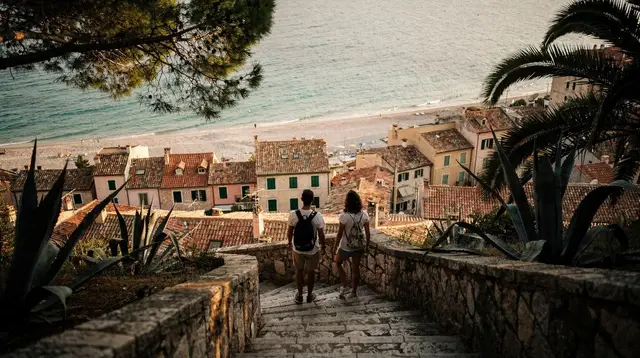
From the top, the pebble shoreline below is easy to make out — worth flagging here, since it’s a common assumption to arrive expecting sand. The beaches directly under Castle Hill and along the Promenade des Anglais are pebble for their full length; sand only appears further west, past Nice’s city limits.
Extending the walk toward Cimiez
For a longer day, Vieux-Nice connects naturally to Cimiez, the hill neighbourhood north of the centre that was Nice’s most fashionable address in the belle époque and is now home to the Musée Matisse and the ruins of a Roman amphitheatre and baths. It’s not a continuation of the same walk in practical terms — Cimiez sits roughly 30 to 40 minutes uphill on foot, or a short bus ride, from Vieux-Nice — but it’s the logical next stop for anyone who wants more of Nice’s layered history in a single day: Ligurian old town, then Roman and belle époque Cimiez, with the Matisse and Chagall museums as the throughline. Treat it as a separate half-day rather than an add-on to the Castle Hill loop, since combining both comfortably on foot in one outing is a long day rather than a relaxed one.
What a guided tour adds — and who can skip it
A self-guided walk with a map covers Vieux-Nice’s geography perfectly well in two to three hours: the streets are compact, well signposted, and hard to get seriously lost in. What a guide adds is context that doesn’t show up on a plaque — why the facades are painted the colours they are (a Sardinian-era tax rule tied ochre pigment to building status, one version of the story guides tell), what stood on the site before each church, and how the 1860 handover from Savoy to France reshaped a town that had spent centuries facing Genoa rather than Paris.
That makes a guided walk worth booking for a first visit to Nice, for anyone who wants the old town’s history explained rather than just photographed, or for a rainy morning when the churches’ interiors become the main event rather than a bonus stop. It’s less necessary for a second or third visit, or for travellers who are happy to read up beforehand and wander at their own pace with a coffee in hand.
a guided walk through Vieux-Nice’s lanes, market square and baroque churches covers the core loop in under two hours with a local guide filling in the history as you go. For travellers who want Castle Hill folded into the same outing, a combined old town and Castle Hill walking tour adds the climb and the viewpoints to the same route, useful if the stepped paths or the lift queue are less appealing to figure out alone. And for something with a different register entirely, a themed walk pairing the old town’s streets with live cabaret songs from French singers turns the same lanes into an evening of music rather than a history lesson.
Practical notes for the walk
- Best time of day: early morning, ideally before 9am, catches Cours Saleya at its most active and Castle Hill at its coolest and least crowded.
- Footwear: Vieux-Nice’s lanes are cobbled and uneven in places; the Castle Hill paths add a genuine, if short, climb. Flat, grippy shoes make both easier than sandals.
- Church visits: free to enter, but dress modestly — covered shoulders are appreciated, and a few churches ask for quiet during services.
- Market days: Tuesday to Sunday for produce and flowers on Cours Saleya; Monday for the antiques and flea market instead.
- Combining with museums: the Nice museums and attractions worth pairing with an old-town walk — the Matisse and Chagall museums, MAMAC when open — sit outside Vieux-Nice itself and need their own time slot rather than a detour mid-walk.
Where this fits in a Nice itinerary
For a first visit to Nice, Vieux-Nice and Castle Hill are usually the anchor of day one, alongside the Promenade des Anglais. Anyone weighing how many days to spend in Nice can treat this walk as a half-day on its own, or a morning if paired with an afternoon at the beach or a museum. It also slots cleanly into a one-day itinerary for Nice as the morning block, or the first half of a two-day itinerary that saves Cimiez, the Promenade du Paillon and the coast for day two. For more context on the neighbourhood itself, things to do in Nice and the broader list of walking and city tours cover options beyond this single loop, while Nice’s destination overview sets the wider frame — how Vieux-Nice relates to the Promenade, the port and the rest of the city.
Vieux-Nice walking tours: frequently asked questions
How long does a Vieux-Nice walking tour take?
Most guided walks run 1.5 to 2.5 hours and cover Cours Saleya, Place Rossetti, the baroque churches and Place Masséna. Adding Castle Hill on foot adds 45 minutes to an hour, since the climb and the ruins are worth lingering in.
Do I need a guide to see Vieux-Nice, or can I just walk it myself?
You can walk Vieux-Nice on your own with a map in half a day; the streets are compact and signposted. A guide adds value mainly through the history you cannot read on a plaque: why the facades are ochre, what the baroque churches replaced, and how the old port town became French in 1860.
Is Castle Hill actually a castle?
No. The castle that gave the hill its name was demolished in 1706 and never rebuilt. What is there today is a landscaped park, ruins of the old fortifications, an artificial waterfall, and viewpoints over the Baie des Anges and Port Lympia.
How do you get up Castle Hill?
On foot via stepped paths from the eastern end of Vieux-Nice, roughly 15 to 20 minutes of climbing, or by a public lift (ascenseur) near the Tour Bellanda that saves the legs. Both routes are free; the lift may have a short queue in summer.
Is Cours Saleya open every day?
The flower and produce market runs Tuesday to Sunday mornings, roughly 6am to 1.30pm, and closes Mondays for an antiques and flea market instead. Afternoons and evenings, the same square becomes a run of restaurant terraces.
Should I combine Vieux-Nice with Cimiez and the Matisse museum on the same walk?
Only if you are building a longer day. Cimiez and the Matisse museum sit on a hill north of the centre, reached by bus or a 30 to 40 minute uphill walk, and belong to a separate half-day rather than an extension of the old-town loop.
Are the beaches near Vieux-Nice sandy?
No. The stretch of coast below Vieux-Nice and along the Promenade des Anglais is pebble, not sand. It is easy to see from the Castle Hill viewpoints, but water shoes help if you plan to swim there.
Walking tours of Vieux-Nice and the Riviera
Verified deep-linked GetYourGuide tours. Book through these links and we earn a small commission at no cost to you.
GetYourGuide does not provide a product photo for this activity — the image shows the meeting point, photographed by us.