How many days do you need in Nice?
How many days should I spend in Nice?
A weekend (2-3 days) covers Nice itself well. A week lets you add Monaco, Èze and either Cannes or Antibes. Ten days to two weeks fits a perched village like Saint-Paul-de-Vence or Grasse and a longer excursion into the Mercantour or the Verdon gorge.
Planning by duration, not by checklist
The honest answer to “how many days in Nice” depends less on a bucket list and more on how far you’re willing to travel each day and how much crowding you’ll tolerate. Nice itself is compact enough to walk, which means the real planning question is how many day trips you bolt onto it, and how long each of those actually takes by train or by car. This page sets out what each length of stay realistically covers, from a short weekend that never leaves the city to a two-week trip that reaches the Mercantour hinterland. For neighbourhood-level detail once you’ve picked a duration, see where to stay in Nice by neighbourhood.
A weekend: 2-3 days, Nice only
Two to three days is enough to get a proper feel for Nice itself, without trying to leave the city. That means Vieux-Nice — its ochre facades, the morning market on the Cours Saleya, socca stands and narrow lanes — plus a walk or a bike ride along the Promenade des Anglais, which runs roughly 7 km along the Baie des Anges from the airport to the Quai des États-Unis. Add the Colline du Château for the view over the bay and the port (there’s no château left, just ruins, a park and an artificial waterfall, reached on foot or by lift), and Cimiez for the Musée Matisse and the Roman arena site.
Two days is workable if you accept that you’ll choose between Cimiez and a slower Vieux-Nice, rather than fitting in both at a relaxed pace. Three days gives enough slack to add a half-day trip: Èze village or Villefranche-sur-Mer are both under an hour away and fit into an afternoon without derailing the rest of the plan. For a structured version of this, one day in Nice and two days in Nice lay out hour-by-hour routes; three days in Nice and the Riviera is the version that adds that half-day excursion.
What a weekend does not realistically fit: Monaco, Cannes, or anything requiring a full day away from the city. Trying to squeeze Monaco into a two-day trip usually means rushing both Nice and Monaco.
A week: add Monaco, Èze, and one direction along the coast
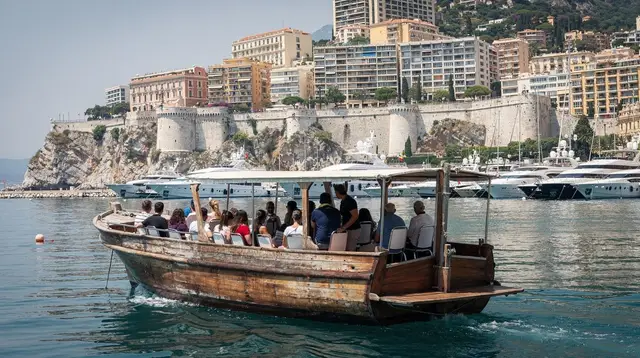
A week is the point where the French Riviera genuinely opens up, because it’s enough time to treat Nice as a base and take day trips in both directions using the coastal train (TER) and the tram, without needing a car. To the east, Monaco deserves a full day on its own — the train from Nice-Ville takes about 20-25 minutes each way, and once there, the Old Town (Monaco-Ville, on the Rocher), the harbour and the Musée océanographique easily fill a day. Èze, a 20-30 minute train or bus ride away, works well as a half-day add-on to a Monaco day or its own shorter outing, given its small scale.
To the west, pick one of Cannes or Antibes as a day trip rather than trying to fit both into a single week alongside Monaco and Èze — the train ride to either is roughly 30-40 minutes from Nice, but a full day exploring one of them (the Croisette and Le Suquet in Cannes, or the ramparts and Musée Picasso in Antibes) plus the return trip already uses most of a day. A week built this way looks like: 2-3 days in Nice, one day for Monaco (with Èze folded in if you start early), one day for Cannes or Antibes, and a spare day for whichever place you want to see again or a short boat trip. The one-week Riviera itinerary and Èze day trip from Nice or Monaco day trip from Nice guides go into the logistics.
A week is also long enough to slot in an activity day rather than another destination — a boat trip along the coast, a food-focused morning in Vieux-Nice, or a scenic flight over the bay, if that appeals more than another train ride.
a guided tasting through Nice’s street food and local specialities is a good way to fill a half-day in the city without adding travel time to the plan.
Ten days to two weeks: villages, Grasse, and the hinterland
Once you have ten days or more, the Riviera stops being purely coastal. This is the point where a night or two in a perched village makes sense rather than a rushed day trip: Saint-Paul-de-Vence, with its Fondation Maeght, or Grasse, the perfume capital, both reward slower visits than a squeezed afternoon allows — Saint-Paul-de-Vence in particular gets crowded fast in summer, and arriving early or staying nearby changes the experience. The Saint-Paul-de-Vence day trip and Grasse day trip guides cover the practical routes from Nice, which run about 45 minutes to an hour by car or bus.
Ten to fourteen days is also realistically where a longer excursion belongs, since these are full-day commitments rather than half-day add-ons. The Verdon gorge, one of Europe’s largest canyons at up to roughly 700 m deep, is about 2.5-3 hours from Nice each way — genuinely a long day out, best planned as a dedicated day rather than tacked onto anything else. The Mercantour hinterland, roughly 1.5-2 hours from Nice, works similarly: a full day for hiking or wildlife-watching, more if you want to reach the Vallée des Merveilles, which has restricted access and sometimes requires a licensed guide. Both are covered in the Verdon gorge day trip and Mercantour day trip guides.
At this length, a car becomes genuinely useful — not for Nice itself, where parking and traffic make it a liability, but for reaching villages and the hinterland at your own pace rather than working around bus and train timetables. See driving and parking in Nice and renting a car on the French Riviera before deciding.
a self-drive day in a vintage Méhari is one way to cover the corniches or a village loop at your own pace without committing to a full car rental for the whole trip. For a guided alternative that reaches Provence beyond the coast, a full-day excursion from Nice into Provence covers ground that would otherwise take real planning to reach independently.
How the season changes the answer
The same number of days buys less ground in July and August than in May, June or September. Peak summer means resorts and hill villages are crowded from mid-morning, prices for accommodation and tours are at their highest, and reservations for popular sites — the Fondation Maeght, the Casino de Monte-Carlo, boat trips to the Îles de Lérins — become close to mandatory rather than optional. A weekend in August is enough for Nice’s core sights, but stretching to a full week of day trips in peak season usually means shorter visits at each stop and more time spent managing crowds than in shoulder season.
May, June and September offer close to the same weather with noticeably fewer people and lower prices, which is when the ten-day-to-two-week plan above works best: villages are still pleasant to walk without arriving at dawn, and long excursions to the Verdon or the Mercantour don’t compete with peak-season traffic on the return drive.
Late October and November bring occasional intense Mediterranean rain episodes (what French forecasters flag as “épisodes méditerranéens”), which can disrupt a single day’s plan on the coast, so it’s worth building in one flexible day rather than a fully fixed itinerary if travelling then. Winter is mild on the coast (often 12-15°C in the afternoon) but snowy in the alpine hinterland an hour or so inland, which rules out the Mercantour or Verdon as day trips for much of the season. See the best time to visit Nice and French Riviera in summer for the month-by-month detail.
Nice as your base
Whatever the length of the trip, Nice works well as the single base for nearly all of it, rather than switching hotels every few nights. The tram (lines 2 and 3) connects the airport to the city centre and the port, and the coastal TER train runs the full length of the Riviera from Cannes and Antibes through Nice, Villefranche-sur-Mer, Beaulieu-sur-Mer, Èze-sur-Mer, Monaco and Menton to the Italian border at Vintimille. That single line covers most of what a week-long or two-week trip needs without renting a car, which is why the day-trip structure above — return to Nice each evening — works better logistically than trying to build a moving itinerary along the coast. The getting around the French Riviera and Nice tram guide cover the network in more detail.
For an overview day that samples the coastline before committing to specific excursions, a hop-on hop-off bus route through Nice is a low-commitment way to get oriented on day one, whatever the total length of the trip.
Putting it together
| Length of stay | What it covers | Travel style |
|---|---|---|
| 2-3 days | Vieux-Nice, Promenade des Anglais, Colline du Château, Cimiez; a half-day excursion (Èze or Villefranche) if 3 days | On foot, in Nice |
| 4-5 days | The above plus a full day in Monaco and Èze combined, and one day in Cannes or Antibes | Tram + coastal TER train |
| 1 week | The above with room for a second western day trip or a boat trip / activity day | Tram + TER, no car needed |
| 10-14 days | A night or two in a perched village (Saint-Paul-de-Vence or Grasse) plus one long excursion (Verdon or Mercantour) | Car useful for villages and hinterland |
None of these durations require rushing if the expectations match the plan: a weekend built around Nice alone is a complete trip, not a compromise, and two weeks doesn’t need to reach every village on this site’s list to feel unhurried. The main honest trade-off is between how many places you see and how much time you spend travelling to see them — the Verdon gorge and the Mercantour in particular are full days of driving on top of whatever time you spend once there, so they belong to longer trips rather than being squeezed into a week already carrying Monaco and Cannes.
FAQ: how many days to spend in Nice and the Riviera
Is 3 days enough for Nice?
Yes, for the city itself. Three days covers Vieux-Nice, the Promenade des Anglais, the Colline du Château and Cimiez at a comfortable pace, with one half-day to spare for a short excursion such as Èze or Villefranche-sur-Mer, both under an hour away.
How many days do I need for Nice and Monaco?
Add at least one full day to a Nice stay for Monaco, since the train from Nice-Ville takes about 20-25 minutes each way and Monaco itself easily fills a day between the Old Town, the harbour and the aquarium. A 4-5 day trip covers both comfortably.
Can you do Nice, Cannes and Monaco in one week?
Yes. A week is enough to base yourself in Nice and take day trips to Monaco and Èze to the east, plus Cannes or Antibes to the west, using the coastal train. Fitting in both Cannes and Monaco as day trips in the same week is workable but leaves little slack.
How long do you need for the whole French Riviera?
Ten days to two weeks lets you go beyond the coast: a night or two in a perched village such as Saint-Paul-de-Vence or Grasse, plus a longer day trip into the Mercantour hinterland or the Verdon gorge, both of which are half-day drives each way.
Is 2 days in Nice too short?
Two days is workable but tight. It covers Vieux-Nice, the Promenade des Anglais and the Colline du Château, but leaves no real time for Cimiez’s museums or any excursion outside the city, so expect to choose rather than see everything.
Does the season change how many days I need?
It changes how far you can comfortably go, not just how long you stay. In July and August, crowds and heat push you toward a shorter, more concentrated plan, while May, June and September make it realistic to add a village or a longer excursion to the same number of days.
Do I need a car to see the Riviera in a week?
No. Nice’s tram and the coastal TER train reach Monaco, Èze-sur-Mer, Villefranche-sur-Mer, Cannes and Antibes without a car. A car mainly helps for the perched villages set back from the coast and for the Mercantour or Verdon excursions.
Trip-planning guides for Nice and the Riviera
Verified deep-linked GetYourGuide tours. Book through these links and we earn a small commission at no cost to you.
GetYourGuide does not provide a product photo for this activity — the image shows the meeting point, photographed by us.