Walking the Cap-Ferrat coastal path
A peninsula best understood at sea level
I’d been to Cap-Ferrat twice before I actually walked it. Both times I drove in, looked at the gates of the villas from the road, and left thinking I’d seen the place. I hadn’t. Cap-Ferrat isn’t really a village you visit — it’s a peninsula you walk around, and the best of it is the rock and water at its edge, not the road that runs along the spine.
The peninsula sits between Villefranche-sur-Mer and Beaulieu-sur-Mer, tucked into the logic of the corniches that carry the coast road east from Nice toward Monaco. It’s a short detour off that route, not a destination you’d plan a whole day around by itself — which is part of why I think it gets underrated. Most visitors come for the Villa Ephrussi de Rothschild, park, see the gardens, and leave. I’m not going to cover the villa here — that’s its own article, and it deserves the space. What I want to defend is the case for walking the shoreline instead, or in addition.
What the path actually is
There’s a public coastal path — a sentier du littoral, the same idea you’ll find along other stretches of the eastern Riviera — that follows sections of the Cap-Ferrat shore. It isn’t one continuous, signposted loop the whole way round; it exists in pieces, with some parts hugging the rock right at the waterline and other parts pulling back onto quiet residential streets where private gardens meet the sea. I won’t give you a precise distance or a duration, because I don’t have one I’d trust, and I’d rather tell you that honestly than invent a number that sounds authoritative and isn’t. Treat it as a half-day outing if you want to do it properly, with stops.
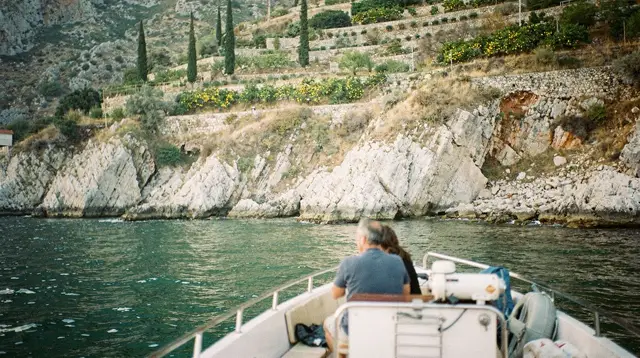
What struck me walking it wasn’t any single view — though there are good ones, back toward Villefranche’s bay and out toward the open sea — it was the rhythm. You’re never far from the water. The rock underfoot is uneven, sometimes slick near the tideline, and there’s very little shade. It’s not a wilderness hike; it’s closer to a long shoreline stroll that happens to be genuinely beautiful, the kind of walk where you stop talking for a while because the sea is doing something more interesting than the conversation.
The rock, not the postcard
I think what sells Cap-Ferrat short in most guides is that it gets photographed from a distance — the villa’s pink façade, the gardens, the yachts in the marina — and all of that is real, but it’s not what you feel when you’re actually on the path. What you feel is the texture of the coast: pale rock worn smooth in places, pine and scrub leaning toward the water, the sea changing colour with the light. Some of the small coves along the way are swimmable if the water’s calm and you’ve brought a swimsuit, though none of them are marked, staffed beaches — you’re improvising, and that’s part of the appeal if you’re comfortable with it.
This is the same rocky-shore character you’ll recognise from Nice’s pebble beaches further west — this coast doesn’t do sand, and Cap-Ferrat is no exception. Don’t come expecting soft footing anywhere near the water.
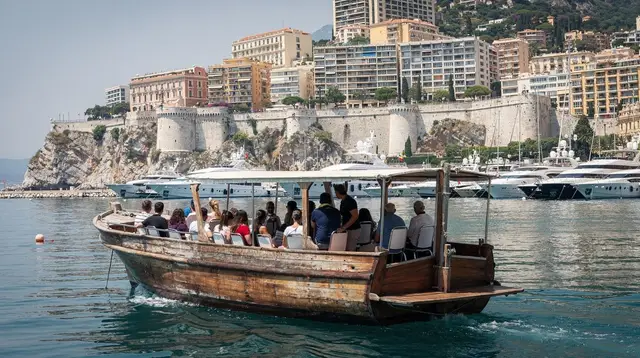
Between the walking, one honest option is to see the peninsula from the sea instead, or as a complement — a slow pass along the coast by boat gives you the shape of Cap-Ferrat that’s hard to read from the path itself. An electric boat cruise along this stretch of coast covers that ground quietly, without the diesel smell and engine noise of a bigger charter. If you’d rather make an afternoon of it with food built in, a private boat outing with a chef-prepared aperitivo on board turns the same coastline into something closer to a proper outing than a quick look.
When to go, and what to skip
Go early morning or late afternoon if you’re here between June and September — the path has almost no shade, and midday sun on pale rock with the sea glare on top of it is genuinely uncomfortable, not just unpleasant. Spring and early autumn are more forgiving, and honestly my favourite time to do this walk, when the light is softer and there’s nobody else on the rocks.
I’d skip trying to combine this with a full visit to the villa gardens in the same few hours unless you’re prepared for a long day — the walk deserves unhurried time, and so does the villa, and squeezing both in tends to shortchange one or the other. If your time on the eastern Riviera is limited, I’d rather you did the coastal path properly and came back another day for the interior, or vice versa, than rushed both.
Getting there and back
Both Villefranche-sur-Mer and Beaulieu-sur-Mer sit on the coastal TER train line that runs along the eastern Riviera toward Monaco and Menton, and both are a short ride from Nice-Ville. That makes a one-way walk practical: start in one town, finish in the other, and take the train back rather than retracing your steps along the same rocks. It’s a small thing, but it changed how I thought about the walk — less a there-and-back errand, more a proper crossing of the peninsula with the sea as company the whole way. If you want the fuller picture of the corniches this peninsula sits inside, the day trip from Villefranche and Cap-Ferrat lays out how to fit the villages, the villa, and this stretch of coast into one outing — or spread across two if, like me, you’d rather not rush any of it.
If you’re weighing how this fits against the rest of the eastern Riviera, a wider loop that also takes in a full-day private trip across several Riviera towns is one way to see Cap-Ferrat as part of something bigger rather than a stand-alone stop. For a gentler, city-based alternative on a day you don’t feel like a coastal scramble, a guided walking and driving tour through Nice itself covers different ground entirely, back on the mainland.
Cap-Ferrat coastal path: questions I get asked
How long is the Cap-Ferrat coastal path?
Nobody I trust gives a single reliable figure for the whole loop, because the path exists in sections and some stretches detour onto streets. Treat it as a half-day outing at a relaxed pace with stops, not a timed circuit.
Do I need to book the Villa Ephrussi de Rothschild to do this walk?
No. The coastal path is public and separate from the villa and its gardens, which sit inside the peninsula and need their own ticket. This walk is about the shoreline, not the interior.
Is the path suitable for kids or people with limited mobility?
Parts are fine for older kids at a slow pace, but the surface is uneven rock in places with no rail in places, and there’s real sun exposure. It’s not a stroller route and not ideal for anyone unsteady on their feet.
Where does the path start and end?
The most walked sections run between Villefranche-sur-Mer and Beaulieu-sur-Mer, on either side of the Cap-Ferrat peninsula. You can start from either town and turn back, or treat it as a there-and-back rather than a strict loop.
What should I bring?
Proper shoes with grip, not sandals, plus water, sun protection, and a swimsuit if you want to get in the sea partway round — some small coves along the rocks are swimmable in season.
Is the path shaded?
Barely, for long stretches. It hugs open rock and low scrub facing the sea. Go early or late in summer, not at midday.
Can I combine the walk with Villefranche-sur-Mer or Beaulieu-sur-Mer?
That’s the natural way to do it. Both towns have cafés, a train station on the coastal TER line, and are easy to reach from Nice, so you can walk one direction and take the train back instead of retracing your steps.
tours.Nature
Verified deep-linked GetYourGuide tours. Book through these links and we earn a small commission at no cost to you.
GetYourGuide does not provide a product photo for this activity — the image shows the meeting point, photographed by us.