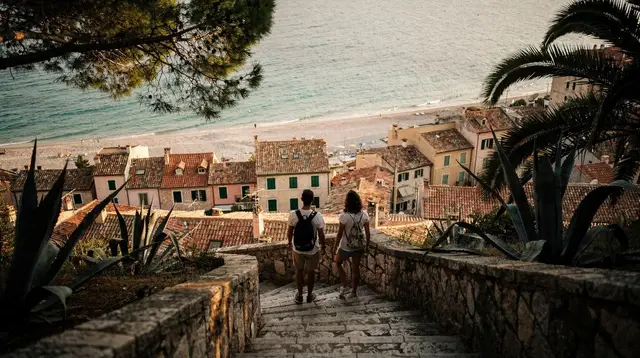
Antibes old town walking tours
What can you see on foot in Antibes old town?
The ramparts walk along the sea, the Musée Picasso inside the Château Grimaldi, the covered Marché Provençal, and Fort Carré a short walk north of Port Vauban. All of it is compact enough to cover in half a day without a car or a boat.
Why Antibes old town rewards a walk, not a drive
Antibes sits on the Riviera ouest, between Cannes and Nice, and its old town is one of the few on this coast where the historic core, a working port and a hilltop fort all sit within a 20-minute walk of each other. The ramparts still trace the old fortified line above the sea, the Château Grimaldi that now houses the Musée Picasso stands right on the water, and Port Vauban’s marina gives the whole walk a fixed point of reference. None of this needs a car, a boat, or a guided minibus loop — it needs a morning or an afternoon on foot.
This page covers what you can see and do inside the walls and immediately around them: the ramparts, the Musée Picasso, the Marché Provençal, and Fort Carré. It does not cover the water. For snorkelling stops, coastal cruises and trips around the Cap d’Antibes peninsula, see Antibes boat tours — a genuinely separate outing, since the old town walk stays on dry land throughout.
Getting your bearings: Port Vauban and the ramparts
Most visits start at Port Vauban, the marina on the eastern edge of the old town and one of the largest yacht harbours on the Mediterranean. It is not a sight in itself so much as a landmark: the old town’s ramparts run along the seafront just behind it, and the walk from the port to the Château Grimaldi takes about ten minutes along the water.
The ramparts date largely from Vauban’s 17th-century fortification of Antibes, though the site was defended long before that — Antibes was a Greek trading post (Antipolis) and later a Roman town, and the old town’s street grid still follows that ancient layout in places. Walking the rampart path above the sea gives a clean view back toward the Baie des Anges and, on a clear day, toward the Alps. It is flat, paved, and free, which makes it the easiest orientation walk in the old town before tackling the narrower streets inland.
Musée Picasso in the Château Grimaldi
The Château Grimaldi is the medieval and Renaissance castle of the Grimaldi family — the same family that still rules Monaco — built on the site of the ancient Greek acropolis, right above the sea at the edge of the old town. In 1946, Picasso was offered a studio inside the château and spent several productive months there; the museum that now occupies the building holds work from that period, including large paintings made directly for the space, alongside ceramics and later donations.
The museum is compact rather than sprawling, and the building itself — thick stone walls, a seafront terrace with sculpture, views over the water — is part of the reason to visit. It gets busy in July and August; a morning visit and, where slots are limited, advance booking are the practical way to avoid a queue. It pairs naturally with the rest of the old town, since it sits directly on the rampart walk rather than requiring a detour.
For a version of the visit built around this and other small museums in the old town, several walking tours combine the Musée Picasso with additional stops — see the tour list below.
Fort Carré, above the port
North of Port Vauban, on a promontory of its own, sits Fort Carré — a star-shaped fortress with a long military history, used to defend Antibes from the sea long before Vauban’s later work on the town walls. It is a 15 to 20 minute walk from the old town gates, mostly flat along the port before a short climb to the fort itself.
Access inside the fort and onto its ramparts is by guided visit only, run on a fixed daily schedule by the Antibes tourist office — you cannot simply walk in and explore at your own pace. You can, however, walk right up to the base of the fort and around it at any time, and the views back over Port Vauban and the old town from outside the walls are worth the walk even without joining a scheduled visit. Check current opening days before planning around it, since the fort typically closes at least one day a week and the schedule shifts by season.
The Marché Provençal and daily life in the old town
Back inside the ramparts, the covered Marché Provençal on Cours Masséna is where the old town’s daily rhythm is easiest to see: stalls of Provençal produce, olives, cheese, flowers and local specialities under a 19th-century iron and glass roof. It runs daily in high season, with fewer open days in winter, and mornings are reliably when it is at its fullest — most stalls close by early afternoon.
Around the market, the streets of the old town are narrow, mostly pedestrian, and lined with the kind of small shops and cafés that make a walking visit worth doing slowly rather than as a checklist. The Church of the Immaculate Conception, built on the site of a Roman temple and Antibes’ former cathedral, sits just off the market square and is a quick, free stop.
Antibes old town vs the water: two different visits
It is worth being direct about the distinction, since both kinds of trip are often marketed together. This guide is about walking: the ramparts, the château, the fort, the market, all reachable on foot from Port Vauban. Antibes boat tours cover the Cap d’Antibes peninsula and the water around it — cruising, snorkelling, and views of the coastline that are simply not visible from inside the old town walls. Neither trip substitutes for the other, and trying to combine both in a single morning usually means rushing one of them. If your time in Antibes is limited to half a day, decide which one matters more before booking.
Juan-les-Pins and Biot: close by, not part of this walk
Two nearby places come up often in the same breath as Antibes old town, and both deserve a separate visit rather than being squeezed into this one. Juan-les-Pins, Antibes’ beach resort neighbour with its sand beaches and summer nightlife, is a short walk or bus ride from the old town but has its own character entirely — beach-focused rather than historic. Biot, the hilltop village known for its glassworks, sits inland and needs its own trip by car or bus. Both are worth the time; neither adds much if bolted onto an already full old-town walk.
Planning your visit
| Stop | Time needed | Cost | Notes |
|---|---|---|---|
| Ramparts walk | 20–30 min | Free | Flat, paved, no ticket needed |
| Musée Picasso | 45–60 min | Ticketed | Book ahead in July–August |
| Marché Provençal | 20–30 min | Free to browse | Mornings only, closed some winter days |
| Fort Carré | 45–60 min with guided visit | Ticketed | Guided access only, check schedule |
| Old town streets and church | 30–45 min | Free | Best done slowly, no fixed route |
A realistic half-day covers all of the above at an easy pace, starting at Port Vauban, walking the ramparts to the château and Musée Picasso, then inland to the market, and finishing with the walk out to Fort Carré if its schedule allows.
Guided walking tours worth booking
For a first visit, a local guide covers the layout and history in far less time than working it out alone, and several tours are built specifically around the old town rather than the wider Cap d’Antibes.
A short, focused option is the two-hour walking tour with a local guide through the ramparts, the château area and the market streets, which fits neatly into a morning without over-scheduling the rest of the day.
For a version with a food element built in, the old town walking tour paired with food tastings along the market and side streets works well around midday, when the Marché Provençal is at its busiest.
Anyone prioritising the Musée Picasso alongside the old town’s other small museums can look at the walking tour covering four of Antibes’ museums, including the art and history sites inside the old town — a denser option better suited to a full morning than a quick visit.
Travellers who want a lighter, more social introduction rather than a museum-heavy itinerary can look at the walking tour through the old town with a small tasting stop and time to pick up a souvenir, a shorter format that works well as a first orientation before returning to explore the ramparts or the market at your own pace afterward.
When to visit Antibes old town
The Riviera’s Mediterranean climate shapes this walk more than most people expect, since almost the entire route — the ramparts, the approach to Fort Carré, the market square — is outdoors and largely unshaded. Summer, from June to September, is hot and dry, and by August the old town’s narrow streets and the open rampart path can feel genuinely crowded on top of the heat; an early morning start is the practical way to see the ramparts and the château before either the sun or the crowds build up. Winter on this stretch of coast is mild, often reaching 12 to 15°C in the afternoon even in January, which makes the walk comfortable, though it is worth checking opening days in advance, since the Marché Provençal and Fort Carré’s guided visits both run reduced schedules outside high season.
Spring and early autumn are the best compromise for this particular walk: warm enough to enjoy the ramparts and the terrace at the Musée Picasso without midsummer heat or midsummer queues. October and November bring a real risk of intense, sudden rain — the kind of Mediterranean weather event the region calls an épisode méditerranéen — so an outdoor-heavy day like this one is worth planning around a settled forecast rather than fixed dates if visiting in late autumn. For a broader look at how the seasons compare across the coast, see the best time to visit Nice guide, whose seasonal pattern of hot dry summers and mild wet-prone autumns applies just as much to Antibes.
Antibes old town in context on the Riviera ouest
Antibes sits on what this guide calls the Riviera ouest, the stretch of coast running from Nice toward Cannes, and the old town is a useful counterpoint to both. Where Cannes trades on the Croisette and the film festival, and Nice’s Vieux-Nice spreads over a larger area with Cours Saleya at its centre, Antibes’ old town is smaller, quieter outside peak season, and organised around a single, walkable loop from the port to the fort. Anyone choosing where to base themselves for a few days on this side of the coast can compare the options directly in Nice vs Antibes: where to stay.
The old town also makes a natural pairing with what is just offshore: the Îles de Lérins, reached by ferry from Cannes rather than from Antibes itself, and covered in full in the Lérins islands ferries and boat trips guide. Travellers building a longer loop through the western half of the coast can see how Antibes old town, Cannes and the islands fit together over two days in the Cannes, Antibes and the Îles de Lérins itinerary referenced below.
Practical notes before you go
Comfortable shoes matter more than usual here: the rampart path and the fort approach are paved but uneven in places, and the old town’s inner streets are cobbled. Midsummer heat is real on the open rampart walk, with no shade for most of its length, so an early start avoids the worst of it. Outside July and August, the old town is noticeably quieter and the market easier to browse without crowds.
Antibes old town connects easily to a wider day out — a two-day loop through Cannes, Antibes and the Îles de Lérins is a straightforward way to combine this walk with Cannes and the Îles de Lérins, reached by ferry from Cannes’ port. For those coming from Nice for the day, see the general Antibes day trip guide for transport options, and the Antibes food and market guide for more on eating in and around the old town. Travellers weighing the wider museum scene on the coast can also check the best museums in Nice for comparison, and those extending toward Cannes can look at the Cannes day trip guide.
Antibes old town walking tours: FAQ
How long does it take to walk Antibes old town?
Two to three hours covers the ramparts, the Musée Picasso and the market at a relaxed pace. Add Fort Carré and it becomes a half-day outing, since the fort sits a 15 to 20 minute walk from the old town gates.
Is the Musée Picasso in Antibes worth visiting?
Yes for anyone interested in Picasso’s 1946 stay in Antibes, when he worked in a studio inside the Château Grimaldi. The museum is small, and the building and its seafront terrace are as much a reason to go as the collection itself.
What is the difference between this walking tour and an Antibes boat tour?
This guide stays on land, inside the old town and around Fort Carré. Boat trips around the Cap d’Antibes peninsula, snorkelling stops and coastal cruises are covered separately.
Can you visit Fort Carré without a guide?
Access to the interior and ramparts is by guided visit only, run on a fixed schedule by the tourist office. You can walk right up to the fort and around its base at any time without joining a tour.
Is the Marché Provençal open every day?
The covered market on Cours Masséna runs daily in high season, with reduced days in winter. Mornings are the reliable window; most stalls close by early afternoon.
Are Juan-les-Pins and Biot part of this walk?
No. Both are separate destinations a short drive or bus ride from Antibes old town, worth their own visit rather than an add-on to a walking route.
Do you need to book the Musée Picasso in advance?
It is not always required, but the museum is small and can sell out its timed slots in July and August. Booking a morning slot avoids the longest queues.
Walking tours of Vieux-Nice and the Riviera
Verified deep-linked GetYourGuide tours. Book through these links and we earn a small commission at no cost to you.
GetYourGuide does not provide a product photo for this activity — the image shows the meeting point, photographed by us.