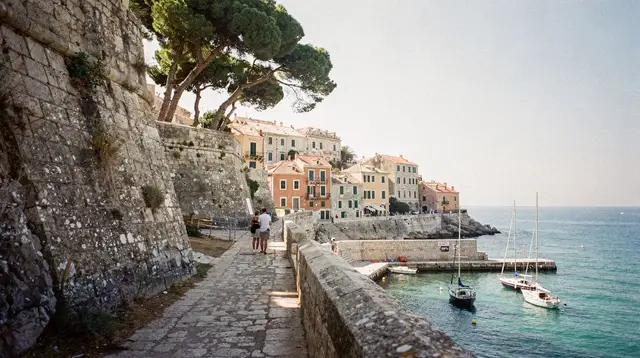
Estérel coast boat trips from Cannes and Saint-Raphaël
What is an Estérel coast boat trip, and how is it different from a Lérins Islands boat trip?
An Estérel coast boat trip follows the Corniche d'Or between Mandelieu and Saint-Raphaël to look at red volcanic rock plunging into the sea — there is no island to land on. A Lérins Islands crossing takes you to Sainte-Marguerite or Saint-Honorat, where you disembark to visit a fort or an abbey.
Red cliffs, not an island crossing
The Estérel massif is a band of volcanic rock that runs along the coast between Mandelieu-la-Napoule and Saint-Raphaël, on the stretch known as the Corniche d’Or. What makes it worth seeing from the water is the rock itself: dark red porphyry cliffs dropping straight into blue-green sea, cut into narrow inlets called calanques, with almost no flat ground for a road or a village to sit on. There is nothing to disembark at and nothing to tour — a boat trip here is built around looking at the coastline, not visiting a site.
That is the point to get straight before booking. A trip to the Îles de Lérins — Sainte-Marguerite and Saint-Honorat, reachable from Cannes in about 15 to 20 minutes — takes you to inhabited islands with a fort, a museum, pine forest paths, and a working abbey on Saint-Honorat. You land, you walk, you come back. An Estérel coast trip does the opposite: the boat stays offshore the whole time, moving along the base of the cliffs, sometimes cutting the engine to drift near a calanque or anchor for a swim. If you want a place to walk around, the Lérins Islands or a Cannes old-town stop fit that better. If you want thirty or forty minutes of red rock and clear water sliding past, this is the trip.
Where the coast runs
The Corniche d’Or road traces the same stretch the boats follow: Mandelieu-la-Napoule, Théoule-sur-Mer, Agay, and on to Saint-Raphaël, with Fréjus just behind it. The most photographed section is around the Pointe du Cap Roux and the Calanque d’Anthéor, where the red rock is at its most intense against the water. Several operators name a specific calanque — Maupas, for instance — as their anchoring point for a swim stop.
Distances by boat depend on the departure point. From Cannes, reaching the Estérel coast and returning typically fills two to four hours depending on how far the route goes and how long the boat lingers. From Saint-Raphaël or Fréjus, the cliffs are close enough that a shorter outing can still cover a decent stretch of coastline, which is one reason those two towns have become common starting points for people based further along the coast rather than in Nice or Cannes.
The Estérel destination page covers the wider massif beyond the boat trip itself — walking trails, viewpoints, and the villages sitting around its edges. Maritime pine forest runs down to the rock in places, and the contrast between that dark green cover and the red cliffs is part of what makes the coastline look so striking from the water, especially in the low light of early morning or late afternoon when the colour is deepest.
Cannes, Mandelieu, or Saint-Raphaël: where to start
| Departure point | Distance to the cliffs | What it suits |
|---|---|---|
| Cannes | Furthest of the three, roughly 30–45 min by boat to the closest cliffs | Combining Estérel with a pass near the Lérins Islands; easiest to reach from Nice by train |
| Mandelieu-la-Napoule | Closest departure point, cliffs start almost immediately | Shorter trips, more time actually along the coast |
| Saint-Raphaël / Fréjus | Close on the eastern side of the massif | Half-day outings, snorkelling stops, often smaller boats |
None of these is objectively “better” — it comes down to how you are getting there. Cannes is the most straightforward base if you are travelling from Nice by train along the coast, since it sits on the same line. Saint-Raphaël and Fréjus work well if you are already staying further west, or combining the boat trip with a night in that area.
What an outing actually looks like
A typical half-day departure follows a similar shape regardless of operator: leave port, motor out past the harbour, then slow down as the boat reaches the first red cliffs. Most captains narrate a little — which calanque is which, why the rock is that colour (iron oxide in volcanic porphyry, for anyone who asks) — then find a sheltered inlet to anchor for a swim and snorkel stop, conditions allowing. Some trips continue further along the coast after the swim stop before turning back; others make the anchoring point the turnaround.
a half-day sea excursion along the Estérel massif follows this pattern — coastal cruising with a swim stop built in. For something more private, a private boat trip to the Calanques de Maupas sets its own pace and anchoring points rather than following a fixed shared itinerary, and a half-day private excursion through the Estérel calanques covers similar ground with a smaller group.
If snorkelling is the main draw rather than the cliffs themselves, a snorkelling outing from Port Fréjus stays closer to shore and spends more time in the water than moving along the coastline. For a quieter, slower option that is not really about the Estérel cliffs at all, a sunset paddle and yoga session in Saint-Raphaël is worth knowing about as an alternative on a calm evening.
Shared, private, or something slower
The options above split into three shapes of outing rather than five interchangeable choices. The shared half-day trip and the two private charters all cover the same red-cliff coastline, with the private options giving more say over pace and anchoring spots — worth the extra cost if a fixed group schedule is not what you want. The Fréjus snorkelling outing is a different kind of trip altogether: it trades distance covered for time actually in the water, which suits anyone who finds the swim stop the best part of a coastal cruise anyway. And a sunset paddle and yoga session in Saint-Raphaël is not really an Estérel-coast trip in the same sense — no cliffs, no calanques — but it is worth knowing about as a calmer alternative for an evening when a fast boat is not what you are after.
If you are weighing this against the Estérel by kayak or snorkelling, the difference is mostly pace and how close you get to the rock: a kayak puts you within touching distance of the cliffs at points a boat cannot approach, at the cost of covering far less coastline in the same amount of time.
What not to expect
Two honest points, because brochure language tends to skip both. First, no operator can promise dolphins or other marine life. Sightings happen in this part of the Mediterranean, but they are not something a half-day trip is built to deliver, and nobody selling a ticket should say otherwise. Second, the sea along this open stretch of coast is not always calm. The Estérel faces the open Mediterranean rather than a sheltered bay, and afternoon wind — sometimes the mistral, sometimes just a sea breeze that picks up as the day warms — can add chop. Morning departures are generally the smoother bet, and cancellations do happen for small boats when conditions turn.
Swimming stops are also weather-dependent. Most trips build in time at a calanque, but if the sea is up, the captain may shorten or skip it. Bring a towel and reef-safe sunscreen and expect the anchoring stop to be a bonus rather than a guarantee.
When to go
Summer (June to September) gives the warmest water and the best light on the red cliffs, but also the most boat traffic in the calanques and the highest prices. Late spring and September offer a reasonable trade-off: still warm enough to swim, noticeably less crowded. Outside of April to October, fewer operators run at all, and sea conditions are less predictable. Whatever the season, book a few days ahead for July and August — the small-boat and shared-excursion slots, especially morning ones, sell out.
Getting to the departure point from Nice
There is no direct boat link from Nice to the Estérel coast; you travel by train or car first, then join a boat locally. The French Riviera by train (TER) runs along the coast to Cannes in well under an hour from Nice-Ville, and on to Saint-Raphaël and Fréjus in a bit over an hour, which makes either town a workable base for a boat departure without a car. If you are driving, renting a car on the French Riviera gives more flexibility for reaching Mandelieu directly, though parking near the ports in July and August is tight.
Because the Estérel sits further from Nice than the eastern Riviera corniches, most people treat it as part of a longer day out — see Estérel day trip from Nice for how to structure the travel time alongside the boat trip itself, or day trips from Nice for how it compares with other options.
Travellers basing a day around Cannes rather than the boat alone can fold in more of the town first — see Cannes day trip from Nice for how to sequence the old town, the Croisette, and a boat departure without rushing either.
Estérel, Lérins, or Saint-Tropez — picking the right boat trip
These three sit in roughly the same stretch of coast west of Cannes, and it is easy to mix them up when booking. The table below is meant to make the choice quick.
| Trip | What you see | Do you land anywhere? |
|---|---|---|
| Estérel coast (this guide) | Red volcanic cliffs, calanques, open coastline | No — offshore cruising with a possible swim stop |
| Lérins Islands | Sainte-Marguerite (fort) and Saint-Honorat (abbey) | Yes — you disembark and walk |
| Saint-Tropez | A separate coastal town roughly 110 km from Nice, its own boat scene and beaches | Yes — it’s a destination with a port and old town |
The Estérel and Saint-Tropez both sit within what locals think of as the “var-coast” excursion zone — further out than Cannes and Antibes, and generally a longer day than a trip to the eastern corniches. That does not mean they are close to each other by boat; a full Saint-Tropez visit is its own outing, covered separately in Saint-Tropez and the Esterel coast in two days if you want to combine both over more than one day.
Practical notes
Expect half-day trips to run somewhere in the €50–€100 per person range for shared departures, more for private charters, though prices shift with season and boat size. Bring a hat, sunscreen, and a light layer — open water means more wind than the harbour suggests, even on a hot day. Swimwear under your clothes saves time if a swim stop happens. Motion sickness is worth planning for if the forecast shows wind; smaller boats feel the swell more than larger ones. For the fuller packing list beyond what a boat trip specifically needs, see what to pack for the French Riviera.
For a broader sense of monthly conditions along the whole coast rather than just the Estérel, Nice weather by month breaks down temperatures and rainfall across the year, useful for weighing a spring or autumn date against the crowded summer window described above.
For a land-based look at the same coastline, or if a boat trip does not fit the day, outdoor adventures around Nice and the best coastal hikes on the French Riviera cover walking routes through parts of the Estérel massif, including sections of the coastal path that pass above the same red cliffs a boat sees from the water. For other ways to see the coast from the sea nearby, Cannes boat tours and yacht cruises and Villefranche and Cap Ferrat boat tours cover different stretches of coastline with a similar offshore format.
Estérel coast boat trips — questions answered
Is an Estérel boat trip the same as going to the Lérins Islands?
No. The Lérins Islands (Sainte-Marguerite, Saint-Honorat) are inhabited, with a fort and an abbey to walk around once you land. An Estérel coast trip stays offshore, following the cliffs between Mandelieu and Saint-Raphaël with no island stop.
Where do Estérel coast boats leave from?
Most departures are from Cannes, Mandelieu-la-Napoule, or Saint-Raphaël and Fréjus, which sit closest to the red cliffs. Some Cannes operators combine the Estérel coast with a run past the Lérins Islands on the same outing.
Will I see dolphins or other wildlife?
It is not something to count on. Dolphins and other marine life show up in the Mediterranean, but no operator can promise a sighting, and most Estérel trips are built around the coastline itself rather than wildlife-spotting.
Is the sea calm on these trips?
Not necessarily. The Estérel coast faces open water and can pick up chop and wind, especially in the afternoon or when the mistral is blowing. Morning departures tend to be smoother, but no operator guarantees calm conditions.
How long does an Estérel coast boat trip take?
Most run half a day, roughly two to four hours including time along the calanques and a stop for swimming where conditions allow. Full-day private charters exist for a slower pace with more swimming stops.
Can I swim during an Estérel boat trip?
Many trips include one or more anchoring stops in a calanque for swimming and snorkelling, sea conditions permitting. It is worth checking with the operator beforehand whether a swim stop is included or optional.
Is this the same coastline as Saint-Tropez?
No, but they sit in the same general excursion area, further from Nice than the eastern Riviera. Saint-Tropez itself is a separate destination roughly 110 kilometres from Nice — this guide covers the Estérel massif near Cannes, Fréjus, and Saint-Raphaël.
Do I need to book in advance in summer?
Yes. July and August fill up quickly for small boats and shared excursions, and the best morning slots go first. Booking a few days ahead is a reasonable minimum in peak season.
Boat cruises to Monaco, Cannes and the Îles de Lérins
Verified deep-linked GetYourGuide tours. Book through these links and we earn a small commission at no cost to you.
GetYourGuide does not provide a product photo for this activity — the image shows the meeting point, photographed by us.