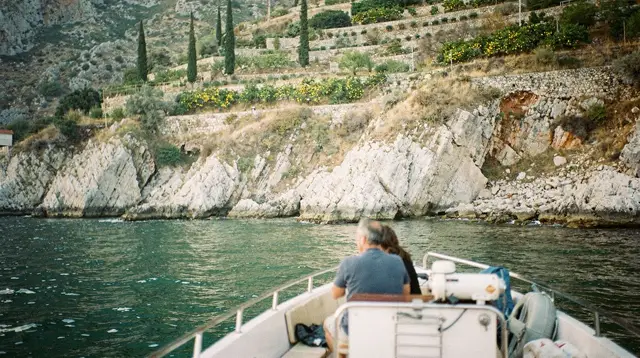
The Estérel is not a place you arrive at and park the car for the day. It is a coastline you drive, cycle or sail along, and the point of going is the road itself: around 30 km of volcanic rock, deep red-brown where it has been cut by wind and rain for millions of years, meeting a sea that runs from turquoise in the shallows to a hard, saturated blue further out. The road that follows it, the Corniche d’Or, runs between Mandelieu-la-Napoule in the west and Saint-Raphaël in the east, with Fréjus sitting just inland from the coast at the eastern end. There is no single town called “Estérel” to walk around; the appeal here is the drive, the viewpoints, and the coves you can reach on foot from a handful of parking pull-offs.
That makes the Estérel a different kind of day from most of what fills a Riviera itinerary. There is no old town, no museum, no palace to queue for. What there is: a series of pull-offs and short footpaths where the road climbs and the rock drops straight into the water, and a few small coves worth the walk down. Treat it as a scenic drive with stops, not a sightseeing list, and it earns its place on the itinerary.
The Corniche d’Or, point by point
The corniche starts to feel like the Estérel once you clear Mandelieu-la-Napoule, where the marina and the low hills give way to red rock. From there the road hugs the coast east toward Saint-Raphaël, climbing and dropping repeatedly as it follows the shoreline’s cuts and headlands. A handful of named viewpoints and small capes punctuate the drive — Le Trayas, the Pointe de l’Aiguille, and the string of coves around Agay are the names you will see on road signs and maps of the area. None of them is a “must,” in the sense this guide avoids that kind of promise, but pulling over at two or three of them, rather than driving the whole stretch without stopping, is what makes the day worth doing.
The color contrast is the actual subject here, and it is worth being specific about rather than reaching for adjectives: the rock is a dense red-brown, almost rust in strong midday sun and closer to purple in early morning or late afternoon light, and it meets water that shifts from pale green over sand and shallow rock to a flat, saturated blue further out. Photographers tend to prefer the light in the first and last two hours of the day, both for the color and for softer shadows on the rock face.
Inland from the road, the Estérel rises into a low mountain range, mostly pine and scrubland (much of it burned and regrown over past decades — wildfire is a real risk here in summer, and some trails close under fire-danger restrictions), with a network of hiking and mountain-bike trails that goes well beyond what a day-tripper from Nice will use. For most visitors, the coast road and its pull-offs are the practical version of the Estérel; the inland trail network is for those staying locally with more time. For hikes that combine well with a coastal base further along the Riviera, see French Riviera coastal hikes: the best day walks.
By car or by e-bike
By car, the corniche itself takes under an hour to drive without stopping, which is misleading as a planning number: the point of the road is the stops, not the transit time. A realistic day allows time to pull over at two or three viewpoints, walk down to a cove for half an hour, and have lunch in Saint-Raphaël or Fréjus, without trying to fix an exact schedule to the drive. Parking at the more popular pull-offs fills up by mid-morning in July and August; arriving earlier in the day avoids circling for a spot.
By e-bike, the same stretch becomes a slower, more physical version of the same drive — you feel the climbs, and the descents reward you for them. The road is narrow in places and shared with car traffic, including tour buses and campervans in summer, so this suits confident riders more than a first-time cyclist, and it is more comfortable outside the busiest midday hours. E-bike and scenic tours along the Riviera corniches are a common way to do this without renting a car; see Nice by bike, segway or vintage car for the general format, though most departures cover the corniches closer to Nice rather than the Estérel specifically — check the route before booking if the Estérel stretch is what you want.
For travelers who would rather book a single package than piece together a rental car and a route, An Estérel day trip from Nice: how it works lays out organized-tour options that cover the corniche without driving yourself. Two more focused guides cover the water side of the same coast: Estérel coast boat trips: options and operators for boat trips along the red cliffs, and Estérel kayak and snorkeling: getting in the water for a closer look at the coves from sea level.
Public transport along the Corniche d’Or is thin compared with the Nice-Menton coastal train line; this stretch of coast is realistically a car or organized-tour day, not a walk-up train-and-bus itinerary. See Getting around the French Riviera: train, tram, bus or car and Renting a car on the French Riviera: when you actually need one for the practical side of arranging a car, and Driving and parking in Nice: why you probably don’t need a car if you are picking up a rental in the city before heading out.
Saint-Raphaël and Fréjus
Saint-Raphaël anchors the eastern end of the corniche: a working seafront town with a marina, a train station on the coastal line, and a base for boat trips, fishing outings and water sports along the Estérel coast. It is a reasonable lunch stop and a natural point to turn around or continue on toward Saint-Tropez if your day allows for more driving.
Fréjus sits just inland and slightly east of Saint-Raphaël, with its own harbor (Fréjus is also where several boat and fishing departures along this coast are based) and a Roman-era history that predates the Riviera’s resort identity by close to two thousand years — an amphitheater and other Roman remains sit in the modern town, a contrast worth noting if the rest of the day has been all rock and sea. Fréjus is not a detour destination in its own right so much as a practical base: it is where several of the on-the-water activities along this stretch of coast depart from.
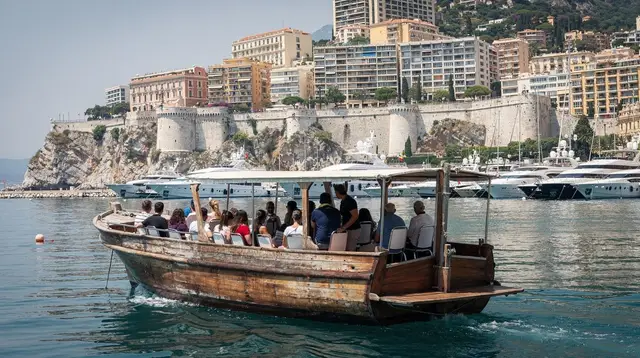
From either town, a short sea outing brings a different view of the same coastline. A morning or half-day of sport fishing out of Fréjus puts the red cliffs at your back rather than your side, and a guided boat trip looking for dolphins off Saint-Raphaël covers more of the coastline in a few hours than a shoreline walk ever could — sightings are not guaranteed, and no honest guide should promise one. For a wider view still, a short scenic flight from Cannes toward Fréjus shows the red-and-blue contrast of the Estérel coast from above, in a way the road itself cannot. If the pace of the day has been about driving and stopping, a sunset paddle session in Saint-Raphaël is a slower, on-the-water way to close it out.
Not Saint-Tropez
The Estérel and Saint-Tropez sit in the same part of the coast — this site groups both under its Var Coast region — and it is worth being clear that they are not the same stop. Saint-Tropez is a destination town, roughly 35-40 km further southwest of Saint-Raphaël, with its own old port, citadel and beaches; it has its own separate guide on this site and is not covered here. See the Saint-Tropez destination page for the town itself, and the Var coast region page for how it fits alongside the Estérel and Saint-Raphaël.
The Estérel is the red-rock coastline and the corniche road itself. Some itineraries combine both into a longer day or a two-day loop — see Saint-Tropez and the Esterel coast in two days — but treating the Estérel as “the road to Saint-Tropez” undersells it as a stop in its own right, and treating Saint-Tropez as part of the Estérel drive overstates how close they actually are.
Getting there from Nice
By car, allow roughly an hour to reach Mandelieu-la-Napoule at the western end of the corniche, and closer to 1h15-1h30 to reach Saint-Raphaël at the eastern end, via the A8 motorway or the slower coastal route through Cannes. Traffic on the A8 around Cannes and Mandelieu builds through the morning in summer, so an early start matters more here than the raw distance suggests. If you are combining the Estérel with Cannes on the same day, see Day trips from Nice: how to choose one that fits your time for how the pieces of a longer Riviera day typically fit together, and Cannes boat tours and the crossing to the Lérins Islands if a boat departure from Cannes toward the Estérel coast suits your route better than driving the full corniche by road.
By train, the coastal line serves Cannes, Mandelieu and Saint-Raphaël, which covers the two ends of the corniche but not the road itself or its viewpoints — the train is a way to reach a base town for a boat trip or a coastal walk, not a way to drive the Corniche d’Or. For the train timetable and how it connects along the coast generally, see The French Riviera by train: the TER coast line explained.
Practical notes
| What | Detail |
|---|---|
| Distance, Mandelieu to Saint-Raphaël | About 30 km along the coast road |
| Drive time, no stops | Under 1 hour |
| Realistic time with stops | A full day |
| Parking | Small pull-offs at viewpoints; fills by mid-morning in summer |
| Swimming | Small rock and shingle coves, not a long sand beach |
| Fire risk | Real in summer; some inland trails close under high fire-danger alerts |
| Best light for photos | Early morning or late afternoon |
For a broader picture of where else on this coast swimming works well, see Best beaches in Nice and the Riviera and Best swimming spots and hidden coves near Nice; neither covers the Estérel’s coves in detail, but both help put a day here in context against the rest of the coastline. What to bring for a day that mixes driving, short walks and a possible swim is covered in What to pack for the French Riviera.
Wildfire risk is worth taking seriously rather than treating as background color: much of the Estérel’s pine cover has burned and regrown within living memory, and inland trails can close on short notice during periods of high fire danger, typically announced locally rather than posted online in advance. If hiking inland trails is part of your plan, check current access on arrival rather than assuming a map or an old blog post is still accurate.
Crowds along the corniche build through July and August, concentrated at the same handful of named viewpoints and cove parking areas; outside those two months, and especially in the shoulder seasons of May-June and September-October, the road empties out considerably and the light is often better for the red-rock color this coast is known for. Winter is quieter still and mild by most standards, though a handful of the coves and short trails can feel exposed on a windy day, since this stretch faces open sea rather than a sheltered bay. For how these seasonal patterns play out across the wider Riviera, not just this stretch, see Best time to visit Nice and the Riviera.
Estérel and Corniche d’Or: questions before you go
Is the Estérel a town you can walk around?
No. The Estérel is a mountain range and coastline, not a town. The towns at either end are Mandelieu-la-Napoule and Saint-Raphaël, with Fréjus just behind the coast; in between, the appeal is the road, the viewpoints and the water, not a historic center.
How long does the Corniche d’Or take to drive?
The road itself, Mandelieu to Saint-Raphaël, covers around 30 km and can be driven in under an hour with no stops. Allow a full day if you want to pull over at viewpoints, walk down to a cove or two, and have lunch, without a fixed schedule pinned to a single stretch.
Is the Estérel the same as Saint-Tropez?
No, and they are often confused because both sit on the Var coast. Saint-Tropez is a destination town about 35-40 km further southwest, with its own separate day-trip page; the Estérel is the red-rock coastline and the road between Mandelieu and Saint-Raphaël, a different stop entirely.
Can you swim in the Estérel?
Yes, in small coves along the coast road, most reached by short paths down from parking areas or the coastal footpath. There is no single large beach; expect rock and shingle coves rather than a long sandy stretch, and expect them to fill up by midday in summer.
Is the Estérel better by car or by e-bike?
Both work. A car covers the whole corniche comfortably in a day with stops at multiple viewpoints; an e-bike suits travelers who want to feel the climbs and descents and who are comfortable sharing a narrow coast road with traffic, especially outside peak summer hours.
Do you need to book anything in advance for the Estérel?
The drive itself needs no booking. Boat trips, fishing outings and scenic flights from Saint-Raphaël and Fréjus fill up in summer and on weekends, so booking a day or two ahead is worth it if a specific activity matters to your plans.
Is Fréjus worth stopping in on the way?
Fréjus sits just inland from the Estérel coast and makes a reasonable lunch or activity stop, with a working harbor and boat and fishing departures; it is not a detour destination on its own so much as a practical base for getting out on the water along this stretch.