Where I actually swim near Nice: pebbles, coves and no sand
The first time a friend visited me in Nice, she packed flip-flops and a beach towel and asked where “the sand” was. I had to break it to her on the tram from the airport: there isn’t any. Not a little bit, not a hidden patch further down. The Promenade des Anglais runs for about 7 kilometres along the Baie des Anges, and every metre of it is pebbles — smooth, round, ankle-turning galets. If a listicle promises you “the long sandy beaches of Nice,” it has never actually stood on one.
Why Nice is pebbles, not sand
This isn’t a flaw in one bad beach — it’s the whole coastline. For the broader picture across the city, our guide to the best beaches in Nice and on the Riviera is a good starting point if you’re planning more than one swim day. The Baie des Anges was shaped by rivers carrying stone down from the Alps rather than sand up from the sea, and that geology hasn’t changed for tourism. So the question isn’t “which Nice beach has sand,” it’s “how do I make pebbles work.” My answer, after a few summers here: water shoes. Cheap rubber ones from any supermarket on Cours Saleya or in Vieux-Nice solve 90% of the discomfort — walking in, walking out, and not hopping around looking for a smooth patch to stand on. Without them, the first ten metres of any swim here are genuinely unpleasant, especially with kids.
Public beaches: free, pebbled, and first-come
Most of the beach along the Promenade is public and free. You show up, find a spot on the stones, and that’s it — no towel rental, no entry fee. What I’d actually tell you:
- Bring your own mat or a thick towel. Pebbles do not get softer as the day goes on.
- Arrive before 10am in July and August, or you’re negotiating for space between rows of towels.
- Beach Castel Plage and Beau Rivage areas, near the eastern end toward the Colline du Château, tend to be a little less packed than the central stretch by Place Masséna.
- The water itself is clean and the drop-off is close to shore — you’re swimming in real depth within a few strokes, not wading across a long shallow flat.
Private beaches: paying for comfort, not sand
Private beaches (plages privées) line long sections of the Promenade too, and they don’t change the pebbles under your feet — what you’re paying for is a mattress, a parasol, a shower, and usually a snack bar. Expect somewhere around €25–45 for a mattress and parasol for the day, more in August, less for a half-day. It’s a legitimate way to spend a beach day here, but I wouldn’t call it necessary. I’ve had just as good an afternoon on a free public stretch with my own mat and a cold drink from a nearby kiosk.
| Option | Cost | What you get |
|---|---|---|
| Public beach | Free | Open pebble beach, bring your own mat |
| Private beach | ~€25–45/day | Mattress, parasol, shower, snack bar |
| Water shoes | ~€5–10 | Makes either option far more comfortable |
Where it’s genuinely different: just outside Nice
If pebbles really aren’t for you, the good news is you don’t have to go far — you just have to leave Nice itself.
Villefranche-sur-Mer, 15–20 minutes by train or bus, has a mix of sand and small gravel rather than round pebbles — noticeably softer underfoot, and the bay is famously calm, one of the deepest natural harbours on the Mediterranean. It’s the closest genuine change of texture.
For real sand, you’re looking further west: Juan-les-Pins and parts of Antibes and Cannes have proper sandy beaches, but that’s close to an hour away by train and a different day trip entirely — not something to bolt onto a Nice beach afternoon. I’d treat those as their own outing rather than a swap-in for a swim near the city; see our day trip from Nice to Antibes if you want to plan one properly.
None of this is a complaint about Nice, to be clear. The water is clear and blue precisely because there’s no sand clouding it up near shore, and the pebble beaches are honestly less gritty in your bag and your sandwich than sand ever is. It’s just a different kind of beach day than the brochures imply.
Beyond the shoreline: swimming from the water
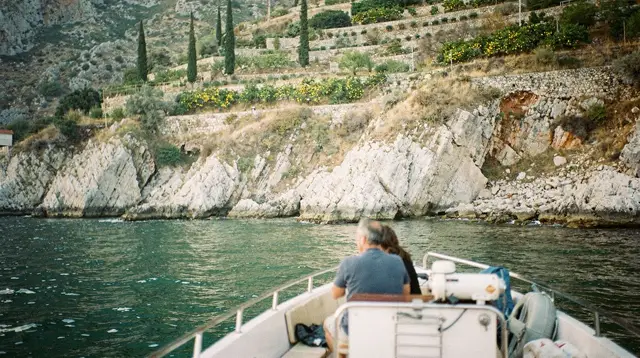
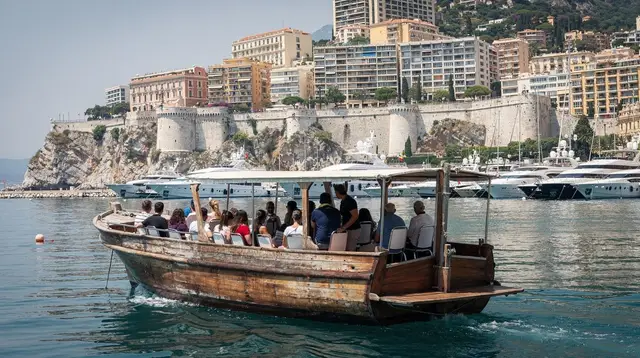
If wading in from a pebble beach isn’t your idea of a swim, the other option I’d genuinely recommend is getting on the water instead of just next to it — our guide to water sports around Nice covers jet ski and paddle options too if a boat isn’t quite what you’re after. A boat trip along the coast toward Villefranche-sur-Mer or the Èze coastline usually includes stops for open-water swimming in coves you can’t easily reach on foot — no pebbles underfoot at all, just a ladder off the boat. If you’d rather book directly with a specialist, our Villefranche and Cap-Ferrat boat tours guide lists the options.
I did the small-group solar boat trip along the coast one August afternoon specifically to escape the crowded shoreline, and swimming off the back of a quiet electric boat beat any beach that week. For something more social, the private boat tour with a chef and aperitivo stop works well for a group wanting a proper day on the water rather than a beach towel. And if you’d rather see the whole coastline in one go — Monaco, Èze, the corniches — with a swim stop built in, the full Riviera coastline tour from Nice covers that ground.
Practical notes before you go
A few things I wish someone had told me sooner. The Mediterranean here sits around 24–26°C in August, genuinely warm and comfortable; by late September it’s already noticeably cooler, and by November most people aren’t swimming at all. Lifeguards (postes de secours) cover the main public stretches in season with flag warnings for currents — worth a glance before jumping in on a windy day.
And don’t expect a deserted cove close to the centre in July or August: the shoreline directly along the Promenade is busy by mid-morning in peak season, pebbles or not. For something quieter, walking further east toward Mont Boron or catching a boat out is more reliable than hoping a central beach will be empty — the coastal path there is one of several covered in our French Riviera coastal hikes guide. If you’re weighing this against a wider first trip to the city, our guide for first-time visitors to Nice puts it in context.
Swimming near Nice: your questions answered
Is Nice beach sand or pebbles?
Pebbles, the whole way along the Promenade des Anglais — about 7 kilometres of round stones, not sand. There is no sandy stretch within the city itself.
Do I need water shoes for Nice beaches?
Not strictly, but I’d genuinely recommend them. Walking on wet, uneven pebbles barefoot is uncomfortable for most people, especially getting in and out of the water, and cheap water shoes solve it completely.
Are Nice’s public beaches free?
Yes. Public beaches along the Promenade des Anglais have no entry fee — you just find a spot on the pebbles. Private beaches charge for a mattress, parasol and facilities, usually around €25–45 a day.
Where’s the closest sandy beach to Nice?
Villefranche-sur-Mer, about 15–20 minutes away, has sand and small gravel rather than round pebbles. For fully sandy beaches, Juan-les-Pins, Antibes and Cannes are closer to an hour away and worth planning as a separate trip.
Is the sea near Nice warm enough to swim comfortably?
Yes, from roughly June through September, with August the warmest at 24–26°C. It cools noticeably by late autumn, and few people swim from November through April.
Are the beaches in Nice crowded in summer?
The central stretch of the Promenade is busy from mid-morning through July and August. Arriving before 10am, or heading slightly east toward Mont Boron, gets you more space.
Can I swim from a boat instead of the beach?
Yes — several boat trips along the coast include stops for open-water swimming in spots you can’t reach on foot, without any pebbles involved.
tours.Nature
Verified deep-linked GetYourGuide tours. Book through these links and we earn a small commission at no cost to you.
GetYourGuide does not provide a product photo for this activity — the image shows the meeting point, photographed by us.