Esterel day trip from Nice: red cliffs, Saint-Raphaël and Fréjus
Is the Esterel a good day trip from Nice?
Yes, but plan for a full day: the Corniche d'Or between Mandelieu and Saint-Raphaël is on the far side of Cannes, so allow well over an hour of driving each way, more by train. Most visitors go by boat, by car along the coast road, or on an organised tour that pairs the red cliffs with Saint-Raphaël or Fréjus.
The Corniche d’Or, between Mandelieu-la-Napoule and Saint-Raphaël, looks nothing like the rest of the Riviera. Instead of pastel facades and a pebble shoreline, the road cuts along red-and-orange volcanic rock that drops straight into a very blue sea. It is one of the most photographed stretches of coast in the south of France, and it is also, honestly, a fair distance from Nice — past Cannes, into the Var department. This guide covers how to get there, what a day actually looks like, and where the line sits between the Esterel and Saint-Tropez, which is a different trip entirely.
Where the Corniche d’Or actually is
The Massif de l’Esterel is a low volcanic mountain range that meets the sea between Mandelieu-la-Napoule (just west of Cannes) and Saint-Raphaël. The coast road that follows it, the Corniche d’Or, threads through red cliffs, pine-covered slopes, and a string of small resorts: Théoule-sur-Mer, Le Trayas, Anthéor, Agay. Saint-Raphaël sits at the eastern end of the massif, with a proper town centre, a marina, and beaches; Fréjus is its immediate neighbour inland and along the coast, with Roman ruins and a working port.
None of this is walking distance from Nice, or from Cannes for that matter. It is a distinct destination in the department of the Var, one region over from the Alpes-Maritimes where Nice itself sits. Framing it as an easy add-on to a Nice city day undersells how much ground it covers.
Getting there from Nice: honest travel times
There is no single fast route, and anyone promising a quick hop is rounding down. Three realistic options:
| Method | Approximate time from Nice | Notes |
|---|---|---|
| Car via the A8 motorway | Around 1h15–1h45 to Saint-Raphaël | Longer to reach the cliffs themselves; tolls apply; summer traffic through Cannes adds time |
| Train (TER) to Saint-Raphaël-Valescure | Around 1h–1h30 | Direct or one change depending on the service; the station is a walk from the marina, not from the cliffs |
| Boat trip departing Cannes or Saint-Raphaël | Varies by operator | Skips road traffic entirely and follows the cliffs from the water, but you first need to reach the departure port |
Boat departures from Nice itself are uncommon for this stretch; most operators run from Cannes, Saint-Raphaël, or occasionally Cogolin near Saint-Tropez. If a tour is sold as leaving from Nice, check carefully whether it includes a coach transfer to the actual embarkation point — that transfer time is part of your day, not extra.
What a day trip covers — and what it does not
Any organised day trip out here is, by definition, a survey rather than a deep visit. A single day can reasonably include the red cliffs seen from a boat, a stop in Saint-Raphaël or Fréjus, and perhaps one small cove for swimming. It cannot also include a proper visit to Saint-Tropez’s old town, a stop in Cannes, and an afternoon in the Esterel massif on foot — that is three separate outings compressed into one, and something will be rushed or cut.
It helps to think of this as the western counterpart to a Monaco–Eze day heading east. Monaco and Eze already fill a full day on the corniches toward Italy; an Esterel, Saint-Raphaël and Fréjus day fills a separate full day heading west into the Var. Trying to combine both directions — Italy-facing corniches and the Esterel coast — in a single day means long transfers in both directions and very little actual time anywhere. Pick a direction for the day and accept that the other stays for a different trip.
Saint-Raphaël and Fréjus
Saint-Raphaël is a working seaside town rather than a curated resort: a marina, a old quarter around the church of Saint-Raphaël, and a public beach promenade. It makes a sensible base or midpoint for a coastal day, with cafés and shops for a lunch stop between a boat trip and the drive or train back.
Fréjus, a short distance inland and along the coast from Saint-Raphaël, has a genuinely different draw: Roman remains, including an amphitheatre still used for events, and an episcopal cloister in the old town. It is a better fit for travellers with a car who want one historical stop alongside the coastal scenery, since it sits slightly off the direct coastal route and needs its own short detour.
Between the two, there are also smaller stops worth knowing about: Agay, a cove and small beach roughly midway along the Corniche d’Or, and Le Trayas, one of the higher, more dramatic viewpoints over the red rock. None of these need more than a short stop — a photo, a look at the water — before moving on.
The red cliffs and small coves
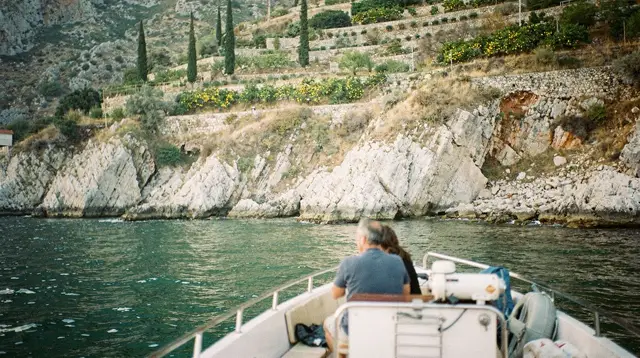
The defining image of the Esterel is the colour contrast: rust-red porphyry rock against pine green and sea blue, most striking in the low light of morning or early evening. Several short viewpoints along the Corniche d’Or are built for exactly this — pull-offs with parking for a few cars, no facilities, just the view.
Below the road, a scattering of small coves and beaches sit at the base of the cliffs, some reachable on foot from the coastal path (the sentier du littoral), others realistically only from the water. Swimming here tends to mean rock and small shingle rather than sand — closer in feel to the coves near Villefranche than to the open sand at Cannes or Fréjus. Bring water shoes if wading in and out over rock appeals more than it sounds.
A boat trip is the most efficient way to see a run of these coves in sequence without a long walk or repeated parking searches, which is why most day-trip itineraries out here are built around one.
Boat trips, flights, and other ways to see the coast
Boats are the default way to experience the Esterel coastline properly, since much of it has no road directly alongside it. A route along the base of the cliffs from Cannes or Saint-Raphaël typically also passes Saint-Tropez’s bay without stopping there, which is a useful distinction: seeing the coastline from the water is not the same outing as walking Saint-Tropez’s port and old streets, and the two should not be confused when comparing tours.
a private boat trip that follows the red cliffs of the Estérel at your own pace covers the coastline itself without a fixed group schedule. For a wider day that pairs the cliffs with a stop further along the coast, a day trip from Nice that crosses to Saint-Tropez by way of the Estérel coastline combines both, though it is worth confirming with the operator how much time is actually spent at each stop rather than in transit.
On the water, wildlife spotting is a possibility rather than a promise: dolphins are seen in the Gulf of Saint-Tropez and along this stretch of coast at times, and a dolphin-watching outing departing Saint-Raphaël is built around that chance, but no operator can guarantee a sighting on a given day.
For a different vantage point entirely, a short scenic flight from Cannes over the coast to Fréjus shows the red cliffs, the bays, and the shape of the massif from above in a fraction of the time a boat or car takes — a good option if the day is short or if seeing the geography from the air matters more than being on the water.
Inland, Fréjus also has a wine-producing area associated with the Côtes de Provence appellation; a guided winery visit and tasting near Fréjus is a reasonable way to fill an afternoon for travellers with a car who have already covered the coast by late morning.
Practical costs and timing
Costs vary by operator and season, but the ranges below give a working sense of what to expect for planning purposes.
| Activity | Typical duration | Rough price range |
|---|---|---|
| Boat trip along the red cliffs | 2–4 hours | €40–€90 per person |
| Saint-Tropez day trip via the Estérel coast | Full day | €70–€130 per person |
| Scenic flight, Cannes to Fréjus | 25–45 minutes | €100–€200 per person |
| Guided winery visit near Fréjus | 2–3 hours | €30–€60 per person |
| Dolphin-watching outing | 2–3 hours | €40–€80 per person |
These are day-trip prices only and do not include the cost of reaching Cannes or Saint-Raphaël from Nice if the tour does not start there. Book boat trips and flights ahead in July and August, when both fill up and coastal weather cancellations (wind, in particular) can push everyone onto the remaining slots.
Best time to go
May, June and September give the most comfortable combination of warm water, reliable weather, and lighter crowds on boats and at coastal parking spots. July and August bring the warmest sea and busiest conditions — book ahead for anything on the water. Spring and early autumn also suit the coastal footpaths better than the height of summer heat, when shade is scarce along most of the Corniche d’Or. As with the rest of the Riviera, October and November can bring intense, sudden rainstorms (épisodes méditerranéens); check the forecast before a coastal walk or boat trip in that window.
Mistakes to avoid
A few recurring issues worth planning around:
- Treating this as a quick add-on to a Nice or Cannes day. It is its own destination, on the far side of Cannes, and deserves its own day rather than a rushed hour.
- Confusing an Esterel coastal tour with a Saint-Tropez visit. A boat that passes the Gulf of Saint-Tropez without stopping is not the same as a day spent walking Saint-Tropez itself.
- Expecting sandy beaches throughout. Much of the Corniche d’Or is rocky red coastline; sand is more common around Saint-Raphaël and Fréjus than along the cliff sections further east.
- Skipping a weather check. Boat trips and scenic flights here are more exposed to wind than sheltered spots like Villefranche, and cancellations happen.
- Driving without a plan for parking. The small pull-offs along the Corniche d’Or fill quickly in summer, particularly around Le Trayas and Agay.
Esterel, Saint-Raphaël and Fréjus day trips: frequently asked questions
How far is the Esterel from Nice?
The Corniche d’Or runs roughly from Mandelieu-la-Napoule to Saint-Raphaël, past the western edge of Cannes. By car, budget well over an hour each way outside peak traffic, more in summer. By train, Nice to Saint-Raphaël-Valescure takes around an hour to ninety minutes depending on the service, then you still need to reach the cliffs themselves.
Is this the same trip as Saint-Tropez?
No. Saint-Tropez sits further west along the same stretch of coast and is its own destination: a village to walk around, not a stretch of cliffs to photograph. Some boat crossings link the two areas, but treat an Esterel day and a Saint-Tropez day as separate outings rather than one combined tour.
What is the best way to see the red cliffs without a car?
A boat trip from Cannes or Saint-Raphaël is the simplest option: it runs along the base of the cliffs, reaches coves that have no road access, and removes any parking search. The train to Saint-Raphaël or Théoule-sur-Mer, followed by the coastal path, also works for a slower, on-foot version.
Can I combine the Esterel with Monaco or Eze in one day?
Not realistically. Monaco and Eze already fill a day heading east from Nice; the Esterel, Saint-Raphaël and Fréjus sit west, on the far side of Cannes. Trying to cover both directions in one day means long transfers and very little time anywhere. Pick one direction per day.
Are there sandy beaches in the Esterel, unlike central Nice?
Some, in pockets. The Corniche d’Or alternates rocky red coves, small sand-and-shingle beaches, and stretches accessible mainly by boat or footpath. Saint-Raphaël and Fréjus have more conventional sand beaches than the cliff sections further east toward Théoule-sur-Mer.
What is there to see in Fréjus besides the coast?
Fréjus has a Roman amphitheatre and other Roman remains, an episcopal cloister, and a working wine-growing area nearby. It is a reasonable add-on to a coastal day if you are travelling by car rather than boat, since the historic centre sits a short drive inland from the marina.
When is the best time to visit the Esterel coast?
May, June and September give warm water and daylight without the peak-August crowding on boats and coastal parking. July and August are busiest and hottest; book any boat trip or flight in advance for those months. Spring and autumn also suit the coastal walking paths better than midsummer heat.
Related reading
For the village itself rather than a coastal survey, see the dedicated Saint-Tropez day trip guide. For the full spread of options heading out of Nice, the day trips from Nice overview compares this route against Monaco, Eze, Cannes and the Verdon gorge. Travellers weighing east against west on a given day may also find the Monaco day trip guide and the Eze day trip guide useful for planning the other direction, and the Italian Riviera day trip guide for a third alternative entirely. Inland, the Verdon gorge day trip guide covers the longest of the day-trip options from Nice.
For context on the wider area, the Estérel destination page, the Var coast destination page and the Saint-Tropez destination page lay out the geography in more detail, and the Cannes destination page covers the town most people pass through en route. The things to do around the Estérel hub lists activities by type, and the two-day Saint-Tropez and Estérel coast itinerary is a better fit for anyone who wants to slow the pace down rather than pack it into one day. For a broader sense of Riviera swimming spots including the coves along this coast, see the guide to hidden coves near Nice, and for boat-based options departing Nice itself, the Nice boat tours and snorkelling cruises guide.
Day trips to Monaco, Cannes and Saint-Tropez
Verified deep-linked GetYourGuide tours. Book through these links and we earn a small commission at no cost to you.
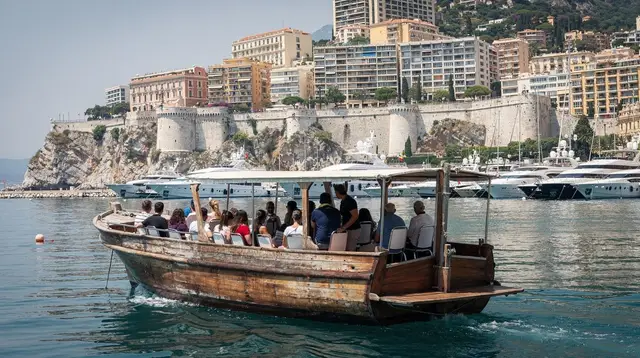
GetYourGuide does not provide a product photo for this activity — the image shows the meeting point, photographed by us.