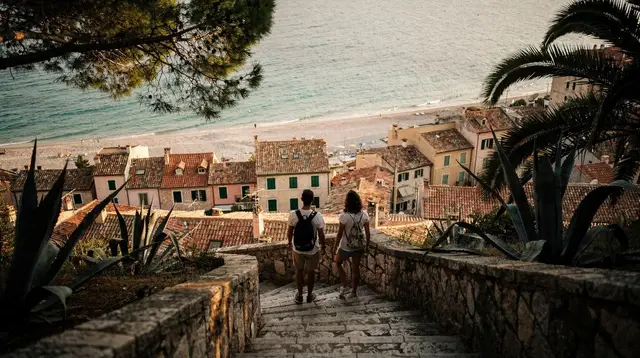
Saint-Tropez walking tours: the old port, the ruelles and the Citadelle
Can you walk around Saint-Tropez on a day trip from Nice?
Yes, but plan the journey first: Saint-Tropez is around 100 km from Nice, often two to three hours by road in summer, or reachable by a seasonal boat from Nice or Cannes. Once there, the old port, the ruelles and the Citadelle are an easy half-day on foot.
Before you start walking: how far Saint-Tropez actually is
Saint-Tropez gets folded into Riviera itineraries so often that visitors assume it sits somewhere near Cannes or Nice. It doesn’t. The village is around 100 km from Nice and about 70 km from Cannes, at the end of a peninsula with no motorway access. In July and August, the coast road through Fréjus, Sainte-Maxime and around the Golfe de Saint-Tropez regularly takes two to three hours from Nice, longer if there has been an accident on the single approach road. Outside peak summer, the same drive can run closer to ninety minutes to two hours.
That distance matters for a walking-tour guide, because the walk itself is short. The old port, the ruelles of La Ponche and the Citadelle hill add up to two or three hours on foot. The journey there and back is usually longer than the walk. Anyone planning a day from Nice should treat the transport as the main logistical decision, not an afterthought, and decide before leaving whether they are driving, taking an organised coach, or catching one of the seasonal boats.
This guide covers the village itself: the port, the old streets, the Citadelle and the practical questions around getting there and back. It does not cover Pampelonne beach in Ramatuelle, which sits several kilometres south of the village and belongs to a separate beach-day plan, and it does not stray into the Esterel coast around Saint-Raphaël and Fréjus, which is a different stretch of the Var covered on its own Esterel day-trip guide.
Getting there: road, coach or boat
By car. The drive from Nice runs via the A8 motorway to Le Muy, then secondary roads down the peninsula. Parking in Saint-Tropez itself is limited and expensive in summer; the main car parks (Parking du Port and Parking des Lices) fill early on July and August mornings, and roadside parking further out means a ten- to twenty-minute walk in. Renting a car makes more sense for combining Saint-Tropez with the Esterel coast or Provence than for a single village visit.
By seasonal boat. From roughly April to October, boats connect Nice and Cannes to the old port of Saint-Tropez, arriving directly at the quay rather than at an inland car park. Crossing times run from about an hour from Cannes to two hours or more from Nice, depending on the operator and any stops along the way. This is the most scenic approach, arriving by sea in front of the pastel façades of the port, and it removes the need to find parking altogether.
By organised tour. A full-day tour from Nice or Cannes bundles the transport and the walk together, useful for anyone who would rather not manage the drive or the boat timetable themselves, and it often includes commentary on the route down.
| Option | Approx. time from Nice | Approx. time from Cannes | Notes |
|---|---|---|---|
| Car (A8 + coast road) | 2–3 hours in summer | 1.5–2 hours in summer | Parking scarce and pricey in July–August |
| Seasonal boat | 1.5–2.5 hours | About 1 hour | Runs roughly April–October, weather dependent |
| Organised day tour | Half to full day round trip | Half to full day round trip | Transport and guiding combined |
a sea crossing from Cannes to Saint-Tropez is the fastest way in without a car, and it lands within a few minutes’ walk of everything covered below.
The old port and the quayside
The walk naturally starts at the Vieux Port, where the working fishing boats that gave the village its identity still share the water with the superyachts that gave it a different reputation from the 1950s onward. The quay is lined with cafés, most of them priced for the view rather than the coffee, and it is the best vantage point for the pastel three- and four-storey houses that line the harbour. Early morning, before the day-trippers arrive, is when the port is genuinely quiet and the fishing catch is still being unloaded near the Môle Jean Réveille.
From the port, the Place aux Herbes sits just behind the quay, hosting a small produce and fish market most mornings — smaller and less staged than Cours Saleya in Nice, but a useful stop for fruit, olives and local cheese before heading into the ruelles.
Into the ruelles: La Ponche and the old fishing quarter
Behind the yacht-lined quay, Saint-Tropez keeps a genuinely old fishing village. La Ponche, the quarter east of the port, is a tangle of narrow lanes, low stone houses and small squares that predates the resort era by centuries. It is where the original fishing community lived, and it is where the village feels smallest and least performed for visitors. The Place de la Mairie and the streets around Rue de la Ponche and the tiny Port des Pêcheurs are worth wandering without a fixed route — this is a quarter that rewards getting slightly lost for twenty minutes.
The Place des Lices, a plane-tree-shaded square a short walk inland, hosts a market on Tuesday and Saturday mornings and doubles as a pétanque ground the rest of the week; it is one of the few spots in the village centre that still functions as a genuine gathering place for residents rather than visitors.
The Citadelle: the view worth the climb
Above the old town, the Citadelle de Saint-Tropez is a 16th-century fort reached by a paved but sloped path, roughly ten to fifteen minutes uphill from the port. The climb is the steepest part of this walk, but it is short, and the payoff is a clear view over the Golfe de Saint-Tropez, the red-tiled roofs of the old town, and the Maures hills behind. Inside the fort, the Musée d’Histoire Maritime covers the village’s naval and fishing history, with a modest entrance fee; opening hours are shorter outside the summer season, so it is worth checking before the climb if the museum itself is the goal rather than the view.
Churches, chapels and small museums
The Église Notre-Dame-de-l’Assomption, with its distinctive pink bell tower, sits just off the port and is a quick stop rather than a destination in itself. The Chapelle Sainte-Anne, further up the hill toward the Citadelle, is smaller still, often closed outside specific opening hours, but its terrace gives another useful sea view partway up the climb. Neither requires more than a few minutes, and both fit naturally into the route between the port and the Citadelle without a detour.
What this walk does not cover
A short village walk is not the same trip as a Saint-Tropez day out, and it is worth being clear about the difference before setting expectations.
- Pampelonne beach, in the neighbouring commune of Ramatuelle, is several kilometres south of the village and requires a car, bus or taxi — it is not walkable from the old port.
- Ramatuelle village itself, a separate perched village inland from Pampelonne, is a different stop on a longer itinerary.
- The Esterel coast around Saint-Raphaël and Fréjus is a distinct region to the east, covered separately, and this guide does not extend into it.
- Wine estates in the Golfe de Saint-Tropez countryside sit outside the village and belong to a food-and-wine outing rather than a walking tour of the streets.
Trying to combine all of the above with a two- to three-hour drive each way from Nice in a single day is the most common planning mistake — the village walk alone is comfortable as a day trip; adding the beach, Ramatuelle and a vineyard visit generally is not.
Crowds, timing and what to skip
July and August bring the heaviest crowds to the quay and the narrow ruelles of La Ponche, particularly between late morning and early evening when both day-trippers and yacht traffic peak. Arriving on an early boat or starting the walk before 10am avoids most of it. May, June and September keep the same village atmosphere with noticeably thinner crowds and lower prices on the port-front cafés. There is no need to book the walk itself — the streets are public and open at any hour — but a seasonal boat crossing or an organised day tour is worth booking a few days ahead in peak summer, since capacity on the smaller boats is limited.
a guided walk through the old port and La Ponche adds context on the fishing-village history that is easy to miss walking through alone, and it keeps the route efficient for anyone working around a boat or coach schedule back to Nice or Cannes.
For a smaller group or a route built around a specific arrival time, a private guided walk of Saint-Tropez can start from the port the moment a boat docks, which matters when the return crossing is fixed for later in the day.
Combining the walk with the rest of the day
Given the length of the journey from Nice, most visitors pair the village walk with either the boat crossing itself as the day’s main activity, or with a longer organised outing that also covers the drive down. a full-day small-group tour to Saint-Tropez typically bundles the transport, free time in the old town for this walking route, and a guide who can flag the practical details — market days, museum hours, where the crowds bunch up — without requiring any planning in advance.
For a different pace once in the village, the flat lanes of the port and the gentler streets toward Place des Lices also suit an easy-going cycling option rather than walking the whole route, which is worth considering on a hot July afternoon.
Practical notes
- Getting there: no direct train; drive via the A8 and coast road, take a seasonal boat from Nice or Cannes (roughly April–October), or book an organised tour.
- Parking: limited and expensive in summer; expect to walk from an outer car park if driving in July or August.
- Walking time: about two hours for the port and old town, three to four hours including the Citadelle.
- Best hours: before 10am or after 6pm in summer; any time in May, June or September.
- Market days: Place des Lices on Tuesday and Saturday mornings; Place aux Herbes most mornings.
- What’s nearby but separate: Pampelonne beach (Ramatuelle), Ramatuelle village, the Esterel coast toward Fréjus.
Frequently asked questions about walking around Saint-Tropez
Is Saint-Tropez close to Nice?
No. It is around 100 km away, and the coast road through Fréjus and Sainte-Maxime often takes two to three hours in summer traffic. There is no motorway link into Saint-Tropez itself, which is what makes the drive slow.
How do I get to Saint-Tropez without a car?
From April to October, boats run from Nice and Cannes directly to the old port, taking roughly one to two and a half hours depending on the departure point and stops. Outside that season, the practical option is a coach or organised tour from Nice or Cannes, since there is no direct train line.
How long does the walking route through the old town take?
The old port, La Ponche and the main squares can be covered in about two hours at a relaxed pace, including stops. Adding the Citadelle hill and its museum brings it closer to three to four hours.
Is the Citadelle worth the climb?
Yes for the view over the Golfe de Saint-Tropez and the Maures hills behind the village. The walk up from the old town takes about ten to fifteen minutes on a paved but sloped path, and there is a small entrance fee for the museum inside.
What is the best time of day to walk around Saint-Tropez?
Early morning, before 10am, when the port is quiet and the fish market on Place aux Herbes is still setting up. Midday to late afternoon in July and August gets crowded on the quay and in the narrow ruelles.
Do I need to book a guided walking tour in Saint-Tropez?
It is not required, since the old town is compact and easy to navigate alone, but a guided walk adds context on the fishing-village history behind the yachts, and a private guide can time the route around your own arrival and departure.
Is Pampelonne beach part of this walk?
No. Pampelonne is in Ramatuelle, a separate commune several kilometres south of the village, reached by car, bus or taxi rather than on foot. It belongs to a day-trip itinerary, not a walk through Saint-Tropez itself.
For the fuller version of the day, including transport comparisons and a route that also reaches Pampelonne, see the Saint-Tropez day-trip guide from Nice. For a two-day pairing with the coast further east, see the Saint-Tropez and Esterel coast two-day itinerary. Transport options on the French Riviera by TER train and renting a car on the French Riviera cover the wider region if Saint-Tropez is one stop among several. For the crossing itself, the Saint-Tropez boat tours guide and Cannes boat tours and yacht cruises lay out departure points and timings in more detail, and Nice to Cannes transport options is useful for anyone starting the day from Nice via Cannes.
Walking tours of Vieux-Nice and the Riviera
Verified deep-linked GetYourGuide tours. Book through these links and we earn a small commission at no cost to you.
GetYourGuide does not provide a product photo for this activity — the image shows the meeting point, photographed by us.