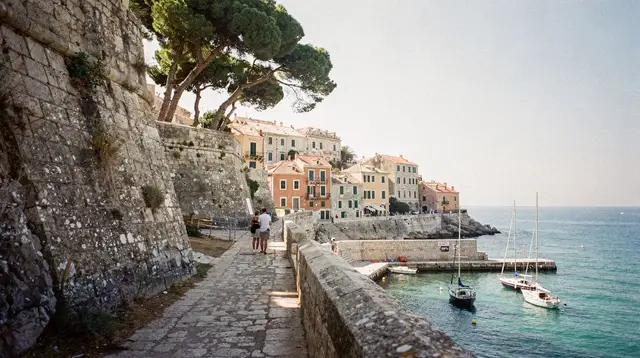
Cannes by e-bike and vintage car: an easier way to see the coast
What's the difference between an e-bike tour and a vintage car tour of Cannes?
An e-bike tour covers La Croisette, Le Suquet and nearby streets at your own pace, with the effort of hills flattened out. A vintage bus, sidecar or classic car tour covers more ground, including the Corniche d'Or toward the Esterel, without any pedalling, and usually comes with a driver-guide narrating as you go.
Why cover Cannes on wheels instead of on foot
Cannes rewards a slower walk through Le Suquet and a stroll down La Croisette, but it also stretches further than most visitors expect once you add the port, the western beaches and the road toward the Esterel. Covering that on foot in a single afternoon means either skipping the Corniche d’Or entirely or arriving too tired to enjoy it. An e-bike, a vintage car or a sidecar closes that gap: the same landmarks, plus the option to keep going west along the coast, without turning the day into a hike.
This page is specifically about getting around Cannes and its near coastline on wheels. If you want the walking version of the old town and its museum, the Antibes old town walking tour guide covers that on foot instead, since Antibes’ ramparts and the Picasso museum are better explored slowly, on narrow lanes a bike can’t easily enter. And if the plan is to reach the Lerins Islands, that’s a boat trip, not a road one — see the Lerins Islands ferries and boat trips guide. Cycling on the other corniches further east, around Eze or above Monaco, belongs to those destinations’ own pages, not this one.
What an e-bike tour of Cannes actually covers
A typical e-bike tour runs around 2 hours and threads together the parts of Cannes that sit close but feel disconnected on foot: La Croisette and its beach clubs, the harbour at Port of Cannes with its rows of yachts, and the climb up into Le Suquet, the old fishing village on the hill above the port. The electric assist matters most on that last stretch — Le Suquet’s lanes rise steeply enough that a standard bike makes it a workout, while an e-bike turns it into a short, manageable climb with a payoff at the top: a wide view over the bay, the islands and, on a clear day, the hills behind Mandelieu.
a 2-hour e-bike tour through La Croisette, the port and Le Suquet is the most flexible format for a first visit — small groups, frequent stops, and enough time to get off and walk into the old town’s covered market or a side street without holding up a bus.
Table below gives a rough sense of how the formats compare, since prices shift by season and operator:
| Format | Typical duration | Ground covered | Best for |
|---|---|---|---|
| E-bike, small group | 2 hours | La Croisette, port, Le Suquet | First visit, flexible pace, some walking |
| Vintage bus | 1.5–2 hours | Cannes highlights, wider loop | Larger groups, no effort required |
| Sidecar or classic car | 1.5–3 hours | Cannes plus Corniche d’Or to the Esterel | Couples, photo-focused, further reach |
| Private car tour | Flexible, often half-day | Cannes plus custom stops | Small groups, families, set schedule |
Vintage bus and classic car options
For visitors who’d rather sit back than pedal, a vintage bus tour loops through Cannes’ main points — La Croisette, the Palais des Festivals, the port and a pass by Le Suquet — with a driver-guide narrating along the way. It’s a shared format, usually the least expensive of the wheeled options, and it suits anyone short on time, travelling with people who can’t cycle, or visiting in the heat of August when riding is uncomfortable.
a vintage bus tour looping through Cannes’ main sights works well as a compact orientation on a first afternoon, especially paired with a later walk down La Croisette at your own pace once you know the layout.
A private car tour built around the port, such as a personalised private tour starting from the port of Cannes, gives more control over the stops and pace, and suits families or small groups who want a set half-day without planning the route themselves.
The Corniche d’Or by sidecar: Cannes to the Esterel
This is where a wheeled tour earns its place over a walking one. The Corniche d’Or runs along the coast between Mandelieu and Saint-Raphael, past the red volcanic rock of the Esterel massif dropping straight into the sea — a landscape that looks nothing like the pale stone and pebble beaches around Nice. It’s roughly 30 to 40 minutes each way from central Cannes by road, too far to fold into a walking day but a natural extension for a car or sidecar tour that’s already covering the coastline.
a sidecar tour along the Corniche d’Or toward the Esterel’s red cliffs is built for exactly this: an open-air ride with the wind and the coast road doing the work, stopping at viewpoints a car tour would drive past. It suits couples and small groups more than families, since sidecars typically carry one passenger per vehicle. Anyone who wants more time on that coastline, including on foot or on the water, should look at the dedicated Esterel day trip from Nice guide, which treats the Esterel as its own destination rather than an add-on.
For context on where the Esterel sits relative to Cannes: it’s the coast immediately west, not a separate region, and it’s covered as its own page at The Estérel: red cliffs and the Corniche d’Or alongside Cannes: the Croisette, the Suquet and the Lérins Islands for the city itself.
What’s genuinely worth the detour, and what to skip
Le Suquet’s viewpoint is worth the climb even on a hot afternoon — it’s the one spot in Cannes where the whole bay, the islands and the surrounding hills line up in a single view, and an e-bike removes the only real obstacle to reaching it. The Corniche d’Or is worth the extra 30 to 40 minutes each way if red rock coastline genuinely interests you; if it doesn’t, a shorter e-bike or bus loop within Cannes covers the essentials without the extra time on the road.
What’s not worth planning around: the Lerins Islands don’t feature on any of these road-based tours, since they sit offshore and are reached only by boat from the port — see the boat guide linked above instead. And a bike or car tour won’t get you inside the Picasso museum in Antibes or through its ramparts in any useful way; that’s a separate destination with its own walking tour.
Best time of year for a wheeled tour of Cannes
Cannes sits on the same Mediterranean climate as the rest of the Riviera: hot, dry summers from June to September, with the sea reaching around 24–26°C in August, and mild winters where afternoons on the coast often hold at 12–15°C even when the hinterland above Grasse and further inland turns cold. That split matters for planning a bike or car tour. In July and August, La Croisette and Le Suquet’s lanes are at their most crowded by mid-morning, and the heat makes unassisted effort uncomfortable — an e-bike’s assistance helps more here than at any other time of year, and an early tour, before around 11am, avoids both the worst of the crowds and the worst of the sun.
Spring and early autumn are the more comfortable stretch for riding: fewer people on La Croisette, cooler temperatures for the climb into Le Suquet, and tour prices that sit below the May-to-August peak. Winter tours run too, since the coastal climate stays mild, though days are shorter and some operators reduce frequency outside the main season. October and November carry a separate risk worth knowing about: this is when the Mediterranean coast is most exposed to intense, sudden rainstorms, so an open-air sidecar or a bike tour booked for that period is worth checking against the forecast rather than assuming a Riviera “mild autumn” holds every day.
If a full day isn’t available
Not every visit allows a dedicated Cannes day. Travellers based in Nice who only have a few hours can still fit in a short e-bike loop or a vintage bus tour around La Croisette and Le Suquet before heading back — the Cannes day trip from Nice guide lays out timing for a half-day version built around the train. For anyone deciding where to stay for a longer Riviera trip rather than just visiting for the day, the Nice vs Cannes as a base guide weighs up the two towns directly, including how easily each one supports a wheeled tour of the other. And for a slower, on-foot alternative to pair with or replace a wheeled tour, the Cannes walking tours guide covers the same streets — La Croisette, the port, Le Suquet — at a walking pace, useful for a second visit once the bike or car version has already given the lay of the land.
The Cannes Film Festival: what it changes
The Cannes Film Festival runs in May, and it reshapes the town for its duration. Sections of La Croisette and the streets around the Palais des Festivals close to general traffic and sometimes to pedestrians without accreditation, hotel and tour prices climb well above their usual range, and some e-bike or vintage car routes get rerouted around closures. None of this is announced far in advance for a given year, so if a trip falls anywhere near the festival period, it’s worth checking current road access and tour availability closer to the date rather than assuming the usual route applies. Details on what to expect are in the Cannes Film Festival for visitors guide.
Getting to Cannes and getting around once there
Most visitors reach Cannes from Nice by train along the coastal TER line, a straightforward ride with no car needed — the transport options from Nice to Cannes guide covers timing and cost. Cannes itself is walkable at its centre, but La Croisette runs long enough, and Le Suquet’s hill steep enough, that an e-bike or vintage tour genuinely saves time rather than just adding novelty. If driving from Nice instead, parking in central Cannes gets difficult and expensive in summer; see driving and parking in Nice and renting a car on the French Riviera for the wider picture, and the general getting around the French Riviera guide for how Cannes fits into a car-free trip.
Combining Cannes with Antibes and the islands
A wheeled tour of Cannes pairs naturally with a walking day in Antibes and a boat day to the Lerins Islands, since the three cover different ground — road, foot and water — without much overlap. The Cannes, Antibes and the Lerins Islands in two days itinerary lays out one way to sequence them. If the Esterel and Saint-Tropez are also on the list, the Saint-Tropez and the Esterel coast in two days itinerary is built around that stretch of coast specifically — worth noting that Saint-Tropez itself sits roughly 110km from Cannes, closer to 1.5 to 2 hours by road, so it’s a separate outing rather than an extension of a Cannes afternoon.
For a wider view over the bay before or after a tour, the best viewpoints on the French Riviera guide includes Le Suquet alongside other spots along the coast worth the climb.
Prices and booking notes
E-bike and vintage bus tours typically run in the moderate range for a 1.5 to 2 hour format, while sidecar and private car tours cost more given the smaller group size and longer routes toward the Esterel. Prices rise noticeably around the Film Festival in May and through July and August, and popular slots — especially morning e-bike tours and sidecar rides — can sell out a few days ahead in peak season. Booking a day or two in advance is usually enough outside of May and midsummer; during those periods, earlier is safer.
Cannes wheeled tours FAQ
Is an e-bike or vintage car tour better for a first visit to Cannes?
An e-bike tour is better for a first visit if you want to stop often, walk into Le Suquet’s lanes and set your own pace. A vintage car or bus tour suits visitors with less time or mobility, or anyone who wants the Corniche d’Or included without driving it themselves.
Do these tours go all the way to the Esterel?
Some do. A sidecar or vintage car tour along the Corniche d’Or reaches the red rock coastline between Mandelieu and Saint-Raphael, roughly 30 to 40 minutes each way from central Cannes. A short e-bike tour usually stays within Cannes and its immediate coastline.
How fit do I need to be for an e-bike tour of Cannes?
Very little. Electric assistance handles the short rises around Le Suquet and the residential streets above La Croisette. Most tours are 2 hours or less and suit casual riders, though narrow old-town lanes mean some sections are walked with the bike.
Does the Cannes Film Festival affect these tours?
Yes. During the festival in May, sections of La Croisette and nearby streets close to traffic and to general access, prices for accommodation and tours rise, and some bike or car routes get rerouted. Check availability further ahead if your visit falls in that period.
Can I see Antibes or the Lerins Islands on the same tour?
Not usually on a Cannes-focused e-bike or vintage car tour, which stays on land around Cannes itself. Antibes is a separate walking destination and the Lerins Islands are reached by boat, not by road, so they’re covered on their own tours.
Are vintage car and sidecar tours private?
Most sidecar and classic car tours run as small private or shared rides for 1 to 3 passengers, since the vehicles seat few people. A vintage bus tour is a shared group format and usually the cheaper option per person.
What’s the best time of day for a bike tour of Cannes in summer?
Morning, before around 11am. La Croisette and the Suquet lanes fill with foot and car traffic by midday in July and August, and the heat makes cycling less comfortable in the early afternoon.
Bike, scooter and vintage car tours of the Riviera
Verified deep-linked GetYourGuide tours. Book through these links and we earn a small commission at no cost to you.
GetYourGuide does not provide a product photo for this activity — the image shows the meeting point, photographed by us.