Walking Cannes: La Croisette, the Palais and Le Suquet
What's the best way to see Cannes on foot?
Walk the seafront along La Croisette to the Palais des Festivals, then climb into Le Suquet, the old hill town, for the view and narrow streets. Add Marché Forville for the daily market. The full loop covers about 4 to 5 kilometres and takes half a day at an easy pace.
Cannes reads as one thing from a car window — the seafront, the hotels, the flags — and as a different, more layered place once you’re walking it. The city is really two towns pushed together: the 19th-century resort that grew up along the bay to serve winter visitors, and the fishing village on the hill above the old port that was there long before anyone thought to build a promenade. Seeing both on foot, in the right order, is what makes sense of Cannes rather than just photographing it.
Getting your bearings in Cannes
Cannes sits on a shallow bay facing south, with the Îles de Lérins visible offshore and the red rock of the Estérel massif closing the view to the west. The city centre is compact enough to walk end to end in under an hour: La Croisette runs along the water for roughly 3 kilometres from the Palais des Festivals to the Port Canto, Le Suquet rises directly behind the old port at the western end, and the newer shopping streets (Rue d’Antibes, Rue Meynadier) sit in between. Nothing described here needs a car, a bus, or more than comfortable shoes.
Most visitors arrive by train into Cannes station, a 10-minute walk from both La Croisette and Le Suquet, which makes this an easy add-on to a day based in Nice or a stop on its own. If you’re coming specifically for the seafront and the Riviera-glamour photographs rather than the history, Cannes photo shoots covers that angle in more depth; this guide is about understanding the city, not styling a picture in it.
La Croisette: the seafront everyone pictures
La Croisette is the curved boulevard that gave Cannes its postcard image: palm trees, the beach on one side, a line of belle-époque and Art Deco hotel facades on the other — the Carlton, the Martinez, the JW Marriott among them. Walking it start to finish takes about 45 minutes without stopping, longer if you pause at the Palais des Festivals or the beach clubs along the way.
The beach itself is mostly private here — sunbeds and parasols belong to the hotel and restaurant concessions that line the sand, and using one means paying for the day. Public sections do exist, generally smaller and less shaded, at intervals along the boulevard; don’t expect to just walk onto a free stretch of sand the way you can at Juan-les-Pins further along the coast. If beach time matters more than the walk, it’s worth checking a section’s access before settling in rather than assuming.
At the eastern end, La Croisette continues past the Port Canto marina and the Palm Beach casino toward quieter residential streets; most walkers turn back well before that, since the interest thins out past the main hotel row.
The Palais des Festivals and the red carpet myth
The Palais des Festivals et des Congrès sits at the western end of La Croisette, where the boulevard meets the old port. This is the building behind the Cannes Film Festival’s red carpet each May, and outside of festival dates it’s a working congress centre — closed to casual visitors on the inside, but its steps, the red-carpeted entrance (recreated for photos even off-season by some tour operators), and the Allée des Stars with its handprints of past festival guests along the promenade are all freely visible from the street.
It’s worth being honest about scale here: the building itself is a large, fairly plain modern convention centre, not an ornate landmark, and its interest is almost entirely what it represents rather than what it looks like. A short stop of 10 to 15 minutes covers it. For visitors specifically interested in the festival’s history and how it reshapes the city each spring, Cannes Film Festival for visitors goes into the detail that doesn’t belong in a walking-route guide.
Just past the Palais, the Vieux Port (old port) opens up, lined with yachts and fishing boats and the departure point for excursions along the coast and out to the islands — covered separately, since that’s a different kind of outing from a walk.
Le Suquet: Cannes before the film festival
Climb the streets behind the old port and you leave the resort town behind almost immediately. Le Suquet is Cannes’ original settlement, built on a low hill for the same reason as most old Riviera villages — visibility and defence against raids from the sea — long before anyone had reason to build a seafront promenade below it.
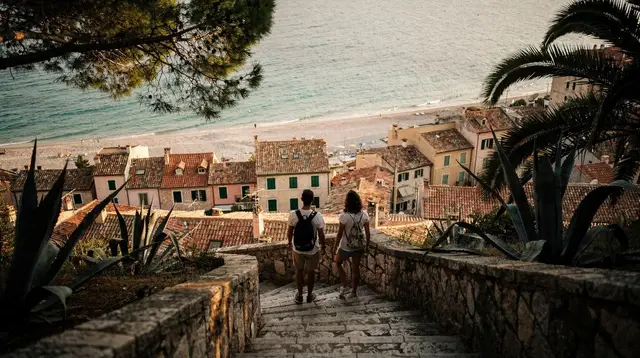
The climb is short but genuinely steep in places: narrow stepped lanes (Rue Saint-Antoine is the main one, lined with restaurants), pastel facades, and laundry strung between windows in the older corners. At the top, the Tour du Suquet and the Musée de la Castre — housed in a former monastery — sit around a small square with the best free view in Cannes: the bay, the Palais des Festivals below, and the Îles de Lérins offshore on a clear day. The museum itself is worth 30 to 45 minutes if art and Mediterranean archaeology interest you; the square and the view cost nothing and take five minutes to reach the edge.
Le Suquet is at its best in the early morning or the last two hours before sunset, when the light is soft and the restaurant terraces aren’t yet at their busiest. At midday in summer, the narrow streets fill with tour groups moving between the port and the viewpoint, and the climb feels more crowded than the modest size of the neighbourhood suggests.
Marché Forville: where Cannes actually shops
A few streets inland from Le Suquet, Marché Forville is Cannes’ main covered market — fish stalls facing the port side, produce and cheese on the other, and a scattering of small counters selling socca, olives, and local specialities to eat on the spot. It runs most mornings and winds down by early afternoon; on Mondays the food stalls close and the hall becomes a brocante and antiques market instead, a different but equally worthwhile stop.
This is the part of a Cannes walk that has nothing to do with the film festival or the seafront, and it’s worth building fifteen minutes into any route for exactly that reason — it’s where the city’s own residents shop, priced and paced for them rather than for visitors. A handful of restaurants around the market’s edges buy directly from the stalls each morning, which is usually a reasonable sign of quality if you’re looking for lunch nearby.
When the Film Festival takes over the city (May)
The Cannes Film Festival runs for about two weeks in May, and it reshapes the city more than most first-time visitors expect. Hotel prices around La Croisette rise sharply — often several times normal rates — and availability tightens weeks in advance. Streets immediately around the Palais des Festivals close to traffic and sometimes to pedestrians without accreditation, security checkpoints appear along the seafront, and the crowds along La Croisette thicken with press, industry guests, and onlookers hoping for a glimpse of arrivals.
None of this makes Cannes unpleasant to visit in May outside the festival’s exact dates — the rest of the month is quiet, and the weather is usually excellent — but visiting the city specifically for the festival period without accreditation means planning around closures and higher prices rather than a normal walking day. If the festival itself is the draw, Cannes Film Festival for visitors covers what’s actually accessible to the public.
A simple walking route, half a day
There’s no need to overthink the order — start at the water and finish on the hill, or the reverse, depending on when you want the best light in Le Suquet.
| Stop | Time to allow | Notes |
|---|---|---|
| Palais des Festivals and Allée des Stars | 15–20 min | Outside only; busiest in late morning |
| La Croisette (full length) | 45–60 min | Longer with beach or café stops |
| Vieux Port | 10–15 min | Departure point for boat excursions |
| Le Suquet (climb, viewpoint, Musée de la Castre) | 60–90 min | Best early morning or late afternoon |
| Marché Forville | 15–30 min | Mornings only; closed for food on Mondays |
Total walking time comes to roughly 3 to 4 hours including stops, comfortably a half-day rather than a rushed hour off a train. Adding a guided version removes the guesswork on timing and context: a 2-hour guided walk covering the Croisette, the Palais and Le Suquet hits the same route with a local guide filling in the history at each stop, and a walking tour paired with a food and wine stop beyond the red-carpet sights works well if Marché Forville’s produce has you thinking about lunch rather than a museum.
For a shorter, self-timed option, a general walking tour of Cannes’ old town and seafront covers the same ground at a gentler pace, and travellers who’d rather have the day built around them than follow a fixed route can book a private, personalised tour starting from the port of Cannes instead.
Beyond the walk: what this guide leaves out
Three things deliberately sit outside this route. The Îles de Lérins — Sainte-Marguerite and Saint-Honorat — are a boat trip from the old port, not a walk, and get their own coverage in Lérins Islands ferries and boat trips; this guide only notes where the boats leave from. Antibes, with its own walled old town and Picasso museum, is a separate Riviera-west destination with its own old town walking tours guide rather than a Cannes add-on. And anyone approaching Cannes purely for photography — the light on La Croisette, the beach clubs, the golden-hour view from Le Suquet — is better served by Cannes photo shoots, which is built around locations and timing rather than orientation.
If Cannes is a stop on a longer Riviera trip rather than a standalone day, Cannes, Antibes and the Îles de Lérins in two days fits this walk into a broader plan, and day trip from Nice covers getting here and back if you’re based on the Nice side of the Riviera. Deciding whether to actually stay overnight in Cannes rather than visit for the day is a separate question, covered in Nice vs Cannes as a base. Food along the walking route, particularly around Marché Forville, gets fuller treatment in Cannes food tours, and travellers curious about Grasse-style perfume workshops closer to the coast can check Cannes perfume workshops. For comparison, the equivalent walk through Vieux-Nice covers a similarly compact old-town route along the coast in Nice.
Cannes rewards walking precisely because the seafront and the hill tell two different, honest stories about the same small city — and neither one takes more than an afternoon to see properly.
Cannes on foot: frequently asked questions
How long does it take to walk Cannes?
A full loop covering La Croisette, the Palais des Festivals and Le Suquet takes about 3 to 4 hours at a relaxed pace, including stops. Add an hour if you also want to browse Marché Forville.
Is La Croisette worth walking if I’m not into shopping?
Yes. The interest is the seafront itself, the Palais des Festivals steps, the belle-époque hotel facades and the view across the bay to the Estérel hills, not the boutiques.
What is Le Suquet and is it worth the climb?
Le Suquet is Cannes’ original hilltop village, older than the seafront resort by centuries, with steep lanes and a viewpoint over the bay and the Îles de Lérins. It’s a short, worthwhile climb, best done in the morning or late afternoon.
Can I visit the Palais des Festivals inside?
The building is mostly closed to the public outside organised events; from the street you can see the steps, the red carpet area and the handprints on the Allée des Stars along the promenade.
What is Marché Forville and when is it open?
Marché Forville is Cannes’ main covered food market, a few streets behind the Suquet, open most mornings except Monday, when it hosts an antiques and brocante market instead. It’s where residents shop, not a tourist stop.
Does the Cannes Film Festival close the city to visitors?
No, but it changes it: the festival runs for about two weeks in May, hotel prices rise sharply, some streets near the Palais are closed to traffic, and La Croisette gets crowded with accreditation holders and onlookers.
Where do the boats to the Îles de Lérins leave from?
From the old port (Vieux Port) next to Le Suquet, a short walk from the Palais des Festivals; a dedicated guide covers the crossing and the islands in detail.
Walking tours of Vieux-Nice and the Riviera
Verified deep-linked GetYourGuide tours. Book through these links and we earn a small commission at no cost to you.
GetYourGuide does not provide a product photo for this activity — the image shows the meeting point, photographed by us.