Eze by e-bike and side-car: touring the corniches on wheels
What is an e-bike or side-car tour to Eze actually like?
It's a motorized or electric-assist route along the corniche roads above Nice, with Eze village as the scenic high point, not a walking tour of the village itself. You cover more coastline than you could on foot, but the road offers sea views along the way rather than one guaranteed panorama at the top.
Riding the corniches instead of walking them
Most visitors reach Eze by car, bus, or train to Eze-sur-Mer followed by a steep uphill walk. There’s another way to do it: on an electric bike or as a passenger in a vintage car or side-car, following the corniche roads that climb from the coast into the hills above Nice. This isn’t a substitute for a slow walk through the village lanes or a visit to the Jardin exotique at the top — it’s a different kind of experience, built around the road itself and the stretch of eastern Riviera it crosses.
The appeal is simple. The three corniches — Basse, Moyenne, and Grande — were laid out to follow the coastline at different altitudes, and each offers a different relationship with the sea below. Covering them by e-bike or by open-top vintage car puts you outdoors, moving at a pace that a coach tour or a train journey doesn’t allow, with stops built in along the way rather than a single destination. For a comparison with the day-trip-and-train approach to this same stretch of coast, see the guide to visiting Eze from Nice.
The stretch of coast these tours cross is part of the landscape recognised in Nice’s 2021 UNESCO World Heritage listing as a winter-resort riviera, and the corniches themselves are as much a part of that story as the seafront promenades in the city — roads built to let visitors take in the view from above rather than just from the water’s edge. Riding or being driven along them is a way to experience that same relationship between the coastline and the hills that first drew visitors to this stretch of the eastern Riviera more than a century ago.
What an e-bike tour to Eze actually covers
Electric-assist bikes take the physical edge off a climb that would otherwise be a serious effort on a standard bicycle. Groups typically leave from Nice and follow one of the corniche roads toward Eze, with the electric motor handling most of the gradient work on the switchbacks. This makes the format accessible to riders who aren’t especially fit, though the road still gains real altitude — Eze village sits at roughly 430 metres above the sea — so some exertion is normal even with assistance. an electric bike tour that follows the corniche road from Nice up to Eze village is built around this climb, with a guide setting the pace and handling road safety in a small group.
Expect the group to stop periodically for photos and a breather rather than riding straight through. The tour typically allows some free time in or near the village before the return, though this isn’t a substitute for the longer, unhurried visit described in the Eze day-trip guide.
E-bike tours suit travellers who want to be outdoors and moving under their own power, without the full physical demand of an unassisted cycling climb. They don’t suit anyone who wants zero physical effort, or who has mobility limitations that would make dismounting and walking sections difficult.
Because the roads are shared with regular traffic, safety briefings before departure typically cover basic road rules — riding single file, hand signals, and what to do if a group gets separated on a switchback. As anywhere in France, the emergency number is 112 if something goes wrong on the road, and guides carry a phone for exactly that reason. None of this is meant to be alarming; it’s the same level of caution any road cycling tour would apply, and the corniche roads, while narrow, are used daily by cyclists training on the same climbs.
Side-car and vintage-car formats: less effort, more ground
The alternative is to sit as a passenger. Side-car tours put two people in an open-air Mehari or similar small vintage vehicle, driven by a guide who narrates the route. This format covers considerably more ground than an e-bike can in the same stretch of time, since there’s no pedaling involved and the vehicle simply follows the road. a side-car style ride through Eze, Beaulieu-sur-Mer, and Cap-Ferrat links several points along the eastern corniches in a single outing, moving between Eze and the villages of Saint-Jean-Cap-Ferrat and Beaulieu-sur-Mer rather than focusing on one stop. Open-air vehicles mean the road noise and wind are part of the experience — this is not a climate-controlled tour, and a scarf or jacket is worth having even on a warm day once the vehicle picks up speed on the open stretches.
A close variant uses restored vintage cars rather than a Mehari and side-car setup. a vintage-car outing between Nice and Eze village runs on the same principle: a small group, an open or classic vehicle, and a guide-driver who handles the corniche roads while passengers take in the views. These trips tend to feel more like a scenic drive with commentary than an active outing, which is the main distinction from the e-bike format above.
Longer combined itineraries: Eze, Monaco, and beyond
Because the corniches connect Eze directly to Monaco and Monte-Carlo, several operators build full- or half-day itineraries that combine the two rather than treating Eze as a stand-alone stop. These trips are usually run in a car or minivan rather than on a bike, given the distance and the number of stops involved. a full-day tour linking Monaco, Monte-Carlo, and Eze covers both destinations in one outing, which suits travellers with limited time who want the corniche scenery and a look at Monaco without arranging separate trips. This kind of combined itinerary is closer in spirit to the guided walking visit covered in the Monaco day-trip guide than to the e-bike or side-car formats above — the vehicle does the work of covering distance, and the focus shifts to sightseeing at each stop rather than the road itself.
One practical note for anyone unfamiliar with the border: Monaco is a sovereign principality and not part of the European Union, but it uses the euro like the rest of France and has no border checkpoint on the road in from Eze. Crossing from Eze into Monaco on one of these tours is seamless — there’s no passport check, no currency to change, and nothing that marks the moment you leave French territory beyond a change of street signage and the sudden density of the Monte-Carlo skyline. Monte-Carlo itself is a district of Monaco, not the capital — the capital is simply called Monaco — a distinction some combined tours mention in passing but that’s worth knowing before you go.
Shorter, Eze-focused options exist too for travellers who’d rather keep the outing tighter and closer to the village.
What sets this apart from other ways to see Eze
It’s worth being clear about what these tours are not. They are not the walking-focused visit of Monaco covered elsewhere on this site, and they are not the train-or-car day trip to Menton that takes in the lemon gardens and the old town near the Italian border. The thread running through this guide is the mode of transport itself — covering the corniche roads by e-bike, side-car, or vintage car — with Eze as the standout stop along the way, not a checklist of the village’s monuments.
They’re also distinct from the walking trail that descends from Eze village toward the sea, nicknamed locally the chemin de Nietzsche. That path is a foot-only route down to Eze-sur-Mer, steep and unpaved in places, and it has nothing to do with the road-based tours described here. If a walk down through the pines to the coast is what you’re after, that’s a separate outing — covered along with the rest of the village visit in the Eze day-trip guide and touched on in more detail in coverage of the Jardin exotique and the descent to the sea.
Choosing between the formats
| Format | Effort level | Ground covered | Best for |
|---|---|---|---|
| Electric bike | Moderate, motor-assisted | One corniche, Eze-focused | Travellers who want to be active and outdoors |
| Side-car (Mehari-style) | None, passenger seat | Several villages along the coast | Groups of two who want an open-air ride with narration |
| Vintage car | None, passenger seat | Nice to Eze, or wider loops | Travellers who prefer a scenic drive with commentary |
| Guided day tour | None, passenger seat | Eze plus Monaco or further stops | Limited time, want sightseeing at each stop |
None of these formats guarantee weather. The corniche roads run at altitude and in the open, so wind and cooler temperatures are normal even in summer, and cloud or haze can affect the view on any given day — no operator can promise a clear panorama, whatever the photos in the brochure suggest.
Best time of year for a corniche tour
The Riviera’s climate is Mediterranean and sunny most of the year, but the season changes what a corniche tour actually feels like. Summer, from June to September, is hot and dry, and by August the sea along this coast sits around 24-26°C — pleasant for anyone combining the tour with a swim afterward, but the corniche roads themselves get busy with day-trippers from Nice and Cannes, and an exposed bike or open side-car in the midday sun is warm work even with the wind of the ride. Morning departures make more sense than afternoon ones in peak summer, both for the traffic and for the heat.
Winter on the coast is mild by most European standards, with afternoon temperatures often in the 12-15°C range at sea level, though the altitude of the corniche roads and Eze village itself makes it noticeably cooler and windier than that once you’re moving, so layers matter more than the season’s reputation for sunshine would suggest. Spring and early autumn tend to be the most comfortable compromise — warm enough to be outdoors without the peak-season crowds — though October and November carry some risk of the short, intense bursts of rain the region is prone to at that time of year, which can affect an outdoor bike or open-vehicle tour more than a museum visit or a walk through covered arcades. Checking the forecast the day before, rather than relying on a general sense of “Riviera weather,” is worth the two minutes it takes.
How these tours compare with the perched villages further along
Eze is often mentioned in the same breath as the other perched villages of the hinterland — Saint-Paul-de-Vence, Vence, and Gourdon among them — but the corniche tours covered here are a different kind of visit from what those villages usually offer. Saint-Paul-de-Vence and Vence sit inland, away from the sea, and are typically reached by road rather than a coastal corniche; the appeal there is art (the Fondation Maeght, Matisse’s chapel) rather than a sea-level-to-clifftop road with views over the water the whole way up. For a direct sense of how the two compare as day-trip destinations, the Eze versus Saint-Paul-de-Vence guide lays out the differences in more detail. If a corniche tour is only one stop on a longer loop through the hinterland villages, the perched villages road trip itinerary shows how Eze fits alongside the others without needing a full separate day for each one.
Practical points worth knowing
The corniche roads are narrow and winding in sections, particularly the Moyenne and Grande Corniche around Eze, and traffic can be heavy in the summer months when day-trippers from Nice and Cannes are all heading the same way. Tours that run in the morning tend to have an easier road than afternoon departures in July and August. If you’re driving yourself rather than booking a tour, the notes on driving and parking around Nice and getting around the French Riviera cover what to expect on these same roads.
Eze village itself has no dedicated parking for tour vehicles right at the entrance, so most tours stop below or beside the village rather than driving into the pedestrian core — expect a short walk in from wherever the vehicle or bike group stops. Once inside, the village is compact, with narrow stepped lanes that aren’t suited to cycling or driving regardless of the tour format.
For travellers arriving by air, a corniche tour is usually booked as a standalone activity during a stay based in Nice rather than tied to arrival or departure logistics; for those, the airport transfer guide covers getting from Nice Cote d’Azur into the city separately.
If Eze is one stop on a wider loop of the eastern Riviera, the two-day Monaco, Menton, and Italian Riviera itinerary shows how it fits alongside Monaco and the villages further along the coast, and the roundup of best viewpoints on the French Riviera puts the corniche views in context against other lookout points along the coast.
A shorter, Eze-only option
Not every visit needs Monaco attached. For a tighter outing focused purely on the village and its immediate surroundings, a shorter guided tour of Eze village is built around the village itself rather than a longer corniche circuit, which suits travellers who want to add Eze to a day that already includes other stops along the coast.
Bottom line
Touring Eze and the corniches by e-bike, side-car, or vintage car is about the road as much as the destination — a way to see the coastline between Nice and Monaco from above, with Eze as the high point rather than the only point. It’s not a substitute for a slow walk through the village or the descent on foot toward Eze-sur-Mer, and it doesn’t come with a guaranteed clear view from the top. What it does offer is a different, more active or more scenic way to cover ground along the eastern Riviera than a train ticket or a coach seat allows.
Bike, scooter and vintage car tours of the Riviera
Verified deep-linked GetYourGuide tours. Book through these links and we earn a small commission at no cost to you.
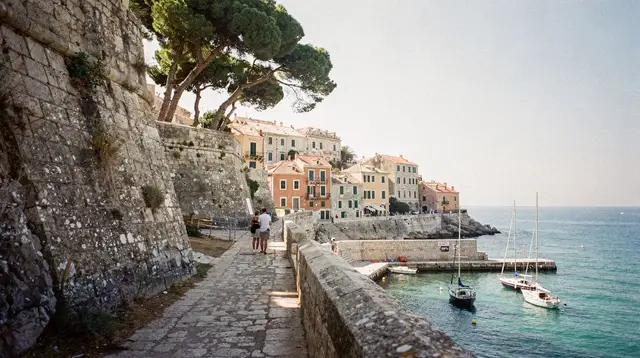
GetYourGuide does not provide a product photo for this activity — the image shows the meeting point, photographed by us.