Is Nice safe for tourists?
Is Nice safe for tourists?
Yes — Nice is a safe destination for the vast majority of visitors. The main risk is petty theft (pickpocketing on coastal trains, the Promenade des Anglais, and in Carnival crowds), not violent crime. Ordinary vigilance with bags, phones, and valuables covers almost every real risk.
What “safety” actually means here
Nice and the wider Riviera are, in practical terms, safe destinations. This page is about the general question — crime levels, traffic, swimming conditions, and how to behave in specific settings like churches or the Monaco Casino. It does not walk through the mechanics of particular scams; for the details on street tricks, fake petitions, or overpriced menus, see common scams in Nice and on the Riviera. Here, the focus is broader: what kind of place is this to move around in, day and night, on foot, by tram, by train, or in the water.
The short version: the realistic risk in Nice is losing a phone or a wallet to a pickpocket, not being the target of violent crime. Visitors who keep an ordinary level of attention to their belongings in crowds and on transport rarely have any trouble at all.
Where you choose to stay barely changes any of this. Nice’s safety profile is fairly uniform across its central neighbourhoods — Vieux-Nice, the area around Place Masséna, and the streets closer to the Promenade all carry the same everyday precautions, not different risk levels. First-time visitors still ask, so see where to stay in Nice by neighbourhood for a rundown, and Nice vs Cannes as a base if you’re deciding between the two for a Riviera trip.
Petty theft: where it actually happens
The pattern reported most consistently in Nice and along the coast is opportunistic theft in crowded, distracted settings, not muggings or confrontational crime. Three situations come up repeatedly:
- Coastal trains. The TER line between Cannes, Antibes, Nice, Villefranche, Monaco, and Menton gets packed in summer, and pickpockets work crowded carriages, especially around doors at busy stops. Keep bags in front of you, not slung on your back, when the train is full.
- The Promenade des Anglais. Long, open, and busy with a mix of tourists, joggers, cyclists, and street performers — the crowd density near Place Masséna and the beaches draws the same opportunistic attention as any popular waterfront.
- Carnival crowds. The Nice Carnival in February packs tight crowds into Place Masséna and along the parade route for the Bataille de Fleurs. Dense, slow-moving crowds are exactly the conditions pickpockets favour; keep valuables in a front pocket or a zipped bag worn across the body.
None of this amounts to a reason to avoid these places. It’s a reason to treat a crowded train carriage or a packed Carnival evening the way you would in any major European city: bag zipped, phone in a front pocket rather than a back one, and no wallet left on a café table while you step away.
Violent crime against tourists is not a notable feature of a Nice trip. The practical safety conversation here is almost entirely about bag and phone awareness in crowds, not personal safety after dark or in quiet streets.
Nice at night
Central Nice stays lively well into the evening, particularly from spring through autumn. Vieux-Nice, Cours Saleya, Place Masséna, and the Promenade des Anglais are well lit, well populated with restaurant terraces and evening strollers, and don’t raise particular concern for walking around after dinner. The waterfront path along the Baie des Anges is used by joggers and cyclists into the night in summer.
As anywhere, the areas immediately around Nice-Ville station and some quieter residential streets away from the tourist centre deserve the same ordinary caution you’d apply in any city at night — nothing specific to Nice, just the general sense to stick to lit, populated streets if you’re unfamiliar with a neighbourhood. A guided evening walk through Vieux-Nice is also a straightforward way to get your bearings before wandering on your own later in the trip.
Traffic and getting around
Driving in central Nice is not dangerous in any specific sense, but it is genuinely inconvenient: one-way systems, a low-emission zone restricting older vehicles, and scarce, expensive parking make a car a burden rather than a help in town. The practical advice for the city centre is to leave the car out of it, not because of a safety risk on the road, but because parking and navigating narrow one-way streets waste time that public transport doesn’t. See driving and parking in Nice for the specifics.
Where a car earns its place is outside the city: reaching the perched villages, the Verdon gorges, or the Mercantour hinterland, where public transport thins out. For city and coastal moves, the tram and the TER trains are the safer and simpler choice by a wide margin.
Tram. Lines 2 and 3 connect the airport, the city centre, and the port, running frequently and reliably. See the Nice tram guide and Nice airport to city centre for routes and fares.
TER trains. The coastal line linking Cannes, Antibes, Nice, Villefranche, Beaulieu, Èze-sur-Mer, Monaco, and Menton is frequent, inexpensive relative to taxis, and the simplest way to see the Riviera without driving. Details at the French Riviera by TER train guide.
Crossing streets and cycling. Nice’s traffic moves briskly in places, particularly around Place Masséna and along sections of the Promenade shared by pedestrians, cyclists, and occasional scooters. Normal street awareness — using crossings, checking both directions, watching for the cycle lane running alongside the Promenade path — is the relevant precaution, not a special hazard.
Safety in Monaco, Cannes, and the hinterland villages
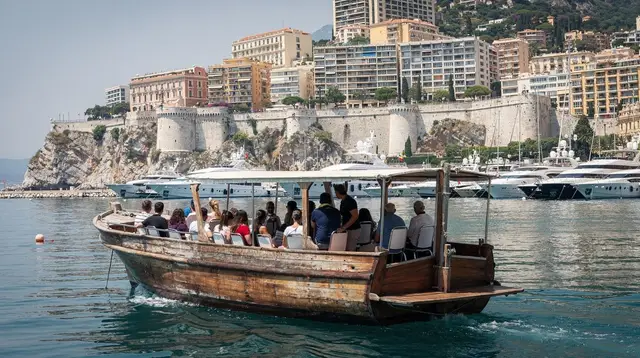
Monaco deserves a specific note, since it isn’t part of France. It’s a sovereign principality, not a European Union member, but there’s no border check crossing from Nice — most visitors barely notice they’ve left French territory. Monaco uses the euro, shares the same 112 emergency number, and in practical safety terms behaves like any other tightly managed stretch of the Riviera; Monaco-Ville and the harbour district around the port are dense with security and CCTV, if anything more so than central Nice. A guided walking tour of Monaco is a straightforward way to get oriented on a first visit, and Monaco day trip from Nice covers getting there, since Monaco has no airport of its own — arrivals come through Nice, by train, bus, car, or helicopter.
Cannes, Antibes, and the perched villages inland — Saint-Paul-de-Vence, Èze, Grasse — carry the same low-key safety profile as Nice: crowded market streets and festival crowds call for the same bag awareness, and quiet village lanes after dark call for nothing more than the ordinary caution you’d use anywhere. The perched villages are largely pedestrian and often built on steep, cobbled slopes rather than flat streets, so sturdy footwear matters more here than any specific safety concern. See best perched villages of the French Riviera for planning a route between them.
Heading further inland — the Mercantour hinterland, the Vésubie and Roya valleys, or a day trip toward the Verdon gorges — the relevant caution shifts from crime toward terrain and road conditions: narrow mountain roads, thinner phone signal in the deepest valleys, and snow at altitude in winter even when the coast stays mild. Checking the route and the forecast in advance matters more here than anywhere else covered on this page, and it’s worth revisiting the note on the Vésubie and Roya valleys above before setting off outside peak season. Travellers who’d rather have someone else handle logistics while still driving something memorable for a day can look at a guided self-drive option through the countryside.
a full-day vintage Méhari self-drive rental through the Nice countrysideSwimming and the water
Nice’s beaches are pebble, not sand — a detail worth knowing before you’re picking your way across stones in bare feet. Water shoes make entry far more comfortable and reduce the (minor) risk of slipping on wet pebbles.
Supervised beaches fly a flag system during the main season: green for open swimming, orange for caution (stronger current or wind), and red for no swimming. It’s worth checking the flag rather than judging conditions by eye, since the Mediterranean here can turn choppy with little warning when the wind picks up along the bay.
Guided options reduce the guesswork if you’d rather not judge conditions solo — a paddle session with a local guide, for instance, sticks to sheltered water and reads conditions on your behalf.
a guided stand-up paddle and snorkelling outing with a local instructor near NiceCurrents away from supervised beaches, and swimming outside flagged hours, carry the ordinary open-water risks of any Mediterranean coastline — nothing specific to Nice, but worth the same respect you’d give any unsupervised sea swim.
Dress codes and civic behaviour
A handful of specific settings expect modest dress, and it’s easy to be caught out if you don’t know in advance:
- Churches. Covered shoulders and no beachwear, standard across France and Monaco.
- The Casino de Monte-Carlo. Minimum age of 18, photo ID required, and a dress code that rules out shorts, flip-flops, and sportswear in the gaming rooms — smart-casual at minimum.
- The streets of Monaco. Bare torsos and beachwear are expected to stay on the beach; walking through Monaco-Ville or Monte-Carlo in swimwear is frowned on.
None of this is enforced with any drama — it’s the kind of expectation any visitor picks up quickly by watching how locals dress, but it’s worth knowing before you plan a day that includes both a beach morning and a Casino evening.
Service is included in restaurant bills by law in France (and in Monaco by convention), so tipping is a discretionary extra, not an obligation — no one will chase you down for more. A gentle, easy way to get oriented on these local norms early in a trip is a guided walk through the old town with someone who explains the everyday rhythm of the place as you go.
a guided introduction to Nice covering the old town, the market, and everyday local customsEmergency numbers
| Number | Use |
|---|---|
| 112 | General emergency, works across France and Monaco, English-speaking operators available |
| 15 | Medical emergencies (SAMU) |
| 17 | Police |
| 18 | Fire brigade (pompiers) |
112 is the simplest number to remember and works from any phone, including a foreign mobile with no local SIM. In Monaco, the same number applies; Monaco is not in the European Union but shares the same emergency infrastructure and euro currency as its French neighbour, with no border formalities crossing between the two.
Pharmacies (marked with a green cross) are widely available in central Nice and can handle minor medical issues without a hospital visit. The European Health Insurance Card (EHIC) is valid for EU/EEA visitors in France; if you’re heading into Monaco for medical care specifically, check coverage in advance, since Monaco sits outside standard EU healthcare arrangements.
Food and water safety
Tap water is safe to drink throughout Nice and the Riviera — no need to buy bottled water on safety grounds, though many restaurants will bring bottled water unless you ask for a carafe. Food hygiene standards are the standard French regulatory baseline, and there’s no particular concern eating at the Cours Saleya market stalls, socca stands, or restaurant terraces in Vieux-Nice. A guided food walk is a relaxed way to sample the local specialties — socca, pan bagnat, salade niçoise — with someone who knows which stalls are worth the queue.
a guided food walk through Vieux-Nice tasting socca and other local specialtiesWeather-related risks
The main weather hazard on the Riviera isn’t storms at sea in summer — it’s the risk of intense Mediterranean rain episodes in autumn, roughly October to November, when short, violent downpours can cause flash flooding, particularly in narrow valleys inland. Météo-France issues vigilance warnings ahead of these events; checking the forecast before a hinterland drive in that window is sensible. Summer brings occasional heatwaves (canicules), for which the usual precautions — water, shade, avoiding midday sun on exposed walks — apply.
The Vésubie and Roya valleys were badly damaged by storm Alex in October 2020, and some roads and trails have been rebuilt in stages since; check current access before planning a hinterland excursion, particularly outside peak season. See day trips from Nice for current options.
Travelling with family, mobility needs, or on your own
None of the general safety picture changes meaningfully by traveller type. Nice is a common choice for families — see Nice with kids — and for solo travellers, the density of the city centre and the reliability of the tram and TER make it straightforward to get around without a car. Visitors with mobility needs should check specific sites in advance, since the old town’s cobbled streets and the Colline du Château’s slopes aren’t uniformly step-free; the accessible Nice guide covers this in detail.
For a first visit, it’s worth reading Nice for first-time visitors and how many days in Nice alongside this page — practical orientation matters as much as safety awareness for a smooth trip.
The honest summary
Nice and the Riviera are not a destination that calls for special caution beyond what any seasoned traveller applies in a busy European city: watch your bag on crowded trains and in Carnival crowds, use water shoes on the pebble beaches, check the swim flags, dress appropriately for churches and the Casino, and lean on the tram and TER rather than a rental car in town. There is no pattern of violent crime targeting tourists here, and the practical risks — theft, traffic inconvenience, occasional autumn storms — are all manageable with a bit of awareness rather than anxiety.
Trip-planning guides for Nice and the Riviera
Verified deep-linked GetYourGuide tours. Book through these links and we earn a small commission at no cost to you.
GetYourGuide does not provide a product photo for this activity — the image shows the meeting point, photographed by us.